


EN
Phillips 66 Stock And Oil Tankers As Iraq Export Routes Shift
Global oil routes are quietly being redrawn as Iraq pushes more crude through an Oman corridor and aims for exports of 5 million barrels per day, and that shift could ripple through everything from fuel prices to risk appetite. Investors watching integrated oil and refining majors now face a fresh test of which business models cope best if supply pressure weighs on pricing. This article unpacks three stocks exposed to that news and explains how each might be positioned, positively or defensively, for the next phase of Iraqi exports.
The three stocks discussed below are only a first cut from this theme. The full screen on Simply Wall St surfaced 15 more large integrated players and refiners with stories just as compelling that are not covered here. To go straight to the full list and identify which giants you want to analyze more deeply, head into the Global Integrated Oil & Refining Majors with Persian Gulf Supply Exposure screener.
Phillips 66 (PSX)
Phillips 66 is one of the clearest ways to play the Global Integrated Oil & Refining Majors with Persian Gulf Supply Exposure theme. The analyst consensus Narrative on Simply Wall St sets out why its refining-heavy model and capital plans matter as trade routes adjust.
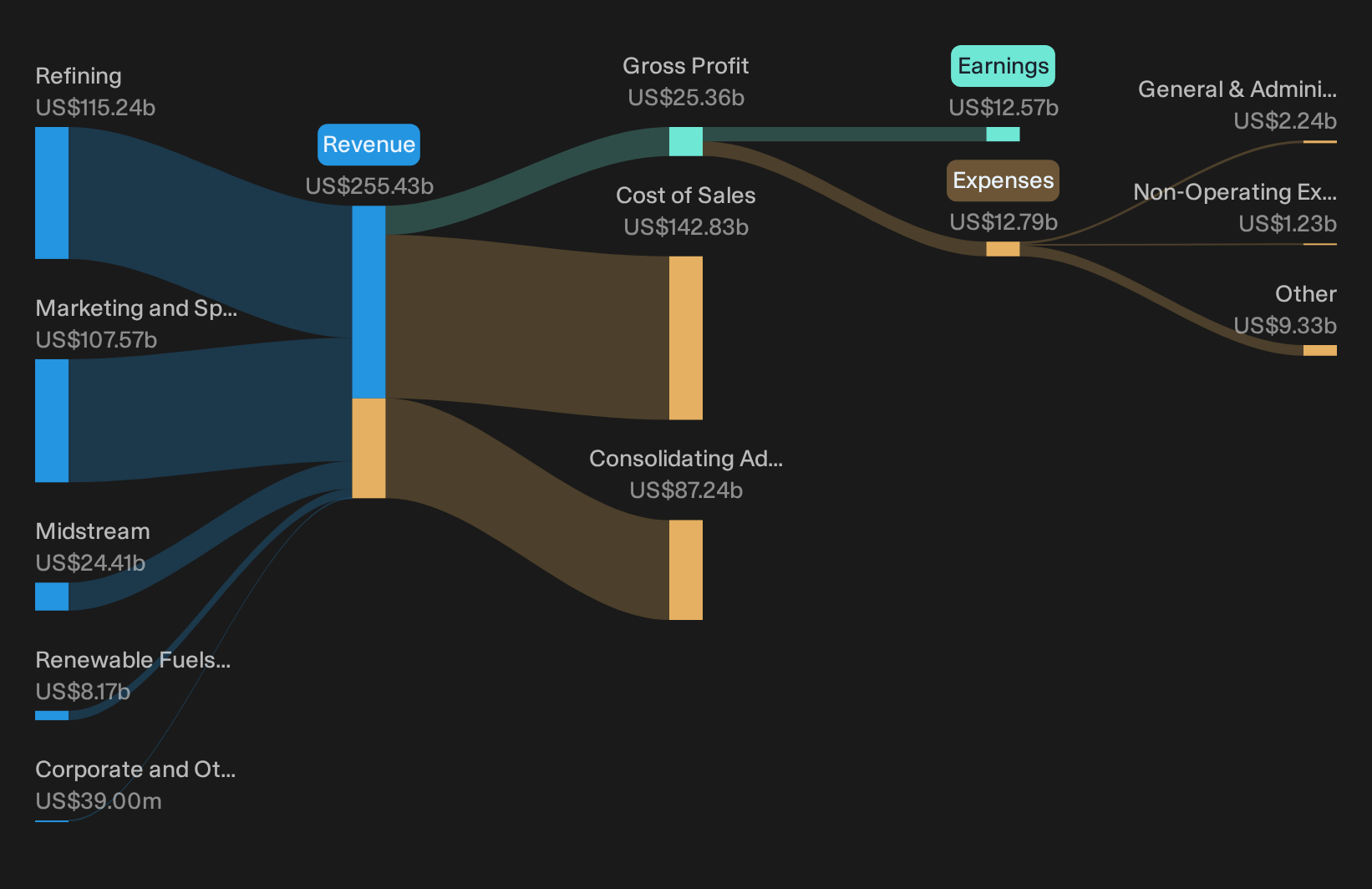
Phillips 66 runs an integrated downstream energy platform across refining, midstream, chemicals, marketing and renewable fuels, with refining and marketing and specialties generating about US$115.2b and US$107.6b of revenue, respectively, supported by smaller midstream and renewables contributions. The company is a large cap at roughly US$95.8b.
The company is improving its refining operations through over 200 low capital, high return projects and AI supported efficiency work, which has already brought operating costs close to 5.50 dollars per barrel and is expected to remove further cost per barrel, supporting future net margins.
What happens when that cost work meets one unresolved pressure around future crude flows and product pricing will be crucial for Phillips 66.
If that cost work is the hinge, the full narrative for Phillips 66 shows where Phillips 66 could be accelerating, where risks cluster, and what might be masking future earnings power.
Frontline (FRO)
Frontline sits closer to the action than most in this theme, because its tanker fleet is directly tied to how crude physically moves when producers like Iraq open new export corridors. The analyst consensus Narrative on Simply Wall St captures that link in very simple terms.
Longer haul routes driven by rerouted flows around risk zones and multi stage ship to ship chains are increasing ton miles and idling days per VLCC. This supports elevated TCEs and keeps revenue and earnings for Frontline closely geared to sustained route inefficiencies.
What happens if one unseen pressure on those long haul trade patterns shifts just as Gulf exports keep rising could matter a lot for Frontline.
Frontline owns and operates a global fleet of crude and product tankers that earn all of their US$2.7b revenue from tanker operations, and with a market value of about US$10.1b it offers investors a pure play on seaborne oil transport within this Iraq linked export story.
If that hidden pressure is what you are focused on, the full narrative for Frontline explains how Frontline’s route exposure, earnings power and risk could be decoupling.

Imperial Petroleum (IMPP)
Imperial Petroleum plugs into this Persian Gulf linked screen through its tanker fleet that moves crude and refined products on long sea routes, while its growing drybulk arm adds a second way to benefit if Iraqi exports and global trade volumes keep building. The analyst consensus Narrative on Simply Wall St frames that twin engine story clearly.
Imperial Petroleum runs a global seaborne transport business across tankers and drybulk ships, generating about US$241 million from shipping services and carrying a market value of roughly US$201 million, so it gives you small cap exposure to this Iraq related trade route theme.
The company's recent expansion into drybulk carriers alongside its tanker fleet positions it to benefit from sustained global energy demand and increased trade volumes.
What happens when that extra capacity meets one unresolved pressure around future route patterns and voyage costs could matter a lot for margins.
That pressure point is exactly what the full narrative for Imperial Petroleum unpacks, highlighting where Imperial Petroleum’s twin engines could be accelerating and where risks might quietly be reshaping returns.

Seeking Alternatives Before The Crowd?
Fresh themes often move first, and latecomers may end up chasing momentum once prices are already moving sharply. Scan potential breakout ideas while they are still under the radar and consider your options early.
- Identify resilient cash generators early by running the list of solid balance sheet and fundamentals (25 results) before others focus on their steady fundamentals and pricing power.
- Follow where AI infrastructure momentum could build next by scanning the 53 AI infrastructure stocks while these picks are still quietly reflecting expectations for demand.
- Review potential power grid upgrades in advance by using the 42 power grid technology and infrastructure stocks while these enablers of electrification and reliability are still revealing signals in plain sight.
Have feedback on this article? Concerned about the content? Get in touch with us directly. Alternatively, email editorial-team@simplywallst.com