


EN
What Devon Energy Holders Got Right
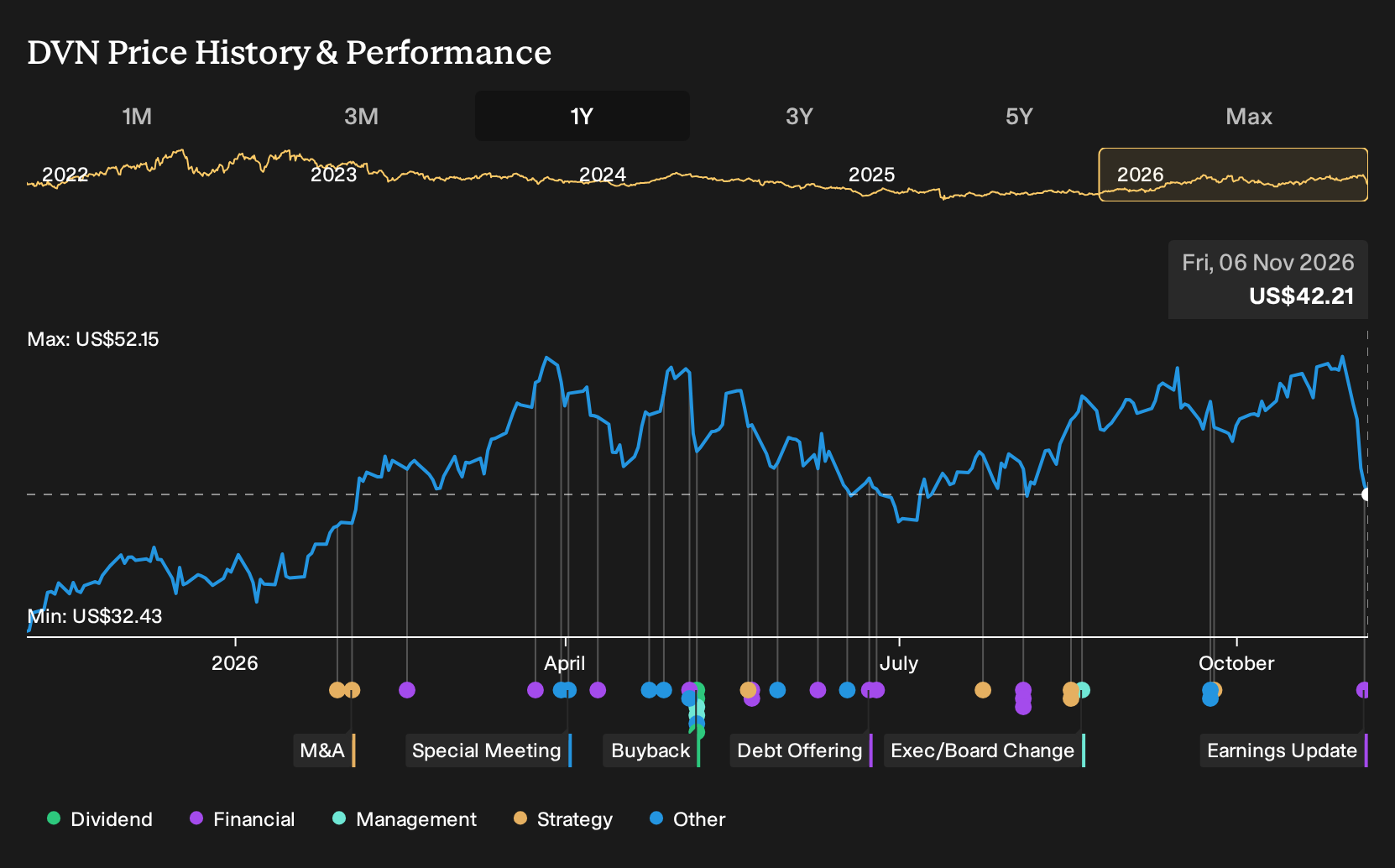
If you had backed Devon Energy a year ago, the headline news today might feel almost beside the point. Holding Devon Energy over the past year would have returned 27.6%, including dividends. That payoff arrived while the firm announced a large all stock merger, fresh Permian leases and a thicker dividend stream. The real puzzle is what this contrast between deal risk and eventual gain says about the information investors actually had on 6 November 2025.
The easy part of this move is behind Devon Energy. Zero in on 40 high quality undervalued stocks for companies trading below our estimates.
The Argument Devon Energy Investors Were Really Weighing
The shares cost US$32.43 at the start of the period, and anyone looking at Devon Energy back then had to choose between two very different stories.
The optimistic camp worked off a Fair Value of US$45.48, a notional target price based on the idea that AI driven efficiency and midstream moves could support 6.3% revenue growth and a 10.7x future P/E.
The cautious side pointed to a Fair Value of US$26.83, an implied valuation that stressed shale concentration risk and future profitability assumptions around a 17.5% margin and an 8.0x P/E.
What The Results Changed For The Devon Energy Debate
The clearest development for Devon Energy was the Coterra all stock merger, coupled with Q3 2026 revenue of US$7,398m and net income of US$1,008m. That pattern backed the optimistic story on scale and cash generation, but the net margin shift from 16.2% to 13.6% challenged the idea of easy, AI led efficiency gains. Overall, the evidence cut both ways.
The key lesson is simple. When a thesis leans on better profitability, you track net margin and not just headline revenue or earnings growth, especially around big mergers and asset shuffles.
What Devon Energy’s Price Seems To Be Saying Now
Devon Energy now trades at US$42.21, after a 27.6% gain over the past year, while the analyst consensus Narrative on Simply Wall St places its Fair Value above that level based on current assumptions.
The Narrative focuses on asset sales, shale depth and midstream projects, and argues that today’s price still does not fully reflect the merger driven synergy and cost reduction plan.
"For this bullish undervaluation view to hold, Devon Energy has to keep pairing strict capital discipline and cost controls with consistent execution from its high quality U.S. shale portfolio while it works through portfolio simplification. Current earnings, cash returns and analyst targets imply the share price still reflects a discount to what Devon Energy could be worth if investors credit its free cash flow profile, Delaware Basin depth and synergy plan."
One Narrative has put a figure on that disagreement. → See the Narrative with its higher Fair Value, assumptions and all
Which Company Could Surprise You Next?
The story behind this run has already been told. The next one could be taking shape somewhere else. Where could you start looking before it becomes the headline?
- Company 1 - 49% below our estimate - grows an asset-light hotel network while integrating a faster moving retail platform.
- Company 2 - 19% below our estimate - sells security gear built on custom chips that lock customers into one operating system.
- Company 3 - 18% below our estimate - supplies high bandwidth memory that becomes the bottleneck component for AI data centers.
Three companies from the same screener. Open all 25 companies with the balance sheet to back it up →
Have feedback on this article? Concerned about the content? Get in touch with us directly. Alternatively, email editorial-team@simplywallst.com