


EN
3 Logistics Stocks Investors Are Watching As UAE Trade Routes Keep Expanding
UAE non-oil trade just reached $801.9b with non-oil exports up 21.6%, and that kind of real-world cargo flow can quietly reshape what shows up in your portfolio. When containers move and customs rules ease under new CEPAs, certain UAE Trade-Linked Logistics and Port Operators stocks can gain fresh attention while others risk being left on the sidelines. This article unpacks three stocks exposed to these trade currents and explains why they may deserve a closer look now.
The stocks covered next are just a small sample, and the full screen surfaced 14 more companies with equally detailed stories tied to UAE trade flows that are not covered here.
If you want to see the broader field and focus on the setups that best match your risk profile, head straight into the UAE Trade-Linked Logistics and Port Operators screener to identify and analyze logistics and port operators that align most closely with your own highest conviction ideas.
Mahindra Logistics (NSEI:MAHLOG)
Overview: Mahindra Logistics runs an integrated logistics and mobility business, handling warehousing, freight, last mile delivery and enterprise transport across sectors in India and abroad.
Operations: Mahindra Logistics generates most of its revenue from Supply Chain Management at ₹73.4b, with ₹4.5b from Enterprise Mobility Services.
Market Cap: ₹43.5b
For an investor watching how UAE trade corridors ripple into regional freight flows, Mahindra Logistics offers a direct way to track how integrated supply chain providers convert higher cross-border movement into warehouse, transport and forwarding work. This is exactly what the bearish analyst Narrative on Simply Wall St focuses on.
"The balance sheet now carries net cash of ₹308 crore with low financial leverage. However, the intent to keep investing in MESPL, technology platforms and auto carrier capacity within a ₹100 crore to ₹110 crore FY27 capex plan could absorb cash generation and slow the translation of lower interest costs into higher earnings."
What happens if that one pressure point in Mahindra Logistics cost base shifts just as regional trade lanes feed in more volume?
If that cost squeeze is really starting to ease just as freight lanes deepen, the full narrative for Mahindra Logistics shows where earnings momentum could accelerate or stall next.

Delhivery (NSEI:DELHIVERY)
Overview: Delhivery runs end to end logistics services across India, linking e commerce, enterprises and cross border freight that taps into India-Gulf trade.
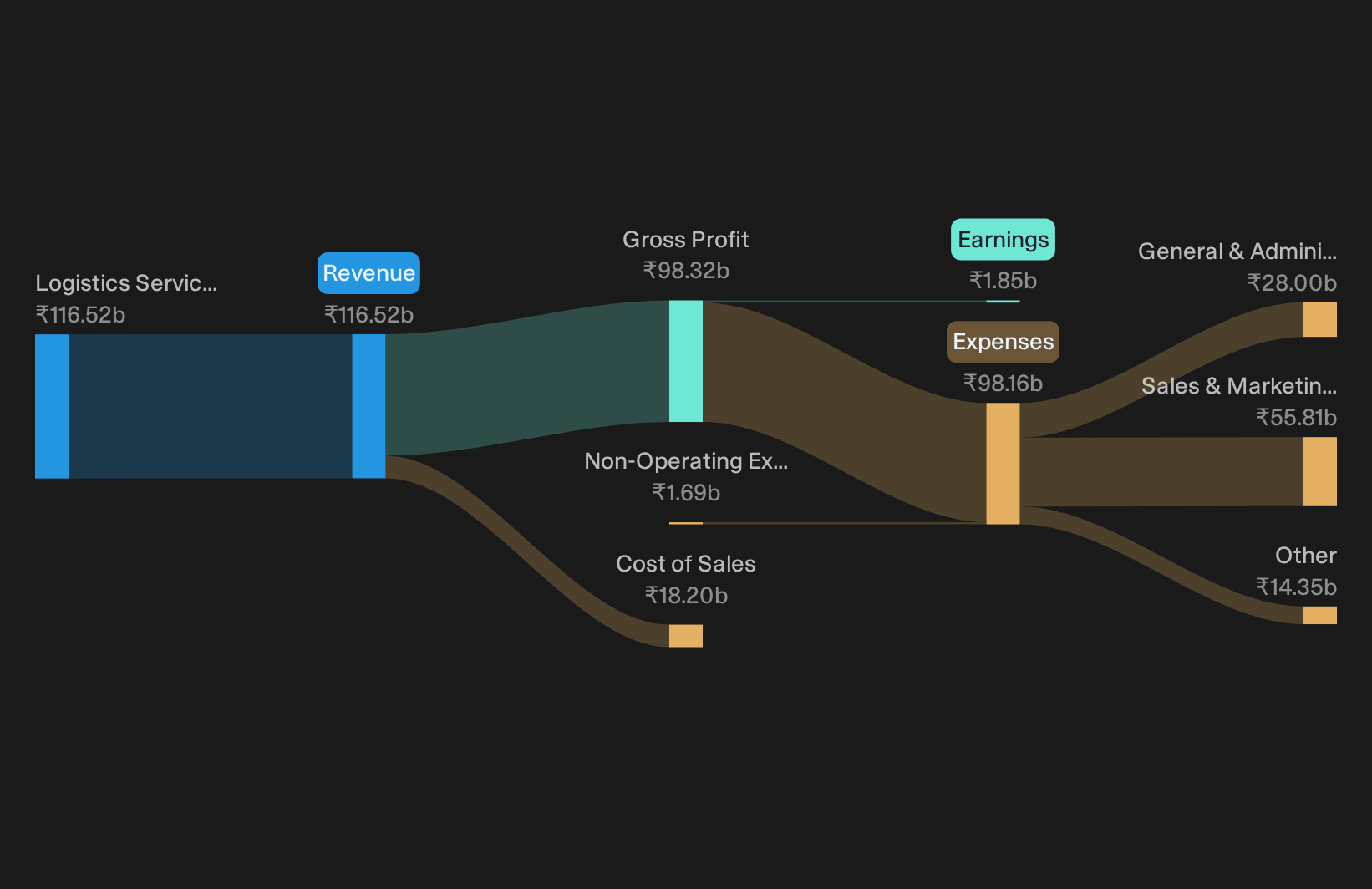
Operations: Delhivery generates ₹116.5b in revenue from Logistics Services, covering parcel delivery, freight, warehousing and related supply chain activities.
Market Cap: ₹322.1b
For a screen focused on UAE linked freight and ports, Delhivery matters because its India based network increasingly routes cargo through Gulf hubs that handle consolidation, customs and onward shipping. This is exactly what the analyst consensus Narrative on Simply Wall St focuses on when looking at its operating model and cost base.
"Delhivery's investments in automation, AI driven orchestration engines, robotics and Delhivery Maps are increasingly embedded in operations and are intended to offset wage and fuel cost pressure over time, which can support service EBITDA margins and operating leverage."
What happens to Delhivery’s margin story if one unresolved cost pressure in those cross border heavy routes moves in the wrong direction?
If that pressure builds instead, the full narrative for Delhivery outlines how Delhivery’s cost curve, pricing power and automation push could accelerate or stall as trade lanes thicken.
JSW Infrastructure (NSEI:JSWINFRA)
Overview: JSW Infrastructure runs commercial ports and related logistics services in India and overseas, linking cargo owners to key regional trade gateways.
Operations: JSW Infrastructure generates about ₹48.7b in revenue from Port Operations and ₹9.3b from Logistic Operations, highlighting its port led income mix.
Market Cap: ₹788.8b
Among the UAE Trade Linked Logistics and Port Operators, JSW Infrastructure matters because its ports, rail linked assets and overseas terminals sit closest to the physical choke points where regional trade growth either flows freely or gets stuck, which is exactly what the bearish analyst Narrative on Simply Wall St tries to stress test.
"Although JSW Infrastructure highlights strong India cargo growth and resilient group EBITDA, the unresolved damage and reduced throughput at the 5 MTPA Fujairah liquid storage facility following Middle East conflict can keep overseas utilization and port EBITDA below what its capacity base implies."
What ultimately happens to JSW Infrastructure’s earnings profile hinges on how one pressure in this trade corridor plays out against ambitious capacity plans.
That hinge point is exactly where the full narrative for JSW Infrastructure shows whether JSW Infrastructure’s Middle East exposure is quietly masking strength or setting up a sharper earnings swing.

Seeking Alternatives Before Momentum Runs
Fresh ideas move first. By the time every chart looks like a breakout, early entries are gone and prices are already flying. Scan what others miss while it matters and aim to participate earlier in the move.
- Spot cash generative operators before momentum screens catch them by running a curated list of solid balance sheet and fundamentals (193 results) that filters for resilience when conditions change.
- Hunt for payout workhorses that can help keep portfolios grounded even when prices swing using a focused 225 dividend fortresses built around higher yielding payers.
- Target future facing infrastructure behind the AI buildout by scanning a tuned 53 AI infrastructure stocks that filters for financially material exposure instead of hype.
Have feedback on this article? Concerned about the content? Get in touch with us directly. Alternatively, email editorial-team@simplywallst.com