


EN
Did Cotton Turn a Bullish Corner Last Week?
December cotton stood out to me last week as it completed a bullish technical reversal on its weekly chart.
Based on classic technical analysis, this would indicate funds could start adding back some of the recently liquidated long futures positions.
Fundamentally, though, the market is not bullish.
You might recall a few things about me: 1) I view commodities as a solid longer-term investment sector, as long as 2) we take the time to understand the structure of the various markets, and 3) I’ve long been told I have a good face for radio. Keeping those ideas in mind, particularly the first two, the December cotton (CTZ26) futures contract stood out to me as I went over all my charts this past weekend. Let’s start at the very beginning, a very good place to start… (My apologies to both Julie Andrews and Mark Twain).
When I talk about market structure, I mean every commodity has two sides: Commercial, interests who are involved in the underlying cash commodity, and noncommercial (funds, speculators, investors, Watson, etc.). Since my Market Rule #1 reminds us to not get crossways with the trend, and the trend is set by the noncommercial side[i], let’s begin there. What is trend? A lot of analysts like to overcomplicate this subject, but the definition I use is simple: Price direction over time. And again, the flow of noncommercial money into or out of a market over time tends to determine the price direction. Therefore, if we don’t get crossways with the trend then it means we are staying in step with the noncommercial side that has a lot more money, power, and influence than we as individuals have.
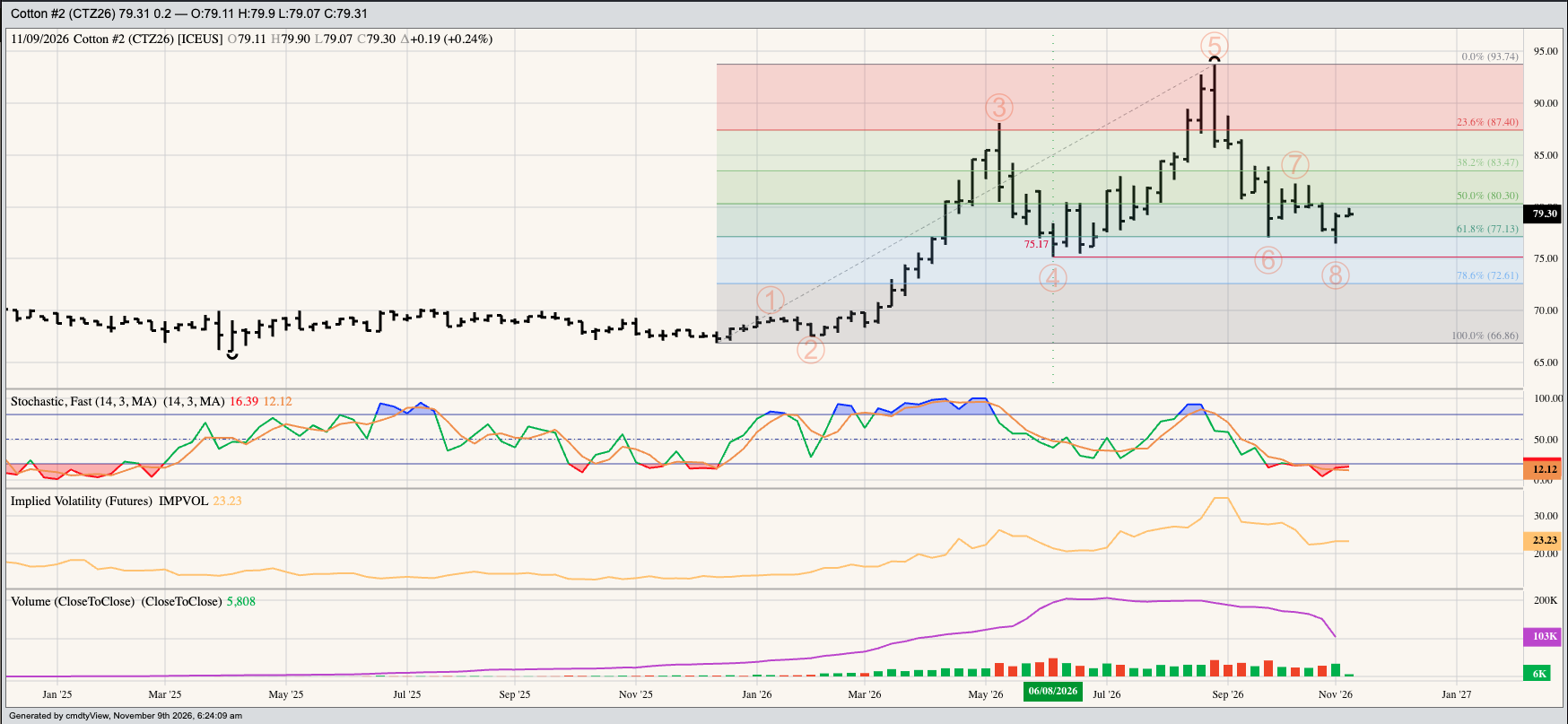
A look at December cotton’s weekly chart (for the secondary or intermediate-term trend) and we see the contract dropped to a new low for its downtrend of 76.47 last week before closing at 79.11, up 1.28 cents (1.6%) for the week. According to classic technical analysis patterns[ii] this completed a bullish spike reversal, marking the end of a 3-wave Elliott Wave downtrend that began with a key bearish reversal completed on Friday, September 4 when Dec closed at 86.33. This coincided with a bullish crossover by weekly stochastics below the oversold level of 20% meaning Dec cotton both signaled (stochastics) and confirmed (reversal pattern) a move to a new secondary uptrend.
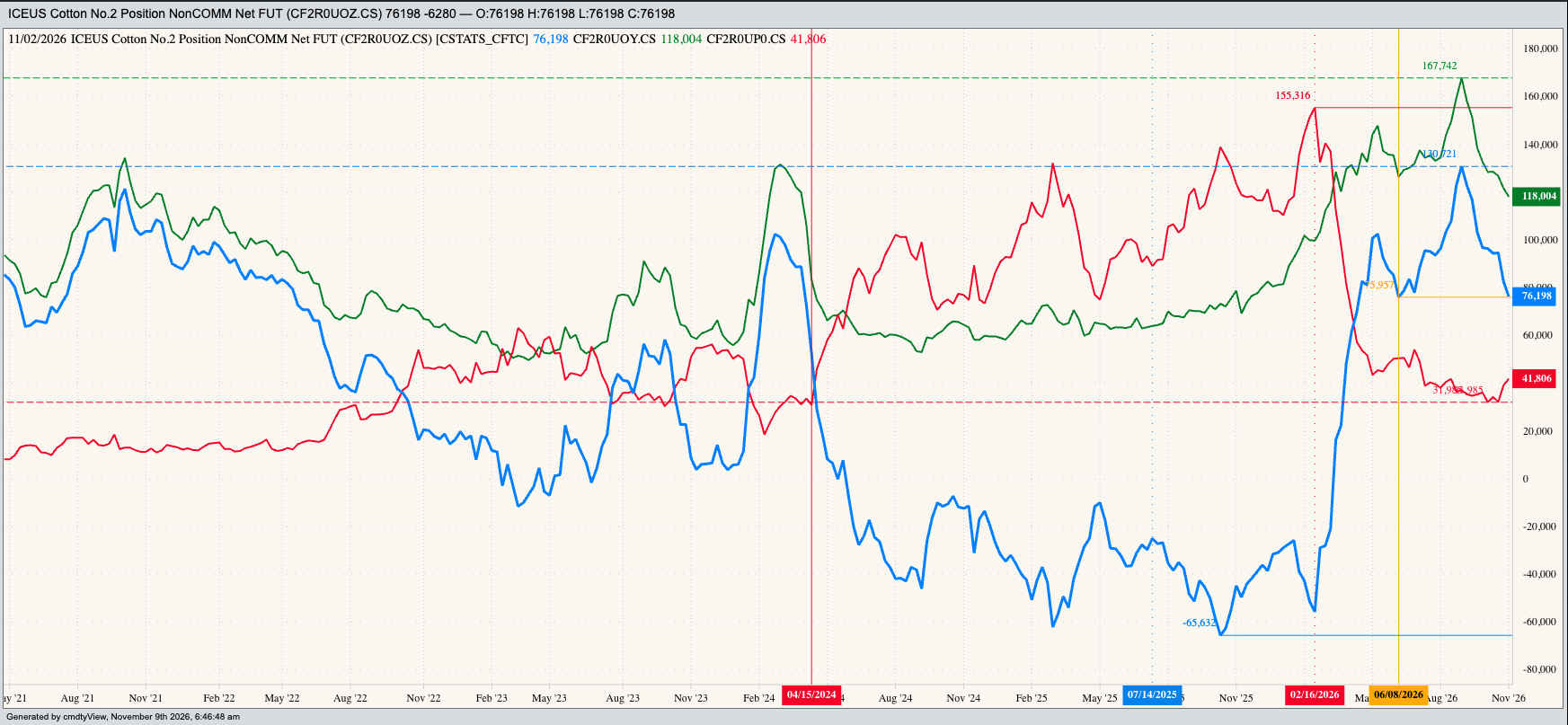
As for Watson, the latest Commitments of Traders report (legacy, futures only) showed a noncommercial net-long futures position of 76,198 contracts as of Tuesday, November 3, a decrease of 6,280 contracts. A few points about the net-futures position:
- It was the smallest net-long since 75,957 contracts on Tuesday, June 9
- The position continues to fall back from its recent record large of 130,721 contracts on September 1
- Keep in mind that was the week of the bearish key reversal on Dec cotton’s weekly chart
- With the long futures position reported at 118,004 contracts, also well off its new record large of 167,742 contracts from September 1
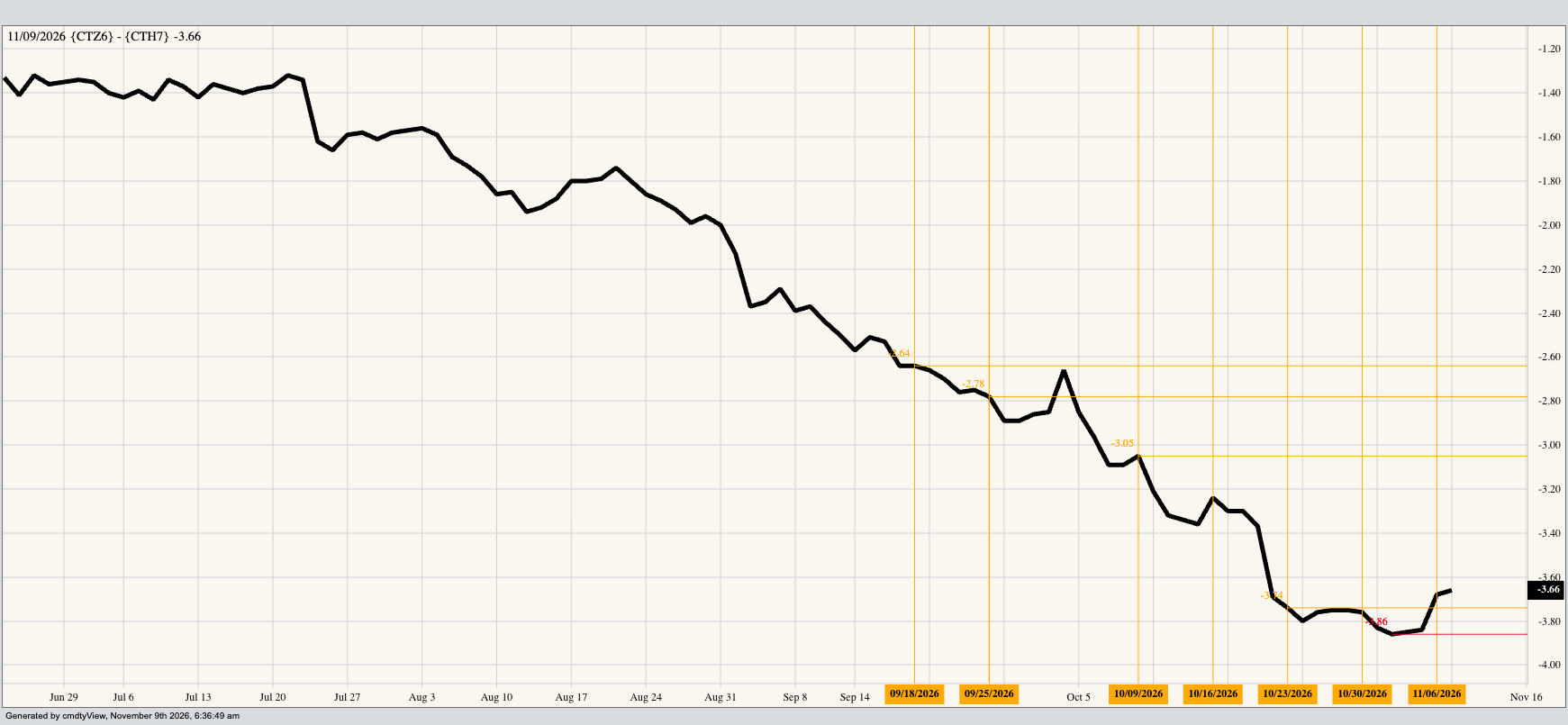
Does the cotton market have a fundamental reason for funds to start rebuilding the net-long futures position[iii]? The Dec-March futures spread closed last Friday at a carry of 3.68 cents after registering a new lifetime low daily close of 3.86 cents carry on Tuesday, November 3. (This indicates pressure came from both noncommercial and commercial interests during the previous Tuesday-to-Tuesday positioning week.) Given the still relatively strong carry in the nearby futures spread (and accounting for the fact the spread could be skewed by the Goldman Roll that started Friday, November 6), my conclusion is Watson does NOT have a fundamental reason to get bullish cotton.
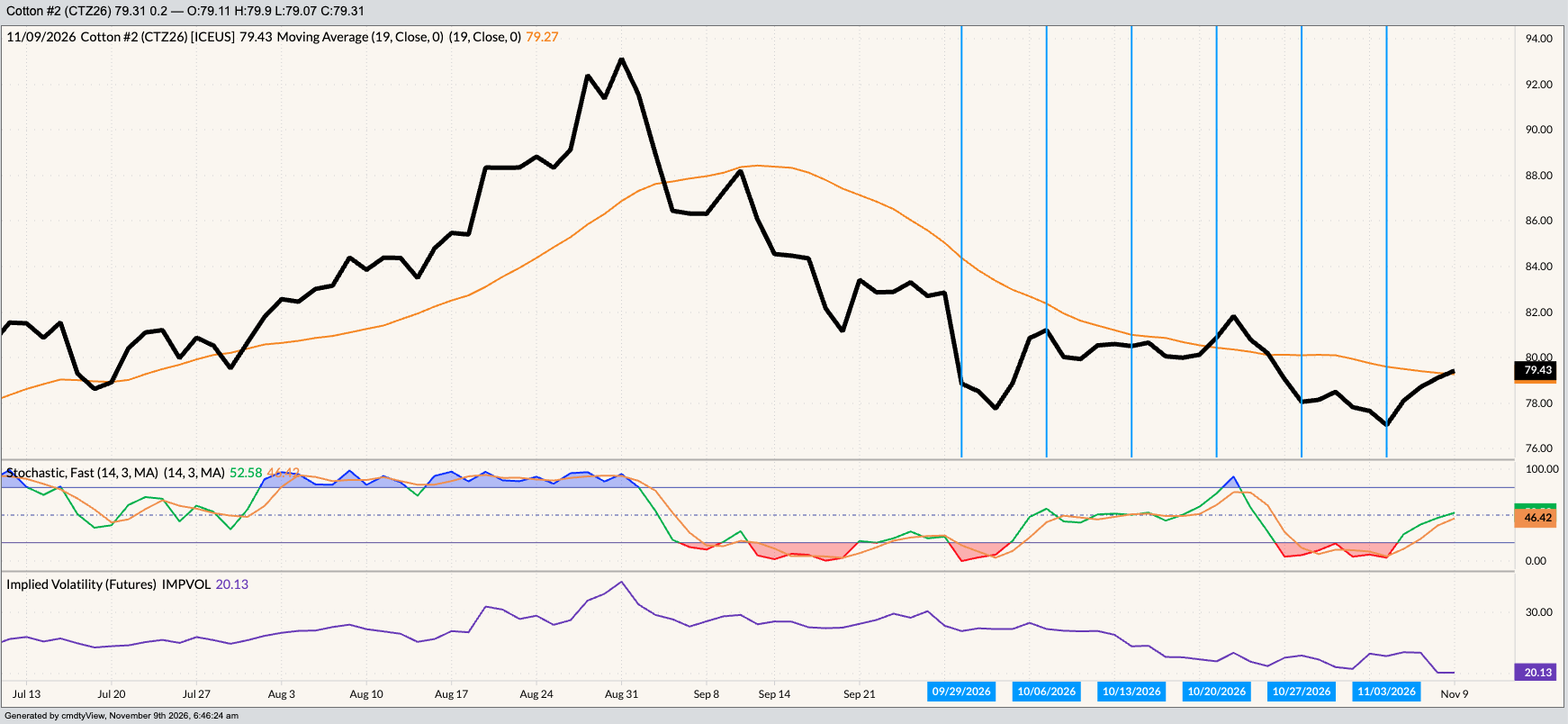
Just for fun, I pulled up the Dec daily close-only chart as well (blue lines mark Tuesday-to-Tuesday positioning weeks), and here we see something interesting short-term. Dec rallying off its low daily close of 77.04 (November 3) up to last Friday’s 79.11 had it testing its 19-day moving average. This average is calculated Monday (November 9) at 79.27. Algorithms do watch technical statistics like momentum, volatility, and moving averages (though it varies from market to market, contract to contract rather than being one size fits all). We’ll see if this provides resistance, leading to a quick round of fund selling, or a break of the moving average triggering increased buying interest.
[i] I’ve argued this point with nearly every die-hard fundamental analyst and economist I have met over the years. I’ve heard all the arguments about why I am wrong. I’m not. Keep in mind the same folks who argue everything is always supply and demand are the same ones who tell us how important USDA reports are to understanding a market’s fundamentals. So, there’s that in my favor.
[ii] I’ve raised the question a number of times that since algorithms don’t use these patterns, should we?
[iii] Market Rule #6: Fundamentals win in the end.
On the date of publication, Darin Newsom did not directly have a position in any of the securities mentioned in this article. All information and data in this article is solely for informational purposes. For more information please view the Barchart Disclosure Policy here.