


EN
Visa (V) Just Gave Investors Something To Think About
Visa earnings and AI benchmark bring fresh focus to the stock
Visa (V) has put fresh attention on its stock after reporting higher quarterly revenue and net income, raising its dividend, and rolling out an AI driven Agentic Commerce Benchmark for real world shopping decisions.
Visa’s recent news sits against a strong run in the share price. A 30 day share price return of 9.65% and a 90 day gain of 16.49% have helped lift the year to date move to 21.98%, while the 1 year total shareholder return of 27.23% and 5 year total shareholder return of 106.40% point to momentum that has built over time.
Track how Visa’s momentum compares to other payment and fintech plays by scanning a curated list of 42 profitable AI stocks that aren't just burning cash with real earnings power behind their AI stories.
Visa appears to be a powerhouse on the business side, and the recent share price jump reflects that confidence. The open question is whether that quality is already fully baked into today’s valuation.
Most Popular Narrative: 73% Overvalued
Visa closed at $422.65, while the leading narrative on Simply Wall St assigns a fair value of $243.70, which points to a steep premium and puts the recent rally under a harsher light.
This view, according to Esteban, an investor in the Simply Wall St Community who wrote the narrative, rests on detailed assumptions about volume growth, margins, and cash conversion that challenge the current price.
Visa executes steadily on its three-pillar strategy: Consumer Payments volume growing 8-9% in constant dollars driven by secular cash-to-card conversion and cross-border recovery; CMS at ~20% initially decelerating to ~12% by FY30; VAS sustaining 20-25% growth before decelerating to ~15% by FY32 as the business matures. The DOJ antitrust case resolves with a monetary settlement and limited routing adjustments, painful but not structurally disruptive to the debit network economics. A2A rails remain fragmented outside Brazil and India, and Visa monetizes the trend indirectly via Visa Direct. Non-GAAP operating margins expand from ~67.7% (FY2025) to ~71% by FY2030 as VAS scales and operating leverage is captured. Revenue grows in low-double-digits in FY2026-FY2027 (consistent with management guidance of low-double-digit adjusted net revenue growth), decelerating to 7-8% by FY2033-FY2035 as the base grows and secular conversion matures in developed markets.
See why 10 investors see Visa as 73% overvalued.
Result: Fair Value of $243.70 (OVERVALUED)
Still, the narrative could be knocked off course if the DOJ antitrust case results differ from expectations, or if A2A payment rails consolidate faster than modeled.
Find out about the key risks to this Visa narrative.
Another View: Visa and the cash flow lens
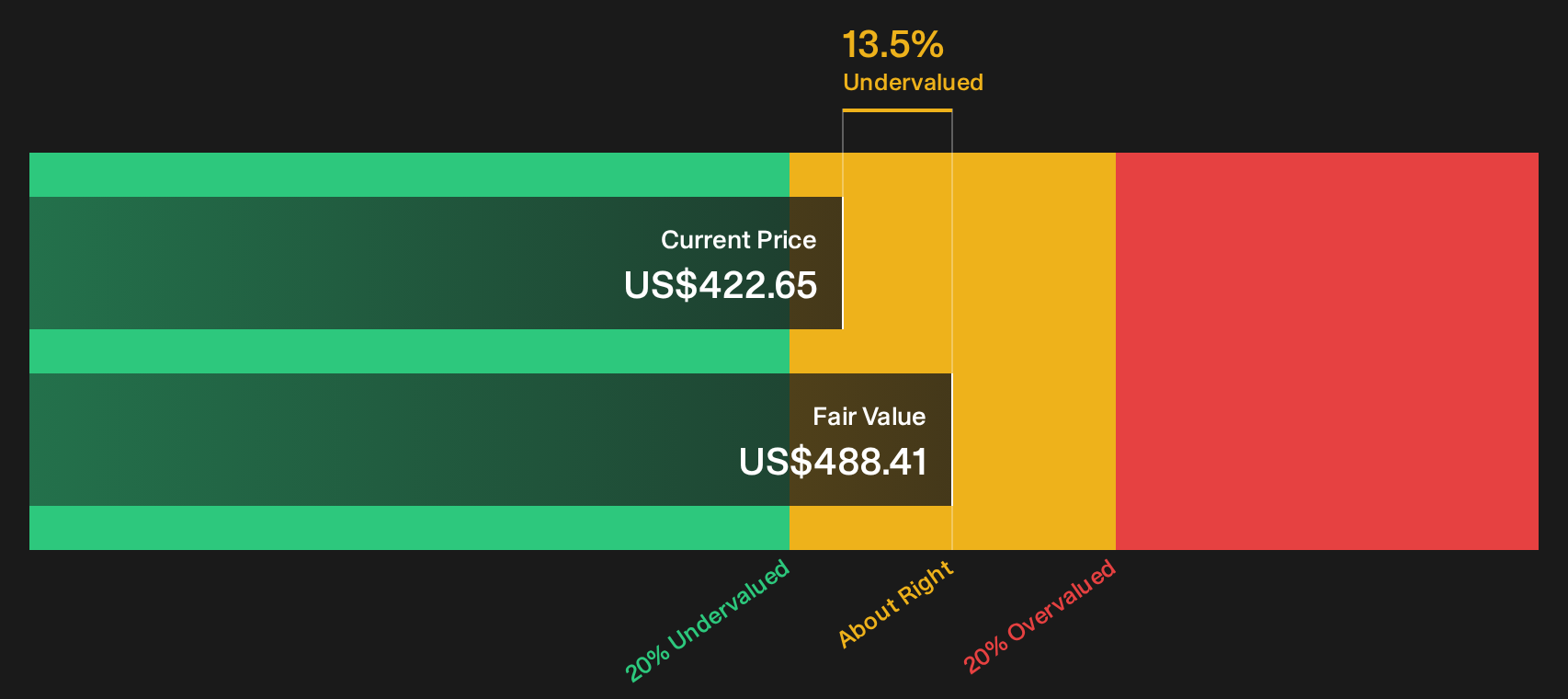
That community narrative pins Visa at $243.70, yet the Simply Wall St DCF model points to a future cash flow value of $488.41. At $422.65, the stock sits about 13.5% below that estimate. This raises a blunt question: Is the premium story rich, or is the cash flow math too conservative?
Look into how the SWS DCF model arrives at its fair value.
Next Steps
Still on the fence about what this mix of premium pricing, cash flow assumptions, and legal overhang really means for Visa today? Move quickly, explore the data, and judge the balance of risks and upside for yourself with 3 key rewards and 1 important warning sign.
Looking for more investment ideas beyond Visa?
If Visa feels fully priced to you right now, you can broaden your watchlist with a few focused screeners that highlight different edges across quality, value, and resilience.
- Target resilient cash generators and build a sturdier core around 31 resilient stocks with low risk scores that aim to pair muted volatility with durable business models.
- Hunt for pricing power by scanning 40 high quality undervalued stocks where solid fundamentals and compressed multiples might offer a margin of safety.
- Strengthen your defensive side by reviewing a list of solid balance sheet and fundamentals (25 results) so potential ideas are backed by healthier leverage and liquidity profiles.
Have feedback on this article? Concerned about the content? Get in touch with us directly. Alternatively, email editorial-team@simplywallst.com