


EN
How Analyst Upgrades Will Impact Reliance Stock Investors
- Reliance is in focus after analysts raised fair value estimates while the business pushes further into consumer goods through an expanded Independence biscuit range and continues to gain attention around a potential Jio Platforms listing.
- The move into India's crowded biscuit category using Reliance's retail reach highlights a push to monetise distribution scale rather than rely only on heavy industry and telecom earnings.
- We will now look at how Reliance's investment narrative is affected by its push into biscuits and renewed attention on Jio.
Scan how Reliance’s biscuit push and Jio buzz compare with other potential breakouts in consumer and industrials by reviewing a curated list of 19 high quality undiscovered gems today.
Reliance Investment Narrative Recap
To own Reliance, an investor needs to be comfortable with a metals service business that leans on non residential construction, infrastructure and government work rather than rapid growth. The analyst consensus Narrative on Simply Wall St assumes fairly flat revenue and earnings with some margin pressure. The big question is how efficiently the company can convert volumes into cash.
Recent target upgrades acknowledge that backdrop but do not change the key near term swing factors. The main potential catalyst remains execution on data center, grid and government contracts. The biggest risk sits with aluminum and carbon price volatility and related tariff or LIFO expense shocks that could compress margins even if demand holds up.
The fresh set of higher fair value estimates from several research houses, while secondary for a long term holder, does spotlight Reliance at a moment when forecasts call for earnings to edge down around 2.7% a year. That puts more weight on the firm continuing to run its processing network tightly and keep customer relationships sticky.
In practice, this analyst attention matters only if it coincides with inflection points in tariffs, metal input costs or capital spending on value added processing. If demand from data centers, infrastructure and defense contracts tracks the catalysts outlined in the analyst consensus Narrative on Simply Wall St, then the operational story, not the new targets, will be what really counts.
Reliance's current analyst narrative ties forecast 2029 revenue of US$17.8b to consensus earnings of US$1.1b, with revenue broadly flat and profits essentially unchanged from earnings today of US$1.1b.
Uncover why Reliance's fair value indicates a 3% potential upside to its current price that could narrow quickly.
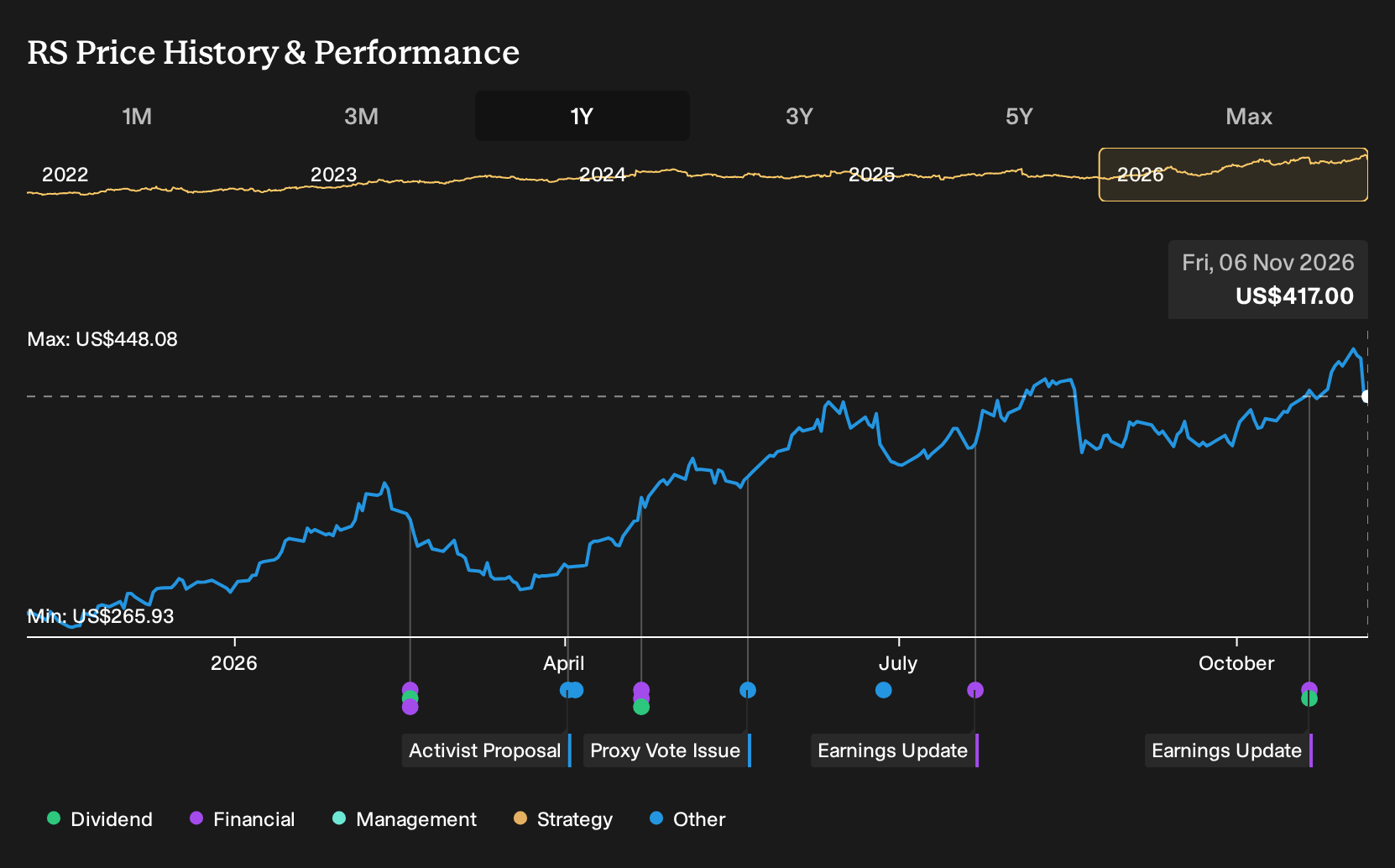
Exploring Other Perspectives
Two fair value estimates from the Simply Wall St Community span a wide band, from about US$169 to roughly US$431. This already shows how far private investors can disagree on Reliance. Those views were formed before biscuit expansion plans and Jio listing talk, so revisit several alternative viewpoints as these potential catalysts and tariff risks evolve.
Explore another Reliance fair value estimate, including one that suggests as much as 59% downside from the current price!
Form Your Own Verdict
Disagree with existing narratives? Extraordinary investment returns rarely come from following the herd, so consider your own analysis and judgment.
- A great starting point for your Reliance research is our analysis highlighting 2 important warning signs that could impact your investment decision.
- See our latest analysis for Reliance. The report includes a comprehensive fundamental analysis summarized in a single visual, the Snowflake, making it easy to evaluate Reliance's overall financial health at a glance.
Looking For More Ideas Beyond Reliance?
If Reliance has you rethinking where the next edge could come from, it can help to line it up against other opportunities with different risk and income profiles.
- For investors hunting for perceived mispricing, scan a focused set of 40 high quality undervalued stocks that pair quality fundamentals with what may look like discounted market expectations.
- If capital preservation sits higher on your priority list, compare Reliance with 31 resilient stocks with low risk scores that score well on financial stability and volatility metrics.
- Income seekers can round out their watchlist by reviewing 7 dividend fortresses that combine higher yields with an emphasis on durability of payouts.
Have feedback on this article? Concerned about the content? Get in touch with us directly. Alternatively, email editorial-team@simplywallst.com