


EN
Should Proxy Fight Escalation Require Action From Vail Resorts (MTN) Investors?
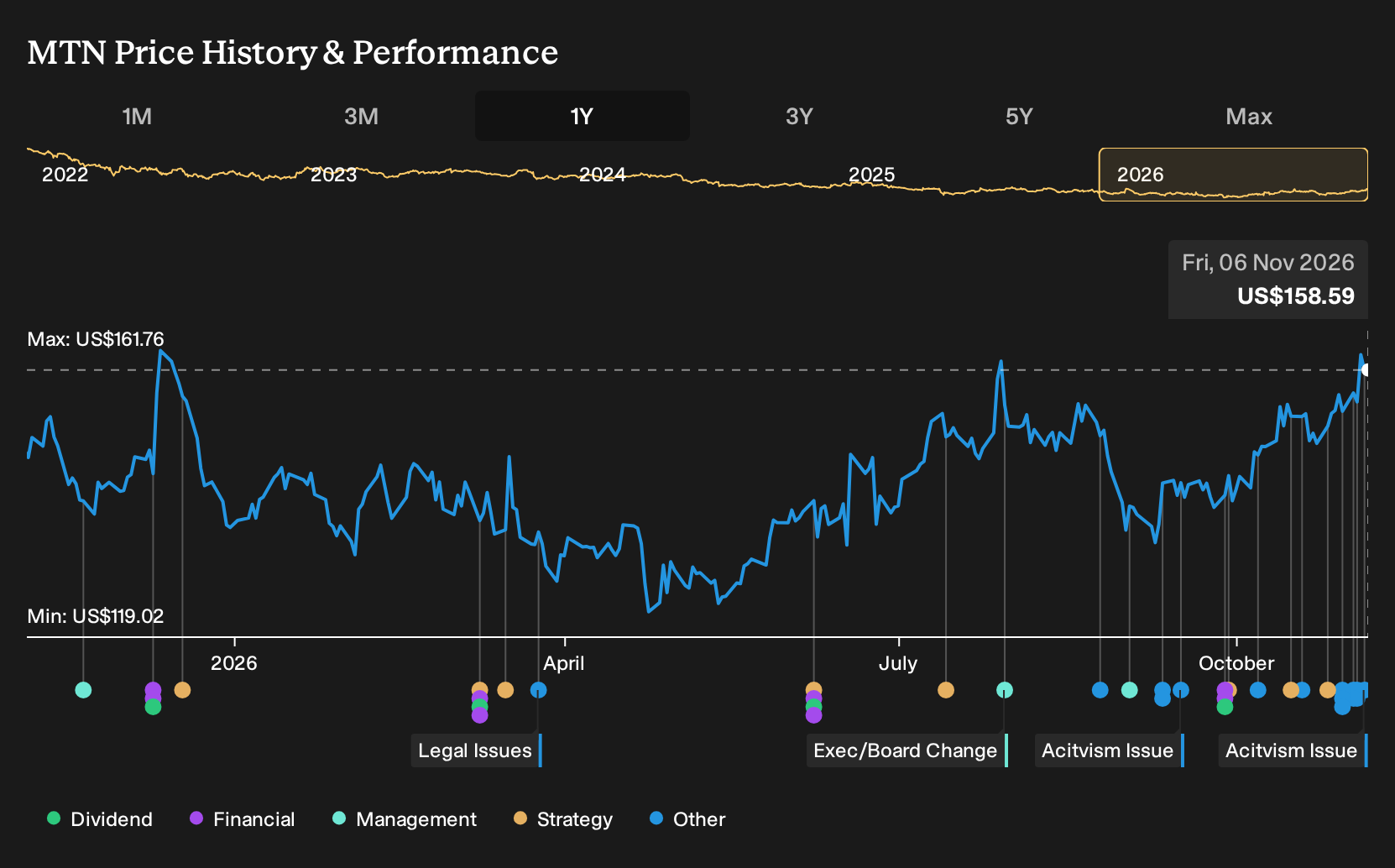
- Oasis Management has escalated its campaign at Vail Resorts, launching a definitive proxy fight to elect two directors, criticizing management over a 50% five year share price decline, weaker North American skier visits and guest experience issues, while the company urges investors to back its existing nine person slate.
- The contest now directly pits Oasis’s focus on reworking governance, pricing and guest experience against Vail Resorts’ emphasis on its existing cost savings plan, Epic Experience rollout and recent capital investments in food, dining and digital products.
- We will examine how Vail Resorts’ investment narrative around earnings resilience and guest experience is tested by Oasis’s governance challenge and board campaign.
Vail Resorts Investment Narrative Recap
To stay invested in Vail Resorts, you need to believe the mountain and lodging network can keep guests coming back even as visit patterns and weather swing around. The analyst consensus Narrative on Simply Wall St leans on the idea that the advanced commitment model, cost savings and Epic Experience rollouts keep earnings resilient. The biggest near term catalyst is whether visitation and guest satisfaction recover from recent criticism around lift lines and overcrowding.
The sharpest risk right now sits with softer Epic pass unit trends, elevated leverage around 3.9x EBITDA and a dividend that is not fully covered by free cash flow. Oasis’s proxy fight does not change the snow or demand backdrop, but it could influence how aggressively management addresses guest experience, pricing and capital allocation, which matters for how those risks are managed.
The most relevant recent announcement is Vail Resorts’ October 30 proxy filing, where the board highlighted the Resource Efficiency Transformation Plan and Epic Experience investments while urging support for its nine director nominees. That disclosure sets the reference point for investors as they weigh Oasis’s critique against the existing cost savings and guest experience agenda.
For catalysts, that filing put concrete numbers and priorities around the efficiency story, including a plan for over US$100 million of annualized savings and further technology efficiencies through 2028. Execution against those targets, together with how the board composition looks after the December 14 meeting, will likely shape how much room the business has to handle weaker visitation, a possible dividend reset and the funding of future resort upgrades.
What The Current Forecasts Assume For Vail Resorts
Vail Resorts' narrative projects US$3.2b revenue and US$269.9 million earnings by 2029. Analysts are baking in 4.5% yearly revenue growth and an earnings increase of about US$122 million from US$147.5 million today.
Uncover how Vail Resorts' fair value indicates a 6% potential downside to its current price, a premium that may not be sustainable.
Exploring Other Perspectives
You can read the Vail Resorts story very differently if you focus on dividend risk instead of cost savings. The most cautious analysts were penciling in about US$3.1b of revenue and US$242.5 million of earnings by 2029, and building in more pressure on the payout. The proxy fight headlines may push those expectations even lower, or pull them higher, so compare a few scenarios before you decide which story you believe.
Explore 2 other Vail Resorts fair value estimates, including one that suggests as much as 6% downside from the current price.
Decide For Yourself
Don't just follow the ticker. Dig into the data and build a conviction that's truly your own.
- A great starting point for your Vail Resorts research is our analysis highlighting 2 key rewards and 3 important warning signs that could impact your investment decision.
- See our latest analysis for Vail Resorts. The report includes a comprehensive fundamental analysis summarized in a single visual, the Snowflake, making it easy to evaluate Vail Resorts' overall financial health at a glance.
Looking For More Investment Ideas Beyond Vail Resorts?
If the Vail Resorts story leaves you wanting alternatives with different risk and income profiles, the Simply Wall St Screener can help you scan a wider field and pressure test your next idea before committing capital.
- For investors who want income to matter as much as share price moves, consider focusing on companies that feature 7 dividend fortresses that have shown an ability to keep payouts flowing.
- If balance sheet resilience is a priority, especially when governance questions are in focus, filter for businesses in our list of solid balance sheet and fundamentals (25 results) to see who carries less financial strain.
- When you want potential upside without the same headline noise, shift your attention to our carefully curated 19 high quality undiscovered gems that pair more straightforward stories with underlying fundamental strength.
Have feedback on this article? Concerned about the content? Get in touch with us directly. Alternatively, email editorial-team@simplywallst.com