


EN
At a time when technology plummeted, “Old Deng Representative” Berkshire's stock price reached a record high! The return to Japanese yen bonds sparks a buzz about “adding positions in Japan”
The Zhitong Finance App learned that American insurance and investment giant Berkshire Hathaway (BRK.A.US, BRK.B.US), which has long been at the helm of Buffett, has appointed Mizuho Securities and Bank of America Securities to prepare the first yen-denominated bond issuance plan since April this year and continue its financing layout in the Japanese market. Just a few days before Berkshire announced the re-issuance of Japanese yen bonds this Monday, when the market re-examined the relationship between AI capital expenditure, financing needs, and return fulfillment, Berkshire relied on diversified operations and abundant liquidity to set a record high in stock price history when global technology stocks plummeted last week and significantly outperformed global technology stock benchmarks including the Nasdaq 100 Index.
Abell, who officially succeeded Berkshire veteran Warren Buffett as CEO in January of this year, said in an interview in early September that the group plans to keep the shares of Japan's top five trading companies for decades and may even increase the size of its holdings. Therefore, after news broke that Berkshire plans to issue Japanese bonds for the first time since April this year, the market speculated that Berkshire might continue to lay out the Japanese stock market or increase its holdings in Japan's top five trading companies, so the Japanese stock market benchmark, the Nikkei 225 Index, and the five major trading companies are moving towards a stronger intraday upward pace.
Some media reported, citing information revealed by people familiar with the matter, that Berkshire Hathaway has hired a bank to prepare the first Japanese yen bond issue since April this year and is preparing to raise more capital in Japan.
People familiar with the matter revealed that Berkshire has appointed Mizuho Securities and Bank of America Securities to arrange for the issuance of a potential benchmark-sized yen bond. The deal is expected to take place in the near future, depending on market conditions.
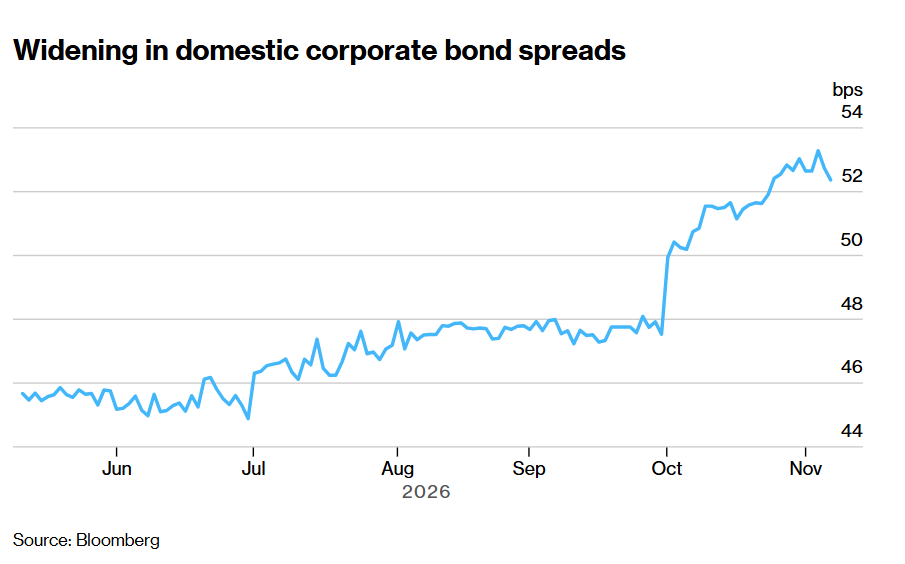
The company has maintained a rhythm of issuing yen bonds approximately twice a year. When the latest issuance plan was proposed, Japanese companies had already slowed down the issuance of domestic bonds. The supply of bonds surged in October, driving up the additional yield of Japanese corporate bonds compared to government bonds, that is, credit spreads; since then, the issuance of new bonds has declined recently. As shown in the chart above, credit spreads on domestic Japanese corporate bonds have widened.
This will be the second time Berkshire has issued yen bonds since Warren Buffett stepped down as CEO. Investors will pay attention to how high the spread premium the company offers and how large scale demand it can attract. In April of this year, the company issued six maturities, ranging from 3 to 30 years, totaling 272.3 billion yen, or 1.7 billion US dollars. This is one of Berkshire's largest Japanese yen bond issuances. The scale is lower than the initial issuance in 2019 and the October 2024 issue.
Takashi Fujiwara, chief fund manager of the fixed income investment division of Resona Asset Management, said, “Berkshire is well known in Japan because it invests in Japanese stocks. As long as the spread is right, there should be strong demand for these bonds.”
AI trading is under pressure, behind the sharp increase in “old stock listings”: Berkshire's strong cash strength regains a premium
Berkshire, which can be called the “old stock market” representing the stock target, set a new stock price record last week and significantly outperformed technology stocks. Meanwhile, the company has appointed Mizuho Securities and Bank of America Securities to prepare the first Japanese yen bond issue since April this year, continuing its financing layout in Japan. The two clues point together — global finance is paying more attention to actual profitability, balance sheet strength, and capital allocation capabilities.
Berkshire's stock price performance has surpassed the historical record set in one fell swoop on November 2: Berkshire Class B shares closed at $579.09 on November 4, setting a new closing high; on November 5, they further hit an all-time high of $586.30 in intraday trading. However, Thursday followed a decline in the US stock market, closing down 1.17%, but significantly less than the 6.36% decline of the NASDAQ 100 and the 12.25% decline of the Philadelphia Semiconductor Index. By the close of November 6, Berkshire's Class B shares were reported at $570.89, up about 5.24% throughout the week, which is very close to the all-time high. In contrast, the NASDAQ 100 and Fee Half fell significantly by about 4.91% and 12.15%, respectively, during the same period.
The so-called “old stock market” in the stock market is the market's joke about traditional industries, mature business models, and value investment targets. It usually emphasizes actual profits, cash generation capacity, and valuation constraints. Berkshire is representative of this style, stemming from insurance, railways, utilities, manufacturing and consumer businesses providing multiple sources of profit. Insurance floating deposits and operating cash flow support long-term investments, while huge liquidity preserves space for acquisitions, repurchases, and countercyclical allocations.
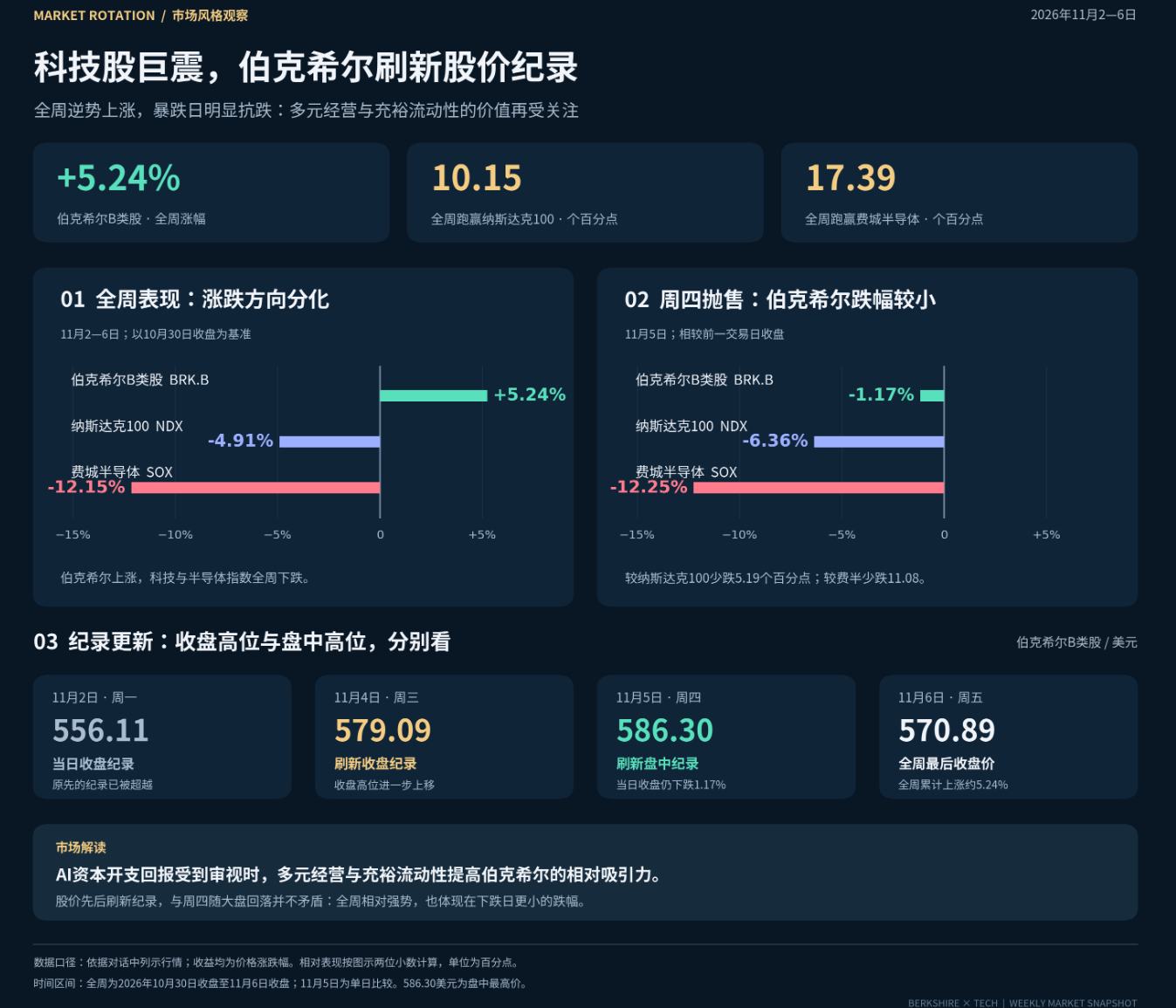
When the value of high-growth companies depends more and more on whether large-scale investments can be realized in the future, companies that already have mature profitable assets are more likely to gain market recognition for their certainty. Cathy Seifert, a senior analyst at CFRA, recently said that balance sheet strength, diversified operations, and buybacks support it, and capital may be shifting to companies with lower volatility and higher quality.
According to the three-quarter report data released by Berkshire on November 7, as of the end of September, Berkshire's cash, cash equivalents and short-term US Treasury bonds totaled about US$377.4 billion, an increase of about US$11.9 billion over the end of the second quarter, and remained close to the highest level of cash flow in the company's history; after deducting unsettled treasury bond purchases, the relevant working capital was still as high as US$356.9 billion.
As of the end of September 2026, Berkshire Insurance and other businesses held US$36.034 billion in cash and cash equivalents and US$336.735 billion in short-term US Treasury bonds. The railway, utilities and energy businesses also held US$4.666 billion in cash, totaling US$377.435 billion. According to the same caliber, the end of the second quarter was 365.514 billion US dollars, thus an increase of 11.921 billion US dollars over the previous quarter.
At the operating level, operating profit for the third quarter was US$12.705 billion, down 5.8% year on year, putting pressure on insurance underwriting and investment income; however, profits from BNSF Railways, Berkshire Energy, and manufacturing, service and retail businesses increased by about 19.3%, 8.3%, and 11.8%, respectively, reflecting the buffering effect of diverse businesses.
However, at the end of the third quarter, the above assets included US Treasury bonds that had not yet been paid for purchases, corresponding to accounts payable of US$20.489 billion. This means that treasury bonds have been included in assets, but the cash from the debt purchase has not yet been released, and at the same time, the books confirm a payment due. After deducting this outstanding payment, the adjusted working capital was US$356.946 billion; after deducting similar payments at the end of the second quarter, it was US$364.743 billion, which actually decreased by about US$7.797 billion over the previous quarter.
With huge amounts of cash, we still borrow yen to allocate assets: the core of Japan's layout is to match assets with liabilities
This potential issuance is in a window worth watching: after Japanese companies concentrated on issuing bonds in October, credit spreads widened, and the supply of new bonds has been declining recently. Berkshire's ability to attract demand depends on its credit quality, term schedule, and final issuance spread.
For investors, a record high stock price reflects the recognition of the equity market, and the subscription of yen bonds will test what price creditors are willing to provide long-term capital at. Currently, the scale, period, coupon and specific use of the issuance have not been disclosed, so it is impossible to assert in advance that financing costs have decreased or that the funds have been determined to be used to increase Japanese stock holdings.
Berkshire continues to issue Japanese yen bonds, in line with the framework of its long-term holdings of Mitsubishi Corporation, Itochu, Mitsui & Co., Marubeni, and Sumitomo Corporation. At the end of 2025, the five trading companies' total cost of holding positions was about US$15.382 billion, with a market capitalization of US$35.368 billion, and contributed US$862 million in dividends that year; the company made it clear that the scale of yen loans roughly matched the yen cost of these investments. At the time, the average cost of financing was around 1.2%, while the dividend yield compared to historical investment costs was about 5.6%.
The Berkshire arrangement described above combines the dividends of mature companies with long-term growth with lower-cost liabilities in the same currency, and reduces the net exchange rate exposure formed by directly purchasing Japanese yen assets with US dollar funds.
This bond issuance can continue the financial base of Japanese investment, but it is not yet possible to confirm a new round of position increases based on this. For example, Berkshire's 272.3 billion yen offering in April this year included multiple uses: first repay a total of 133.9 billion yen maturing bonds, and the remaining net raised capital was used to partially support the acquisition of minority shares in Tokio Marine Holdings. The financing arrangement thus serves both debt continuation and long-term asset allocation. US dollar cash undertakes the group's liquidity and investment reserve functions, while yen financing serves the management of Japanese assets and local debt. There is no conflict between the two.
Berkshire's latest earnings report also shows that the weighted average interest rate for April's new bonds was about 2.4%, higher than the average interest rate of about 1.4% on existing Japanese yen bonds at the end of September; therefore, the positive investment significance of this transaction ultimately still lies in whether a reasonable match can be formed between the financing price and the return on the supported assets.
When Buffett was at the helm, Berkshire favored the five major trading companies. The first thing he was interested in was “global management assets+capital allocation capacity,” not just trade business or commodity price exposure. Buffett clearly stated in his 2024 shareholder letter that these companies hold extensive business interests and that their operating methods are similar to Berkshire; what initially attracted him was the contrast between excellent financial records and lower stock prices, and later more recognition of their management, capital use, and attitude towards shareholders, including moderately increasing dividends, repurchasing shares at reasonable times, and more restrained executive remuneration.
Judging from Abel's previous statement, Berkshire is still willing to hold for a long time after experiencing a sharp rise in the stock prices of the five major trading companies, and is even considering increasing its holdings, showing that it maintains long-term confidence in the ability of the five major trading companies to continue to generate cash flow, allocate capital effectively, and give back to shareholders through dividends and repurchases.