


EN
Did New Belt Launch Just Shift Gates Industrial's (GTES) Investment Narrative?
- Gates Industrial recently launched Poly Chain Carbon ONE, a next generation synchronous belt aimed at shifting customers from roller chain systems by offering maintenance free operation, narrower drives, lighter systems and compatibility with existing Poly Chain sprockets across a wide set of industrial applications.
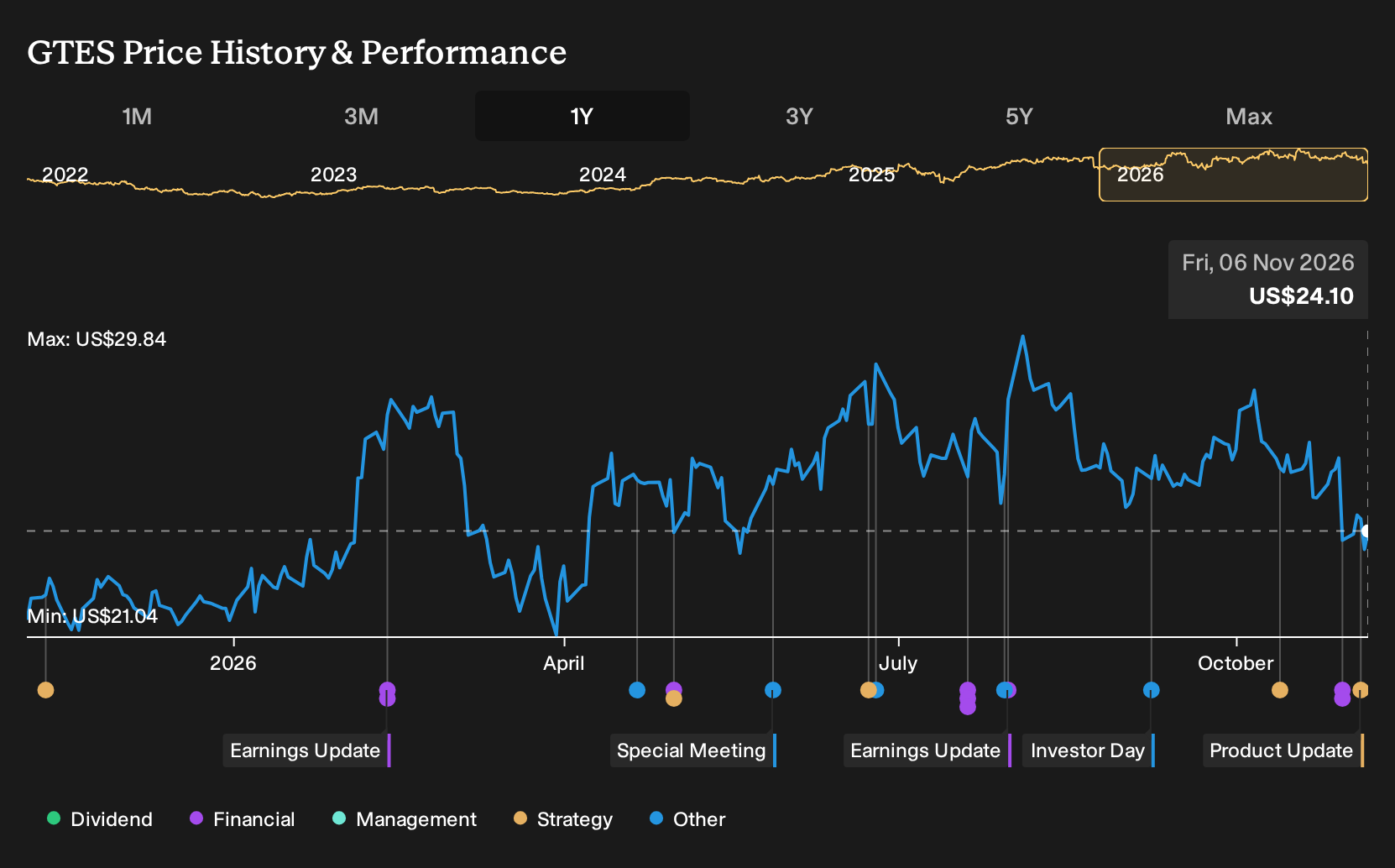
- The product arrives shortly after Gates Industrial reported third quarter 2026 sales of US$903.6 million and net income of US$86.5 million, linking fresh technology in power transmission directly with a period of solid reported profitability and an earnings guidance range of US$905 million to US$925 million in fourth quarter sales.
- The next area of interest is how Gates Industrial's investment narrative could evolve as Poly Chain Carbon ONE feeds into its chain to belt push.
Scan a curated set of industrial and manufacturing peers that, like Gates Industrial pushing chain to belt, could be positioned for the next leg up in efficiency driven demand through the 91 robotics and automation stocks.
Gates Industrial Investment Narrative Recap
To own Gates Industrial, you need to believe the chain to belt push can steadily shift more industrial and mobility applications onto higher value products while legacy auto and construction exposure does not drag too hard on results. Poly Chain Carbon ONE fits that story, but the key near term catalyst still sits in execution across data center, personal mobility and automation projects already in the pipeline.
The immediate risk is that softness in core OEM and construction customers, especially in North America and EMEA, keeps order volumes subdued even as Gates Industrial introduces new products. If end markets stay sluggish or the chain to belt conversion in stationary automation and personal mobility stalls, profit improvement and returns on capital could remain under pressure.
The launch of Poly Chain Carbon ONE is the announcement that most directly links to those catalysts. It is aimed at expanding the chain to belt opportunity into a wider range of industrial applications while narrowing the upfront cost gap that often kept customers tied to roller chain. That goes straight to the thesis that product engineering, not just volume recovery, can support earnings over time.
For you as an investor, the key questions now are practical. Does Poly Chain Carbon ONE actually accelerate conversion in packaging, processing and automated production lines, and does that show up alongside the fourth quarter 2026 sales guidance of US$905 million to US$925 million? If adoption proves slower than hoped or OEM integrations lag, the lift from this product cycle to margins and revenue mix could take longer to come through.
Gates Industrial's current analyst narrative points to revenues of US$4.1b and earnings of US$435.2 million by 2029, based on forecast top line growth of 5.0% a year and an earnings increase of about US$71 million from US$364.1 million today.
Uncover how Gates Industrial's fair value indicates a 38% potential upside to its current price before that discount closes.
Exploring Other Perspectives
Some of the lowest analysts focus on a different risk for Gates Industrial. They worry that personal mobility and data center liquid cooling stay too small to offset softer core markets, which is why their models only point to about US$4.0b of revenue and US$388.9 million of earnings by 2029. Those forecasts, set before the Poly Chain Carbon ONE launch, paint a more cautious story than the consensus US$4.1b and US$435.2 million view. You do not need to pick a side today; however, it is worth comparing both narratives and asking how this new product launch could shift expectations from here.
Reach Your Own Conclusion
Don't just follow the ticker; dig into the data and build a conviction that's truly your own.
- A great starting point for your Gates Industrial research is our analysis highlighting 5 key rewards that could impact your investment decision.
- See our latest analysis for Gates Industrial. The report includes a comprehensive fundamental analysis summarized in a single visual, the Snowflake, making it easy to evaluate Gates Industrial's overall financial health at a glance.
Looking For More Investment Ideas Beyond Gates Industrial?
If the Gates Industrial story has sharpened your thinking on efficiency, cash generation and balance sheet strength, you can use that same framework to scan a broader set of opportunities with the Simply Wall St Screener.
- For investors who care most about resilient cash flows and smaller drawdowns, consider a shortlist built from 31 resilient stocks with low risk scores that may suit a steadier approach to compounding.
- If you want to focus on businesses where price and fundamentals line up more tightly, filter for potential value candidates with the 38 high quality undervalued stocks and compare their profiles to Gates Industrial.
- Those who prefer financial robustness and cleaner balance sheets can start with the list of solid balance sheet and fundamentals (25 results) to see which companies pair lower leverage with more flexible funding options.
Have feedback on this article? Concerned about the content? Get in touch with us directly. Alternatively, email editorial-team@simplywallst.com