


EN
Goldman Sachs dismantles SpaceX (SPCX.US) index effects: valuations, fluctuations, and concentration are almost “insensitive”
The Zhitong Finance App learned that Goldman Sachs strategist Ben Snyder recently published a research report stating that although there were many concerns in the market on the eve of SpaceX (SPCX.US)'s record-breaking IPO, the weight of this stock in major stock indexes continued to rise, yet there was little disturbance in the index's valuation and performance.
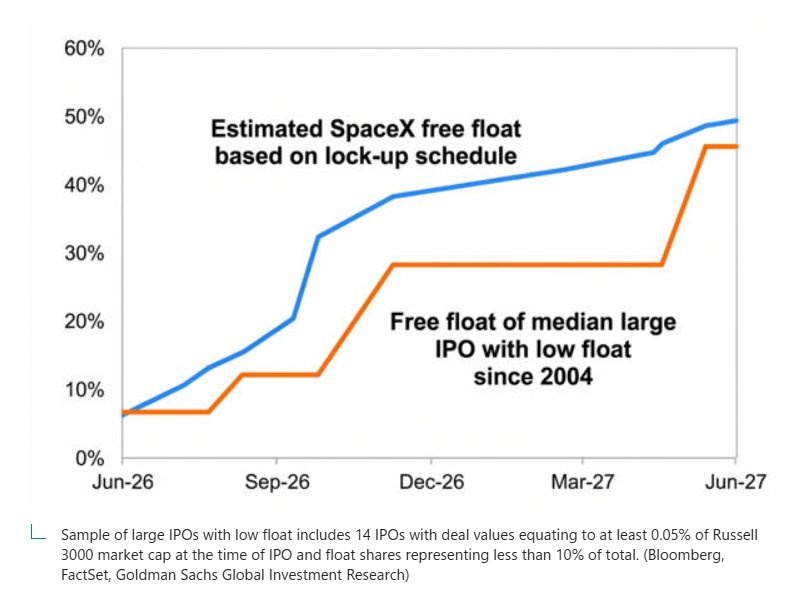
Nearly five months after listing, about one-third of SpaceX's shares have entered free circulation transactions, compared to only 5% at the beginning of the listing. Snyder and his team wrote in a research report released on November 6 that the expansion of the circulation market boosted its weight in several benchmark indices, and funds tracking the index also increased their allocations to this stock.
For index investors, this conclusion means that the inclusion of SpaceX did not significantly change the overall characteristics of the portfolio. Goldman Sachs's comparative estimates show that under the two scenarios of including and excluding SpaceX, the valuation, volatility, and concentration of components of the NASDAQ 100 Index all changed only slightly.
NASDAQ 100 affected moderately
Among the major US broad-based indices covered by the research report, SpaceX has the highest weight in the NASDAQ 100 Index, at about 2.5%.
Goldman Sachs estimates that the current price-earnings ratio of the NASDAQ 100 Index is 19.5 times the expected profit for the next 12 months; if SpaceX is excluded, the valuation will fall back to 19.2 times.
Since SpaceX was included in the index, the NASDAQ 100 index has accumulated a decline of 10.3%; if this stock is excluded, the index has declined by 10%. After incorporating SpaceX, the annualized volatility, which measures stock price fluctuations, also increased only slightly.
Under both measurement measures, the total share of the top ten constituent stocks in the index was 50%; the total share weight of the top 20 constituents was 67%, excluding SpaceX, 64%.
Index position adjustments may result in buying
According to research data, as of the end of October, passive ETFs held a total of about 30 billion US dollars of SpaceX shares, of which funds tracking the NASDAQ 100 Index held about 20 billion US dollars.
As the number of freely tradable shares increases further, the size of index fund holdings is expected to continue to rise. Goldman Sachs expects that as the old shareholders' lockdown period expires one after another, about half of SpaceX's shares will be publicly tradable by mid-2027.
Prior to that, regular index adjustments could result in additional buying. Goldman Sachs estimates that the Russell 1000 Growth Index position adjustment will drive passive ETFs tracking the index to buy more than $10 billion in SpaceX. The next regular rebalance of the index is scheduled for December 11.
The research report also mentioned that due to the NASDAQ 100 Index's rules for preparing individual stocks with low free circulation markets, the impact of this position adjustment on SpaceX's weight within the NASDAQ 100 Index will be relatively limited.
Inclusion in the S&P 500 index may have to wait until 2027
SpaceX is currently not included in the S&P 500 Index. Goldman Sachs judged that according to S&P's entry rules, it probably won't be eligible for inclusion until the second half of 2027.
According to S&P rules, individual stocks need to meet: at least 12 months of listing; at the same time, the net profit from continuing operations is positive for the latest quarter and the sum of the past four quarters under standard accounting standards.
Based on the market's consistent profit expectations, SpaceX will meet the profit threshold after disclosing the financial report for the second quarter of 2027; it is likely that the listing period requirement will also meet the standards at that time.
Goldman Sachs added that the other path is to merge with existing S&P 500 constituent stocks. However, this type of inclusion is a case-by-case review, and there is uncertainty about the timing.