


EN
Best Buy (BBY) Expands Zip In Stores On A Rally That Looks Fully Valued
Best Buy stock reacts to expanded Zip partnership
Best Buy (BBY) is back in focus after Zip Co Limited expanded its flexible payment partnership into physical Best Buy stores nationwide, extending the online arrangement to in-store shoppers using tap to pay.
Zip reports that in First Quarter Fiscal Year 27, U.S. in-store transaction volume grew 61% year over year, with in-store purchases reaching 30% of total U.S. transaction volume. This provides context for Best Buy's move.
Best Buy shares have picked up momentum in recent months, with a 30 day share price return of 14.5% and a 90 day move of 20.9%. The 1 year total shareholder return of 32.8% and 3 year total shareholder return of 79.8% point to a strong run that contrasts with a weaker 5 year total shareholder return, suggesting sentiment has improved as investors weigh recent partnerships and the current valuation.
Compare Best Buy's momentum and consumer finance angle with a curated list of retailers and payment driven stories in our 19 high quality undiscovered gems before you move on.
Bulls point to Best Buy’s Zip rollout and recent returns as a sign the retailer has more room to run, while bears see a rally already priced in. Which case do the current valuation markers lean toward?
Most Popular Narrative: 15% Overvalued
Best Buy last closed at $99.63, while the most followed narrative pegs fair value at $86.95, so the current price sits comfortably above that estimate and puts more pressure on the underlying business story to hold up.
Best Buy’s current valuation implies investors are already pricing in a fairly valued, bullish case in which the company sustains mid single digit comparable sales growth, maintains an adjusted operating income rate around the mid 4% range, and keeps funding its dividend and store investments from ongoing cash generation.
See why 64 investors see Best Buy as 15% overvalued.
Result: Fair Value of $86.95 (OVERVALUED)
Still, the Best Buy story could wobble if higher tech prices push shoppers toward cheaper options or if ads and memberships fail to offset rising operating costs.
Find out about the key risks to this Best Buy narrative.
Another View: Best Buy on earnings multiples
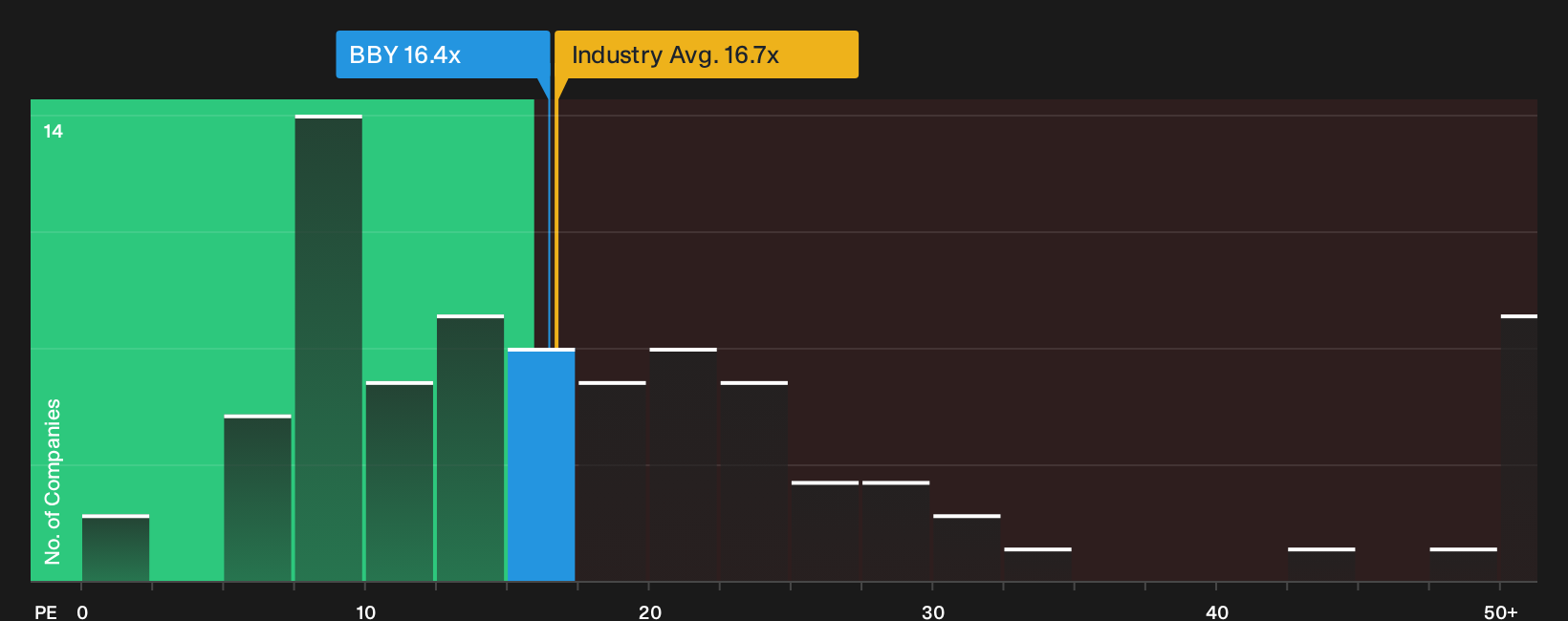
Best Buy looks expensive against the $86.95 fair value narrative, yet the P/E picture is softer. BBY trades at 16.4x earnings, slightly below the US Specialty Retail average at 16.7x and under a fair ratio of 17.7x. Does that gap signal limited downside or just less upside?
For a closer look at what the numbers imply if the market leans back toward that fair ratio, See what the numbers say about this price — find out in our valuation breakdown.
Next Steps
Mixed messages on Best Buy’s value story so far. Treat that as your starting point, move quickly through the data yourself, then weigh up the 5 key rewards and 1 important warning sign
Looking for more Best Buy sized ideas?
If Best Buy has sharpened your eye for opportunity, do not stop here. Broaden your watchlist and pressure test your thesis against fresh ideas.
- Hunt for strong businesses trading below what their fundamentals suggest they could justify by scanning the 38 high quality undervalued stocks.
- Strengthen your income stream by reviewing the 7 dividend fortresses that pair higher yields with supporting financial profiles.
- Protect your downside by filtering for companies with steadier profiles through the 31 resilient stocks with low risk scores.
Have feedback on this article? Concerned about the content? Get in touch with us directly. Alternatively, email editorial-team@simplywallst.com