


EN
3 Export Stocks Retail Investors Are Watching as US Tariff Policy Shifts
Washington is about to get louder as Democrats prepare to run both chambers of Congress, and that noise could ripple straight through tariff policy, regulation and export heavy business models. Policy risk often feels abstract until it starts to shift pricing power, profit pools and funding costs. This piece walks through three U.S. exporters from our screener that appear closely tied to the latest trade and oversight headlines so you can judge whether they deserve a closer look or a wide berth.
The stocks covered below are just a starting sample from this tariff-sensitive theme. The full screen surfaced another 50 export exposed businesses with equally compelling narratives that do not fit into one article. To size up the broader field and identify your own highest conviction ideas, head straight into the U.S. Tariff-Sensitive Exporters and Trade Beneficiaries screener.
Terex (TEX)
Terex plugs neatly into this tariff-sensitive theme as a global supplier of heavy equipment for materials processing, recycling and aerial work, where cross-border trade terms can influence both costs and export demand.
Terex manufactures equipment across Aerials, Materials Processing and Environmental Solutions, each generating about US$1.7b to US$2.3b in revenue, with a market value around US$6.2b that puts it firmly in mid-to-large cap industrial territory.
"The sustained increase in global infrastructure and manufacturing investment supported by policy incentives and federal construction allocations remains a live driver, with Terex now pointing to a Q2 2026 backlog of US$6.9b and upgraded 2026 sales guidance of US$7.9b to US$8.2b. These are indicators that this demand cycle could continue to support revenue growth and earnings."
One consideration is what may happen if a pressure on Terex’s cost base eases just as that infrastructure heavy order book rolls through the income statement.
That cost release could be exactly what reshapes Terex’s earnings profile, so read the full narrative for Terex to see how tariffs, pricing and backlog could be decoupling.

AGCO (AGCO)
AGCO is a pure-play farm machinery group whose tractors, combines and parts move across borders, so any shift in tariff policy can quickly touch both export demand and imported component costs.
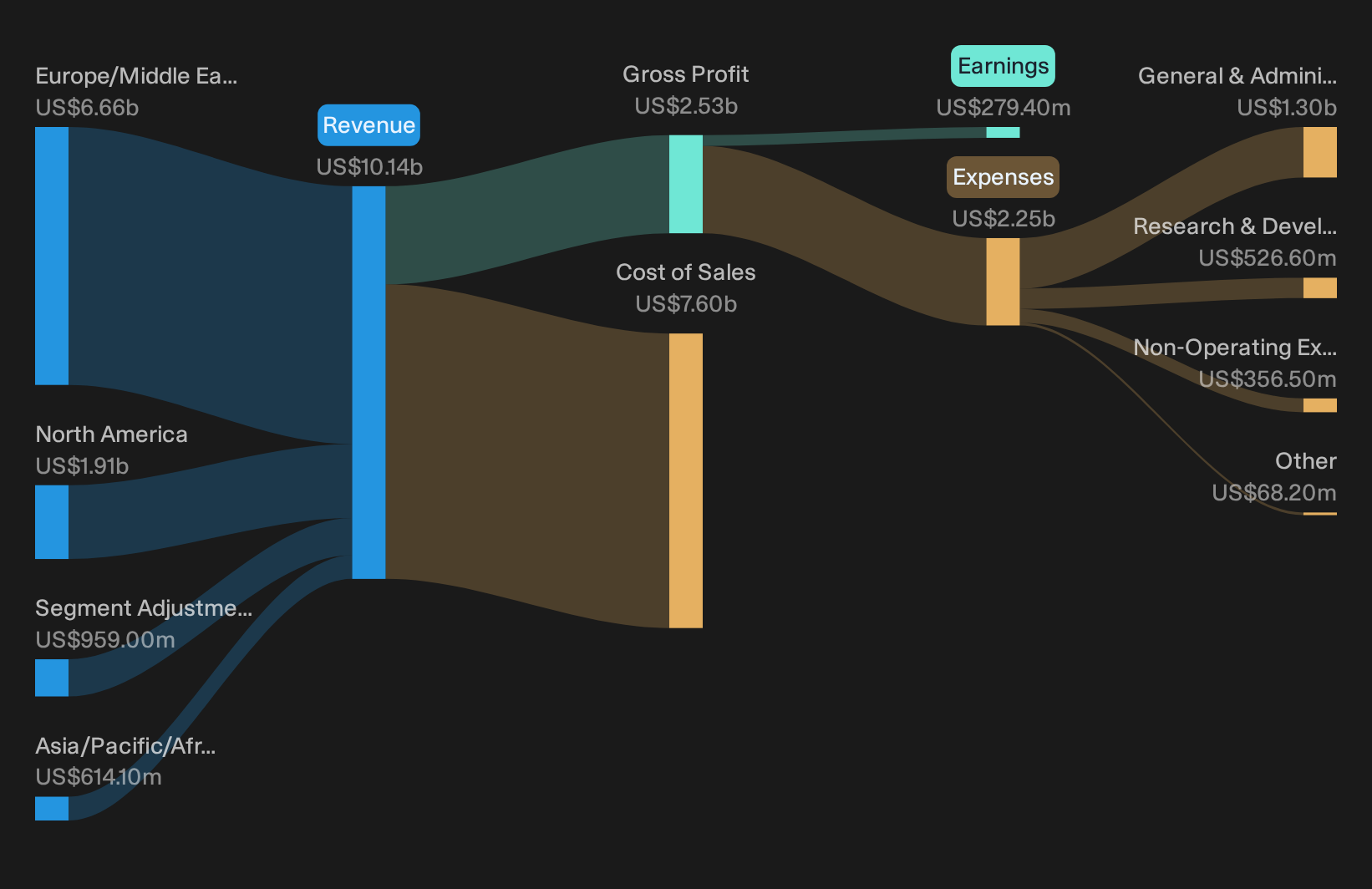
AGCO manufactures and services farm machinery and protein systems for growers worldwide, with revenue tilted to Europe/Middle East at about US$6.7b, North America at roughly US$1.9b and Asia/Pacific/Africa near US$600 million, and a market value around US$7.6b.
"AGCO’s PTx precision agriculture platform is targeted to grow from just under US$900 million of revenue to US$2 billion by 2029, with over 50% gross margins and mid to high 20% operating margins."
What happens to those margin ambitions if one quiet cost pressure linked to tariffs and supply chains does not ease as quickly as expected?
If that pressure point matters to your thesis, read the full narrative for AGCO to see how AGCO’s precision margins, tariffs and demand cycles could be interacting.
Deere (DE)
Deere is the flagship tariff-sensitive exporter in this group, with U.S.-built farm and construction machines shipped worldwide and a growing software layer that can shift how much pricing power it has when trade rules change.
Deere & Company sells large production and precision agriculture gear that brings in about US$16.9b, Small Ag & Turf adds roughly US$11.7b, Construction & Forestry contributes around US$13.8b, Financial Services about US$6.2b, and the business carries a market value near US$181.1b.
"Rapid adoption of Deere precision agriculture and automation solutions, now evidenced by See & Spray covering significantly more acres with herbicide savings of over 50% and higher technology take rates on 2027 sprayers and planters, supports the earlier view that higher value equipment and software engagement can lift future revenue and net margins through a larger mix of technology rich offerings."
The real swing factor is how one less visible policy shift filters through that export heavy order book and shows up in Deere’s margins.
That policy ripple is the missing piece, so read the full narrative for Deere to see whether tariffs, tech adoption and capital allocation are quietly reshaping Deere’s trajectory.

Seeking Fresh Alternatives Before Others?
Fresh ideas move first. Breakout stories build momentum while they are still under the radar for now. Do not get caught watching prices change without having a plan. Consider your options and act according to your strategy.
- Identify smaller companies building real traction before momentum develops by scanning the curated 9 elite penny stocks with strong financials and reviewing which stories still appear early stage.
- Track where machine learning cash flows and product pipelines already exist by working through the focused 40 profitable AI stocks that aren't just burning cash and noting potential long-term candidates.
- Follow capital moving into data centers, chips and power support by reviewing the filtered 53 AI infrastructure stocks and shortlisting the platforms you consider most resilient.
Have feedback on this article? Concerned about the content? Get in touch with us directly. Alternatively, email editorial-team@simplywallst.com