


EN
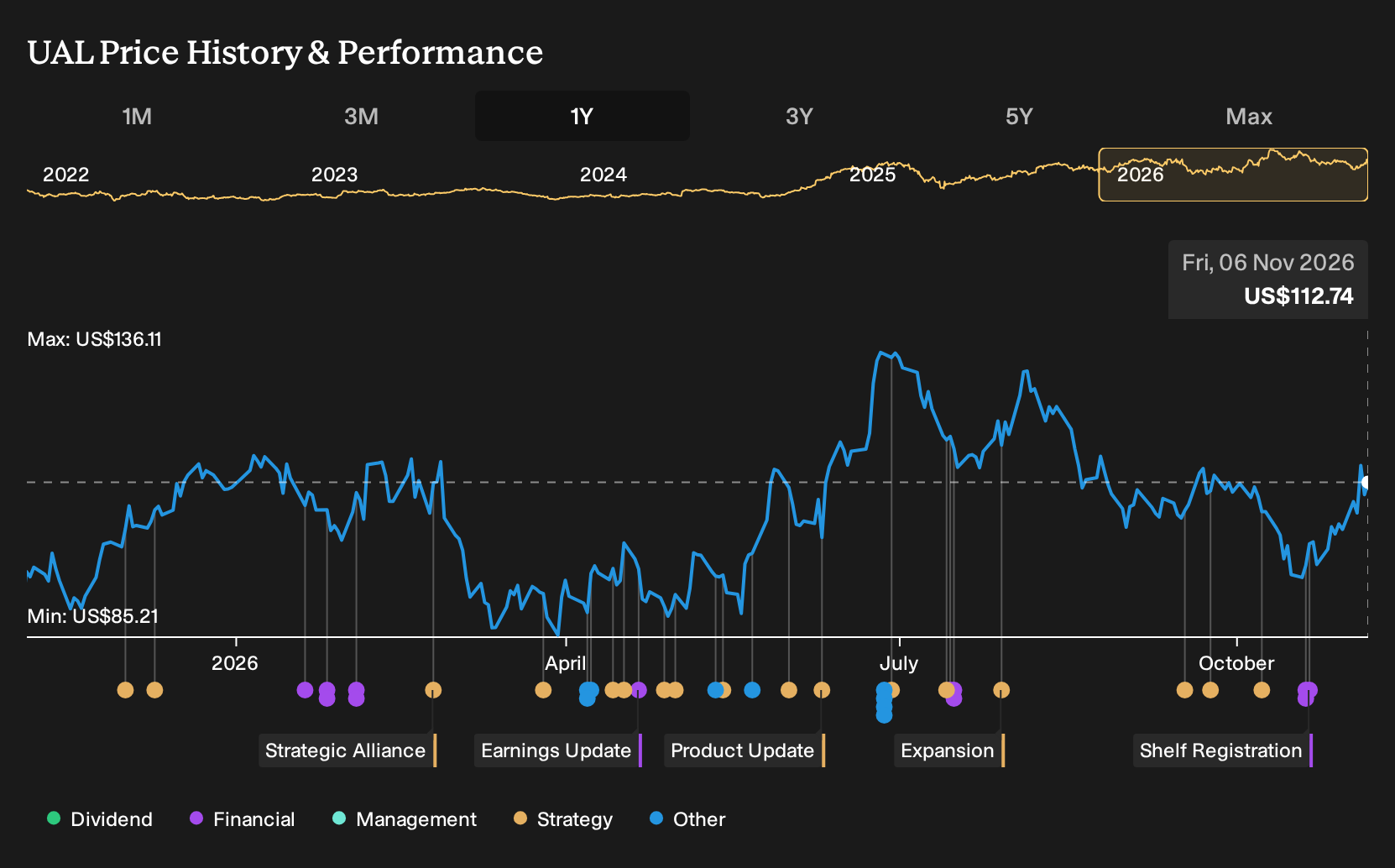
How Fuel Cost Pressure Will Impact United Airlines Stock Investors
- United Airlines Holdings reported that fourth quarter revenue in 2026 is expected to be more than 20% higher than a year earlier, while management pointed to elevated jet fuel and nonfuel expenses as key risks to earnings.
- The combination of strong demand and sensitivity to fuel prices highlights how United Airlines Holdings cost structure can heavily influence how much of that revenue turns into profit.
- We will examine how United Airlines Holdings investment narrative around premium growth and cash generation is tested by higher jet fuel costs.
Compare United Airlines Holdings' fuel exposed setup with airlines and travel stocks that pass tighter balance sheet and cash flow filters in our curated list of solid balance sheet and fundamentals (25 results).
United Airlines Holdings Investment Narrative Recap
To own United Airlines Holdings, you need to believe the premium growth, loyalty, and fleet plans can convert a relatively thin 5.5% net margin and high debt load into steadier cash generation over time. The latest guide for Q4 revenue to run more than 20% above last year supports that demand side of the story.
The more immediate swing factor is fuel. Management already flagged jet fuel and nonfuel expenses as key risks, and the business saw Q2 2026 pretax margin at 4.8%. If rising fuel costs persist without matching pricing power or cost discipline, the near term earnings and free cash flow catalyst stays fragile.
Recent commentary that United Airlines Holdings expects a moderation in unit cost growth excluding fuel in Q4 is the most relevant operational data point here. Slower nonfuel unit cost growth, on top of strong revenue, would give the company more room to absorb volatile fuel expenses without further squeezing profitability.
For you as an investor, the question is whether that cost control can show up consistently enough in reported numbers to offset the pressure from jet fuel. If the promised efficiency gains from United Next, better reliability, and premium mix improvement start to line up with this unit cost moderation, the current fuel shock risk looks more manageable in the near term.
United Airlines Holdings Forecast Setup Versus Fuel Risk
United Airlines Holdings' narrative reflects analyst projections of US$77.4b in revenue and US$3.6b in earnings by 2029. These figures are based on assumptions of revenue growth of 5.7% per year and earnings remaining broadly flat from US$3.6b today to a consensus forecast of US$3.6b in 2029.
Uncover how United Airlines Holdings' fair value indicates a 33% potential upside to its current price, which could narrow quickly.
Exploring Other Perspectives
Some of the most optimistic analysts lean into United Airlines Holdings pricing power as a potential upside catalyst. Before this fuel news, the bullish camp was sketching out revenue of about US$82.4b and earnings near US$6.0b by 2029. Your view may differ a lot, so treat these pre news forecasts as inputs to test, not conclusions to follow.
Explore 3 other United Airlines Holdings fair value estimates, including one that suggests up to 71% upside from the current price.
Reach Your Own Conclusion
Disagree with existing narratives? Extraordinary investment returns rarely come from following the herd, so go with your instincts.
- A great starting point for your United Airlines Holdings research is our analysis highlighting 5 key rewards and 3 important warning signs that could impact your investment decision.
- See our latest analysis for United Airlines Holdings. The report includes a comprehensive fundamental analysis summarized in a single visual, the Snowflake, making it easy to evaluate United Airlines Holdings' overall financial health at a glance.
Looking For More Ideas Beyond United Airlines Holdings?
If the United Airlines Holdings story has you thinking about portfolio balance, it can help to compare this stock with others that show different mixes of quality, income, and risk. The Simply Wall St Screener lets you quickly filter for companies that better match your own tolerance for volatility, balance sheet strength, or cash generation.
- If you care most about shock absorption in tough conditions, start with a 31 resilient stocks with low risk scores that have historically scored well on resilience and risk factors.
- For investors hunting for value with quality fundamentals, run through a 38 high quality undervalued stocks that combine solid balance sheets with healthier cash flows.
- If you want potential growth with cleaner financial footing, scan a 9 elite penny stocks with strong financials that already show stronger balance sheets and more disciplined capital use.
Have feedback on this article? Concerned about the content? Get in touch with us directly. Alternatively, email editorial-team@simplywallst.com