


EN
How Investors May Respond To UHS Third Quarter Earnings Report
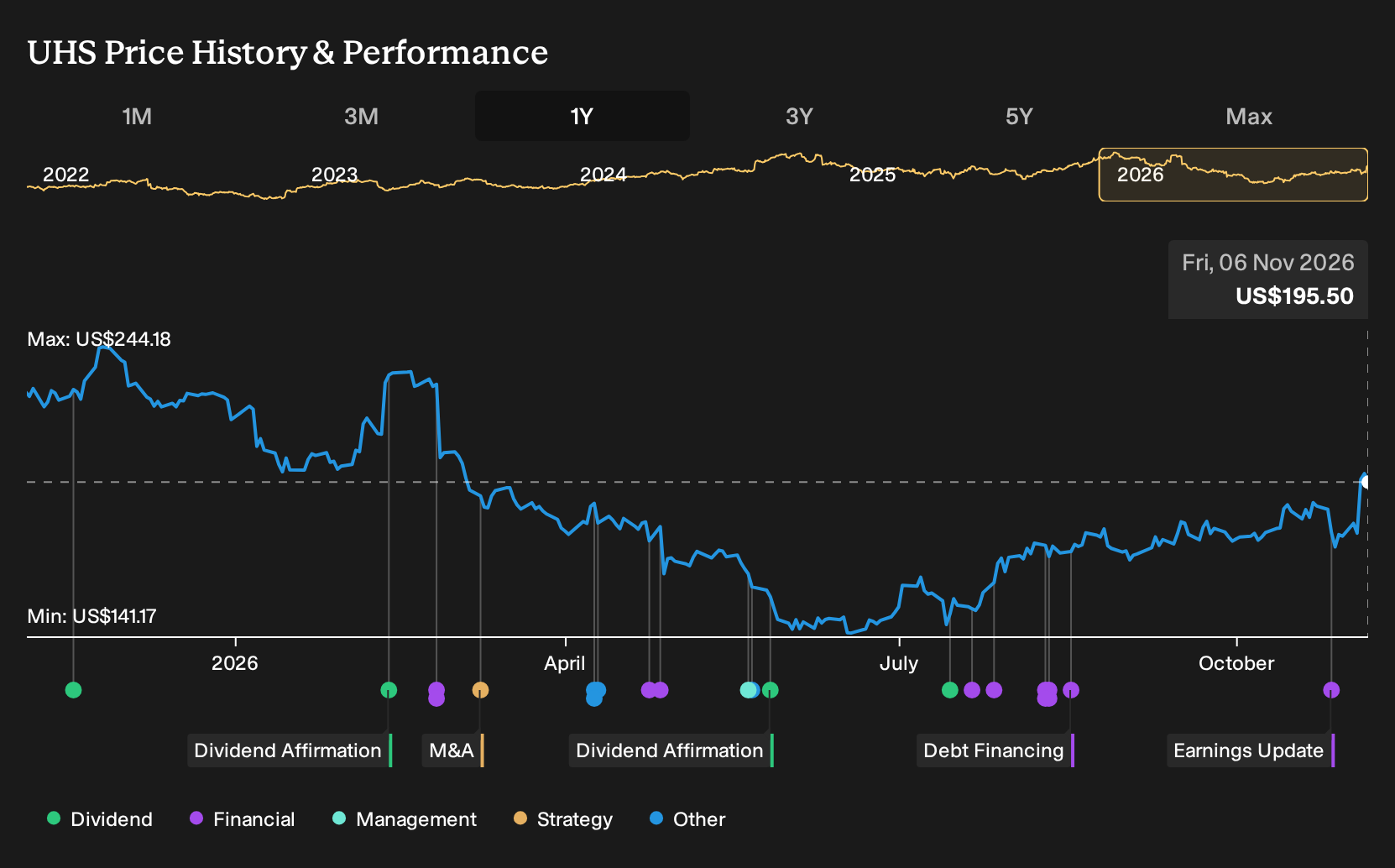
- Universal Health Services reported third quarter 2026 results with sales of US$4,733.35 million, net income of US$308.68 million and diluted EPS from continuing operations of US$5.22.
- Across the first nine months of 2026, Universal Health Services reported sales of US$13,866.55 million, while net income of US$1,015.81 million stayed close to the prior year, indicating changing profitability drivers relative to topline growth.
- This sets the context for evaluating how Universal Health Services' higher quarterly revenue but lower net income may influence its broader investment narrative.
Scan how Universal Health Services compares on quality and financial resilience next to a hand-picked list of solid balance sheet and fundamentals (25 results) that have been screened for stronger balance sheets and fundamentals.
Universal Health Services Investment Narrative Recap
For an investor to own Universal Health Services, the core belief is that its mix of acute hospitals and behavioral health assets can keep generating solid cash flows even as reimbursement rules and liability expenses shift. The latest quarter showed higher sales but lower quarterly earnings, which points to cost and payor mix pressures rather than a broken demand story.
The near-term hinge remains whether outpatient behavioral expansion, virtual services such as Talkspace, and AI tools can protect margins as Medicaid supplemental payments and ACA-related coverage pressures weigh on revenue. The main risk is that rising liability costs and earlier-than-expected funding cuts hit earnings before efficiency gains and new beds fully contribute.
The most relevant update for this earnings print is management’s ongoing push in outpatient and virtual behavioral health, including the Talkspace integration. That acquisition adds around US$250 million of outpatient behavioral revenue and access to roughly 6,000 therapists, which ties directly into Universal Health Services’ effort to shift toward more commercially reimbursed behavioral care.
This behavioral buildout, together with 177 new acute beds in Florida, Nevada and California and AI-supported revenue cycle tools, frames the key execution test after the quarter. Recent results highlight that higher sales do not automatically translate into higher net income. The investment case leans on these newer assets and systems helping offset Medicaid, ACA and liability headwinds over time.
Universal Health Services' analyst narrative projects US$21.0b revenue and US$1.3b earnings by 2029. This implies 5.1% yearly revenue growth and an earnings decline of US$0.2b from US$1.5b today.
Uncover how Universal Health Services' fair value indicates a 3% potential downside to its current price, resulting in a valuation premium that leaves little room for error.
Exploring Other Perspectives
One bearish twist on Universal Health Services focuses on policy risk rather than execution. The lowest analysts lean into ACA and Medicaid pressure, expecting revenue nearer US$20.1b and earnings around US$1.2b by 2029, versus consensus at US$21.0b and US$1.3b. These views were set before this earnings release, so the story could shift meaningfully.
Explore 4 other Universal Health Services fair value estimates, including one that suggests it could be worth just $189.94.
The Verdict Is Yours
Disagree with existing narratives? Extraordinary investment returns rarely come from following the herd, so consider your own research and judgment.
- A starting point for your Universal Health Services research is our analysis highlighting 3 key rewards and 2 important warning signs that could impact your investment decision.
- See our latest analysis for Universal Health Services. The report includes a fundamental analysis summarized in a single visual, the Snowflake, making it easier to review Universal Health Services' overall financial profile at a glance.
Looking for more investment ideas beyond Universal Health Services?
If Universal Health Services has sharpened your thinking but you want a broader watchlist, the Simply Wall St Screener can help you quickly surface other companies that fit different risk and return profiles.
- For investors who care most about financial resilience and balance sheet strength, scan a curated 31 resilient stocks with low risk scores that score well on lower risk metrics and robustness.
- If income is a priority and you want potential yield alongside stability, check out a set of 7 dividend fortresses that may interest long term dividend collectors.
- Curious about opportunities that are less crowded but still grounded in fundamentals, filter through a focused 19 high quality undiscovered gems that many investors may not yet be watching closely.
Have feedback on this article? Concerned about the content? Get in touch with us directly. Alternatively, email editorial-team@simplywallst.com