


EN
Does Marc Jacobs License Expansion Change The Bull Case For G III Apparel Group Stock?
- Coty Inc. extended its long-term Marc Jacobs fragrance and beauty license with WHP Global and G-III Apparel Group, while WHP and G-III also granted I.T Group a new license and operating control for Marc Jacobs across Greater China.
- The two licensing moves deepen G-III Apparel Group’s role in Marc Jacobs beauty and Greater China retail, reinforcing the owned brand focus that is at the center of its shift away from expiring third-party licenses.
- We will examine how G-III Apparel Group’s investment narrative evolves as the extended Coty license strengthens the Marc Jacobs franchise.
G-III Apparel Group Investment Narrative Recap
To own G-III Apparel Group, you need to be comfortable with a business that is actively swapping out expiring Calvin Klein and Tommy Hilfiger licenses for higher margin owned labels and Marc Jacobs. The near term story still hinges on how quickly these brands scale versus the planned revenue roll off, and how well cost savings and gross margin initiatives hold up.
The biggest near term swing factor remains execution on that portfolio shift, not this week’s headlines. The extended Marc Jacobs beauty license helps brand depth, but does not erase risks around European traffic, supply chain disruptions or earnings forecasts that currently point to declines over the next three years.
The most relevant update here is Coty’s long term extension of the Marc Jacobs fragrance and beauty license with WHP Global and G-III Apparel Group. That agreement ties G-III more tightly into a beauty business where Marc Jacobs already ranks within the Top 10 to 15 prestige female fragrances in several key markets and has early traction in color cosmetics at Sephora.
For you, the link back to catalysts is clear. Management has highlighted Marc Jacobs as a pillar in replacing PVH license revenue and moving toward a larger owned brand mix. A long dated beauty license helps reinforce that pillar. Execution risk around international expansion, supply chain reliability and weaker European demand still sits in the background.
What The Current Analyst Numbers Assume For G-III Apparel Group
G-III Apparel Group's current analyst playbook leans on shrinkage, not expansion. Consensus calls for revenue to decline by 2.3% a year over the next three years, with earnings sliding from US$135.4 million today to US$97.8 million by 2029. Profit margins are modeled to compress from 4.8% to 3.7%, while the share count edges up by 1.63% annually. This means per share earnings rely even more on how the owned brands and Marc Jacobs scale.
For that story to line up with the current price targets, the stock would need to trade on a P/E of 20.9x those 2029 earnings, compared with 8.5x today and a sector marker of 16.1x for US luxury peers. Analysts also anchor on a revenue figure of US$2.7b and the same US$97.8 million earnings estimate in 2029, which ties the Marc Jacobs push and broader brand pivot directly into what they view as justified valuation territory.
G-III Apparel Group's narrative projects US$2.7b revenue and US$97.8 million earnings by 2029. This is built on an assumed 2.3% yearly revenue decline and an earnings decrease of about US$37.6 million from US$135.4 million.
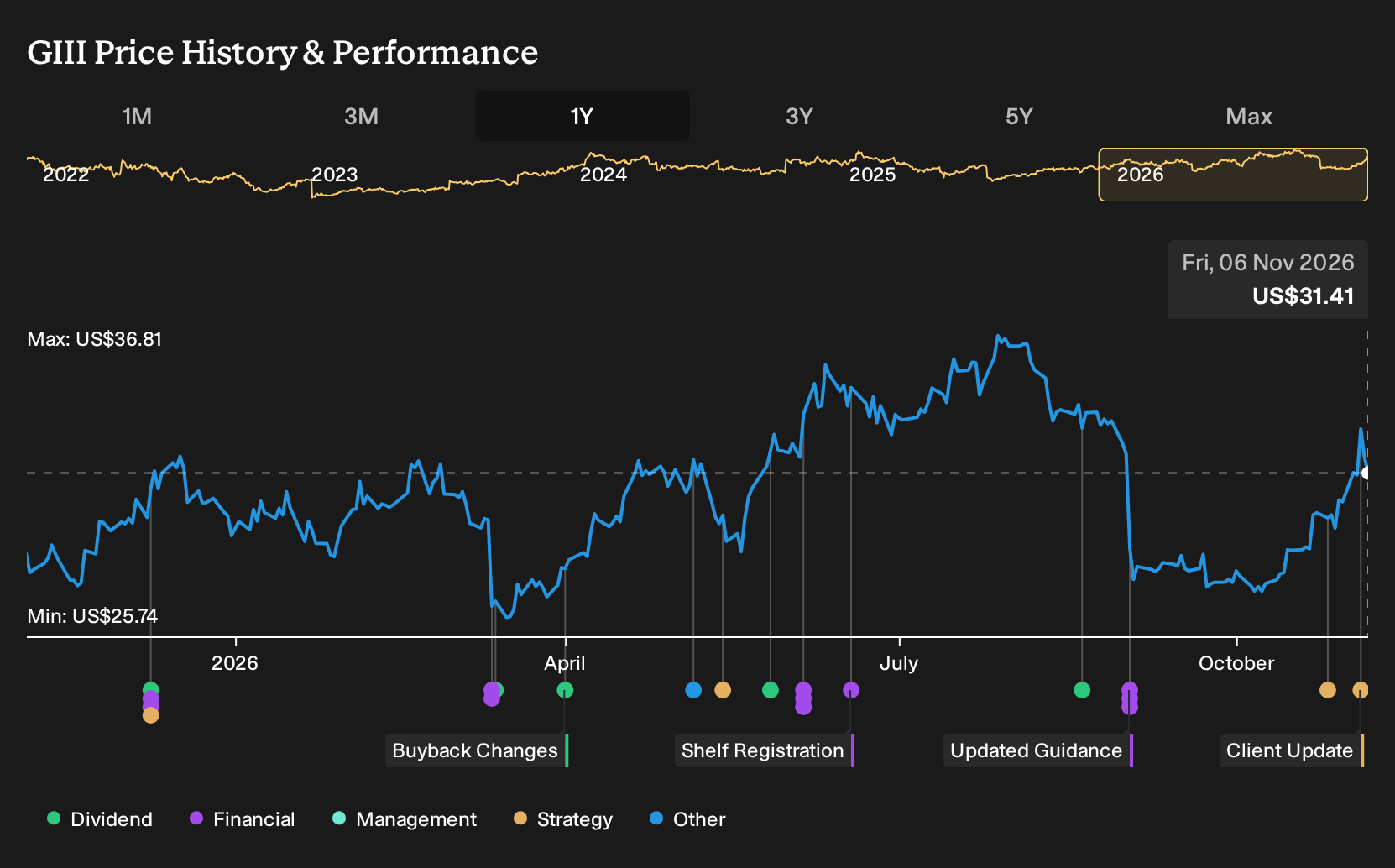
Uncover why G-III Apparel Group's fair value indicates an 11% potential upside to its current price that could narrow quickly.
Exploring Other Perspectives
The most bearish analysts put far more weight on integration risk around Marc Jacobs. They were penciling in revenue of about US$2.7b and earnings of roughly US$110.9 million by 2029, and still called G-III Apparel Group fairly valued to overvalued. This can be read as a reminder that views differ widely and may shift once this fresh licensing news filters into the models.
Explore 3 other G-III Apparel Group fair value estimates, including one that suggests as much as 23% downside from the current price.
The Verdict Is Yours
Disagree with existing narratives? Extraordinary investment returns rarely come from following the herd, so go with your instincts.
- A great starting point for your G-III Apparel Group research is our analysis highlighting 1 key reward and 2 important warning signs that could impact your investment decision.
- See our latest analysis for G-III Apparel Group. The report includes a comprehensive fundamental analysis summarized in a single visual, the Snowflake, making it easy to evaluate G-III Apparel Group's overall financial health at a glance.
Looking for more investment ideas beyond G-III Apparel Group?
If the G-III Apparel Group story has you thinking about portfolio upgrades, it can help to scan a broader set of opportunities that share similar traits like value, quality or resilience. The Simply Wall St Screener lets you quickly filter for stocks that match the type of risk and return profile you want instead of relying on headlines alone.
- For investors who want potential upside without abandoning quality, start by focusing on companies that combine strong fundamentals with attractive pricing through a 38 high quality undervalued stocks.
- If capital preservation and steadier balance sheets matter most to you, narrow your search to businesses that pass strict financial health checks using a list of solid balance sheet and fundamentals (25 results).
- For those hunting for ideas that the broader market may not be paying close attention to yet, cast a wider net across a 19 high quality undiscovered gems.
Have feedback on this article? Concerned about the content? Get in touch with us directly. Alternatively, email editorial-team@simplywallst.com