


EN
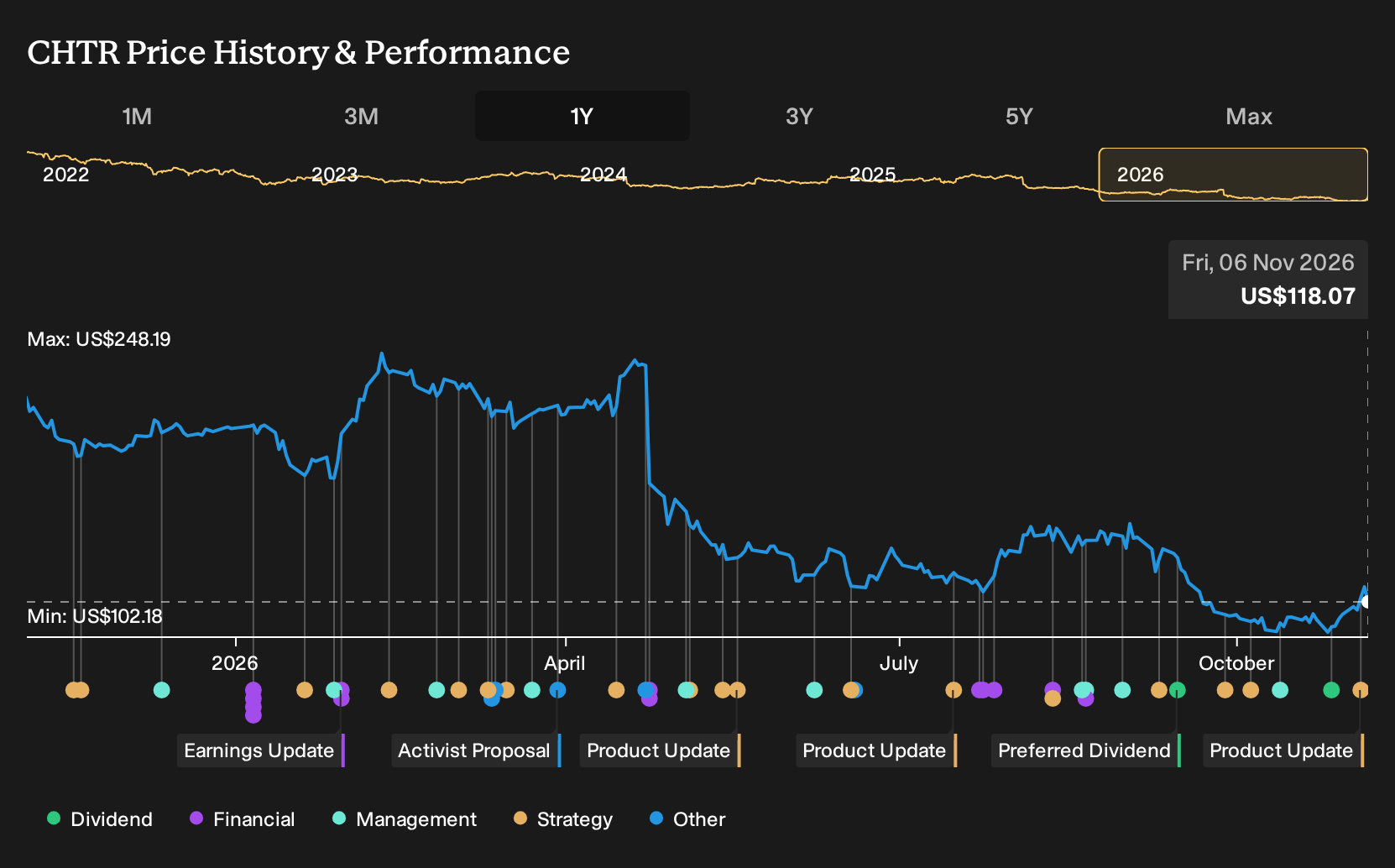
Why Charter Stock Is Down 6.2% And What's Next
- Charter Communications reported third quarter 2026 sales of US$14.9b and a net loss of US$2.4b, driven largely by a US$6.3b noncash franchise impairment, along with continued broadband and video subscriber weakness.
- Management is overhauling operations after closing the Cox Communications acquisition, targeting US$2b in annualized cost savings and more than US$1b in Cox synergies, while contending with ongoing internet customer losses.
- We will look at how Charter Communications' franchise impairment charge and cost-cutting plan reshape its broader investment narrative and risks.
Charter Communications Investment Narrative Recap
To own Charter Communications right now, you need to believe the broadband and mobile bundle model, plus the enlarged Cox footprint, can offset pressure from internet subscriber losses and weaker video trends. The third quarter franchise impairment and swing to a US$2.4b loss highlight how dependent the story is on execution and on keeping churn in check.
The key short term catalyst is management delivering on the US$2b operating expense savings while stabilizing internet trends after Cox integration. The biggest risk is that broadband competition and affordability headwinds keep weighing on customer counts, which would make it harder to improve margins and service the existing debt load.
The latest earnings release is the anchor event here. Charter Communications reported third quarter 2026 sales of US$14.9b, a net loss of US$2.4b and a large noncash franchise impairment tied to weaker broadband economics. That single accounting charge leaves trailing profitability looking thin and reduces room for error on leverage and interest coverage.
Against that backdrop, the planned US$2b of annualized cost savings and more than US$1b of Cox related synergies become the critical execution swing factor. If the operating redesign, Cox integration and bundling push do not improve customer additions and retention, those savings would need to work harder just to offset competition and cost inflation rather than support a clearer earnings and cash flow profile.
Charter Communications' current narrative points to 2029 revenue of US$63.5b and earnings of US$4.9b, based on analyst assumptions that the top line will grow around 5.3% per year while earnings stay broadly in line with current levels of about US$4.9b. This implies flat profit in dollar terms even as sales expand into that forecast period.
Uncover why Charter Communications' fair value indicates a 47% potential upside to its current price before that gap starts to close.
Exploring Other Perspectives
One alternate view focuses squarely on earnings power. While the baseline narrative assumes flat earnings of about US$4.9b by 2029, the most pessimistic analysts were already stressing EBITDA pressure and pegging revenue near US$66.5b with earnings around US$5.3b for this impairment driven quarter. That gap shows how sharply expectations for Charter Communications can still shift.
Explore 6 other Charter Communications fair value estimates, including one that suggests as much as 42% downside from the current price.
The Verdict Is Yours
Disagree with existing narratives? Extraordinary investment returns rarely come from following the herd, so go with your instincts.
- A great starting point for your Charter Communications research is our analysis highlighting 3 key rewards and 3 important warning signs that could impact your investment decision.
- See our latest analysis for Charter Communications. The report includes a comprehensive fundamental analysis summarized in a single visual, the Snowflake, making it easy to evaluate Charter Communications' overall financial health at a glance.
Looking for more investment ideas beyond Charter Communications?
If the Charter Communications story leaves you wanting a broader watchlist, it can help to compare it with other businesses that have different balance sheet strength, income profiles and risk levels using the Simply Wall St Screener.
- For investors who care most about quality at a reasonable price, scan a curated set of 38 high quality undervalued stocks that combine stronger fundamentals with more measured expectations.
- If capital preservation is front of mind, focus on a 31 resilient stocks with low risk scores that screens for companies with more resilient financial risk scores.
- If you prefer sturdier finances and cleaner balance sheets, even when headline growth is quieter, the list of solid balance sheet and fundamentals (25 results) can help you focus on those types of opportunities.
Have feedback on this article? Concerned about the content? Get in touch with us directly. Alternatively, email editorial-team@simplywallst.com