


EN
Lindsay (LNN) Reports Weaker Full Year Results, Is The Stock Still Trading At A Discount?
Lindsay (LNN) is back in focus after management reported full-year results that showed declines in both revenue and earnings, tied to softer irrigation activity and the wind-down of a major MENA project.
The share price reaction has been muted rather than dramatic, with a 1-day share price return of down 0.5% and a 30-day share price return of down 5.1% as investors absorb weaker irrigation trends and the CFO transition. Over a longer stretch, momentum has faded. The year-to-date share price return is down 12.2% and the 5-year total shareholder return is down 29.0%, highlighting how recent news fits into a tougher multi-year stretch for Lindsay.
Scan the irrigation and infrastructure space beyond Lindsay by reviewing a curated list of resilient peers in our 31 resilient stocks with low risk scores that may be weathering similar headwinds differently.
The muted drop in Lindsay after weak irrigation results and a CFO handover hints at two possibilities: is pricing now tracking business pressure or just sentiment fatigue, and what does that imply for valuation next?
Most Popular Narrative: 13.6% Undervalued
Lindsay closed at $106.33 while the most followed narrative places fair value at $123. The key question is whether the business can earn into that gap using its project pipeline, technology mix and cost actions.
The growing contribution from digital and AI-enabled irrigation technology, including FieldNET, FieldNET Advisor, FieldWise and SmartPivot with new features such as TowerWatch and predictive maintenance, is expected to lift technology revenue and support higher margin mix within Lindsay irrigation earnings.
See why 2 investors see Lindsay as 14% undervalued.
Result: Fair Value of $123 (UNDERVALUED)
Still, this story can break if North American irrigation weakness drags on and if Project Fortify spending weighs on margins longer than analysts anticipate.
Find out about the key risks to this Lindsay narrative.
Another View on Lindsay’s Valuation
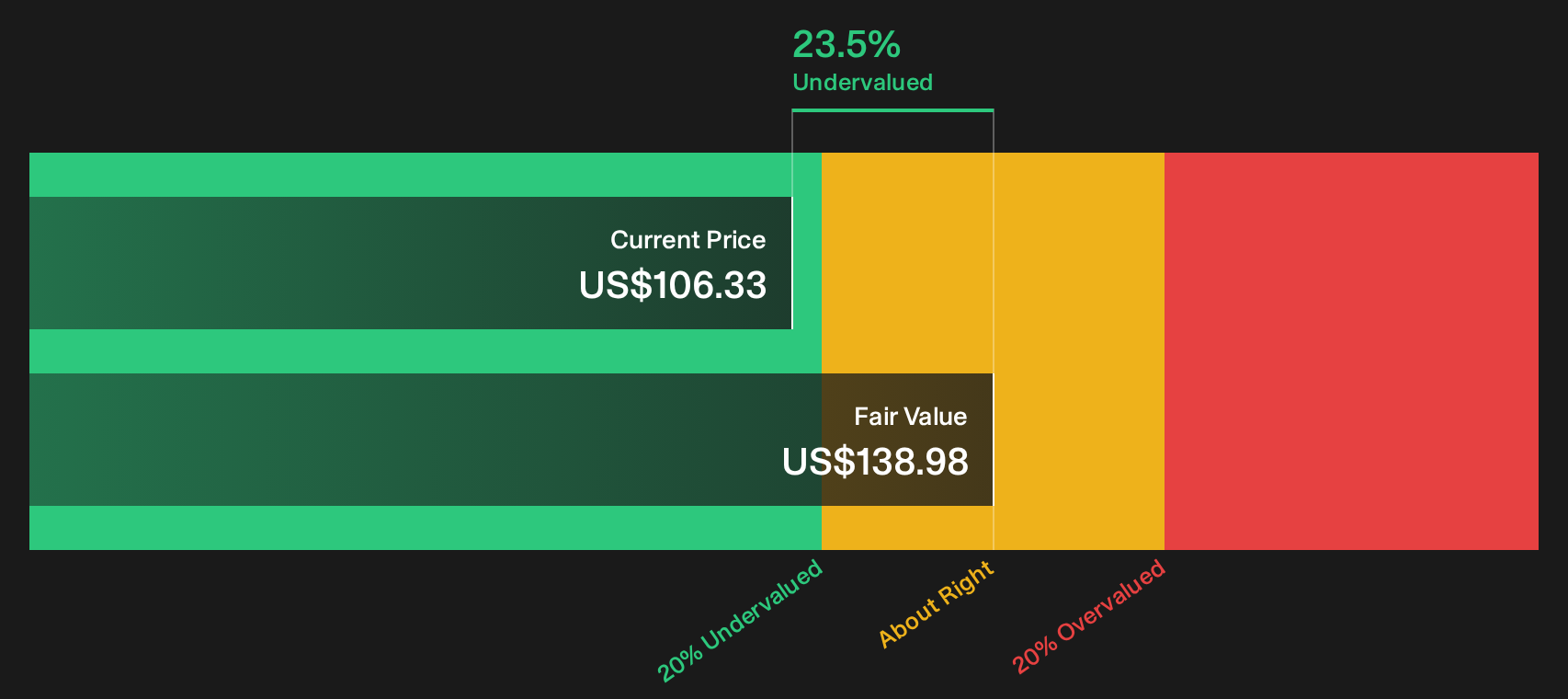
Lindsay screens as undervalued on a cash flow basis, with the stock trading at $106.33 versus an estimated future cash flow value of $138.98. That 23.5% gap suggests the SWS DCF model paints a more generous picture than the current share price. The key question is whether you trust the cash flow path implied by those forecasts.
To see how this model works in practice and decide how much weight to give it in your own process, Look into how the SWS DCF model arrives at its fair value.
Next Steps
Mixed signals on Lindsay can be confusing, especially with differing valuation models and sentiment. Act quickly, review the numbers yourself, and weigh the 3 key rewards.
Looking for more investment ideas beyond Lindsay?
Lindsay is only one piece of your portfolio puzzle, and the real edge often comes from lining up a few high quality ideas side by side.
- Target potential mispricings by scanning a curated set of quality opportunities through the 38 high quality undervalued stocks that match strict fundamentals and valuation filters.
- Strengthen portfolio resilience by focusing on balance sheets that look robust in multiple scenarios using the list of solid balance sheet and fundamentals (25 results) as your starting point.
- Spot under-the-radar stories early by working through the 19 high quality undiscovered gems before attention and liquidity move on to the next theme.
Have feedback on this article? Concerned about the content? Get in touch with us directly. Alternatively, email editorial-team@simplywallst.com