


EN
Why We Think it's Time to Take Profits on Soybean Shorts
“Why We Think it's Time to Take Profits on Soybean Shorts”
by Jim Roemer - Meteorologist - Commodity Trading Advisor - Principal, Best Weather Inc. & Climate Predict - Publisher, Weather Wealth Newsletter and Co-Producer of Climatelligence
Edited by Scott Mathews: Co-Producer of Climatelligence
- Weekend Update - November 6-8, 2026
Just as our "Teleconnection Analysis" nailed our summer crop prediction early…
Source: The above insert is entirely written and designed by BestWeather, Inc. This resulting depiction was rendered via BestWeather's account with ChatGPT.
Looking Beyond the Summer Weather Headlines
One of the biggest mistakes commodity traders make is reacting emotionally to isolated weather extremes rather than understanding the larger atmospheric picture.
During the summer of 2026, drought affected portions of the western Corn Belt, while excessive rainfall and flooding created serious concerns across the eastern Midwest and Ohio Valley. These developments encouraged speculation that U.S. soybean production might suffer substantial losses.
However:
Our ClimatePredict Pro teleconnection research suggested that the broader atmospheric pattern was not necessarily consistent with a nationwide crop disaster.
By examining historical analogs, ocean temperatures, atmospheric circulation patterns, and teleconnections such as ENSO, the PDO, PNA, and other climate indices, we were able to look beyond the headlines.
While certain growing regions experienced legitimate weather problems, other important soybean-producing areas benefited from adequate moisture and generally favorable growing conditions.
Our conclusion: Regional weather adversity did not automatically translate into a small national soybean crop.
The Record Crop That Helped Prove Our Point
Rather than getting caught up in bullish weather speculation, we continued emphasizing the potential for a very large U.S. soybean harvest.
The USDA's October forecast of 4.56 billion bushels and a record 53.1 bushels per acre reinforced that assessment.
Over the last month, we also warned that two developments could pressure soybean futures:
- U.S. harvest pressure: An enormous crop moving into commercial channels would create seasonal selling pressure.
- Favorable early South American weather: Generally adequate moisture and good planting progress in Brazil and Argentina reduced immediate fears of another global production shortfall.
Soybean futures subsequently suffered a substantial decline, with prices falling more than $1 per bushel from their early-autumn highs. For traders who followed our bearish recommendations, this created an opportunity to capture meaningful profits.
Why We're Now Advising Taking Profits
Successful commodity trading is not simply about predicting the weather correctly. It is also about recognizing when bearish fundamentals have become widely anticipated and reflected in prices.
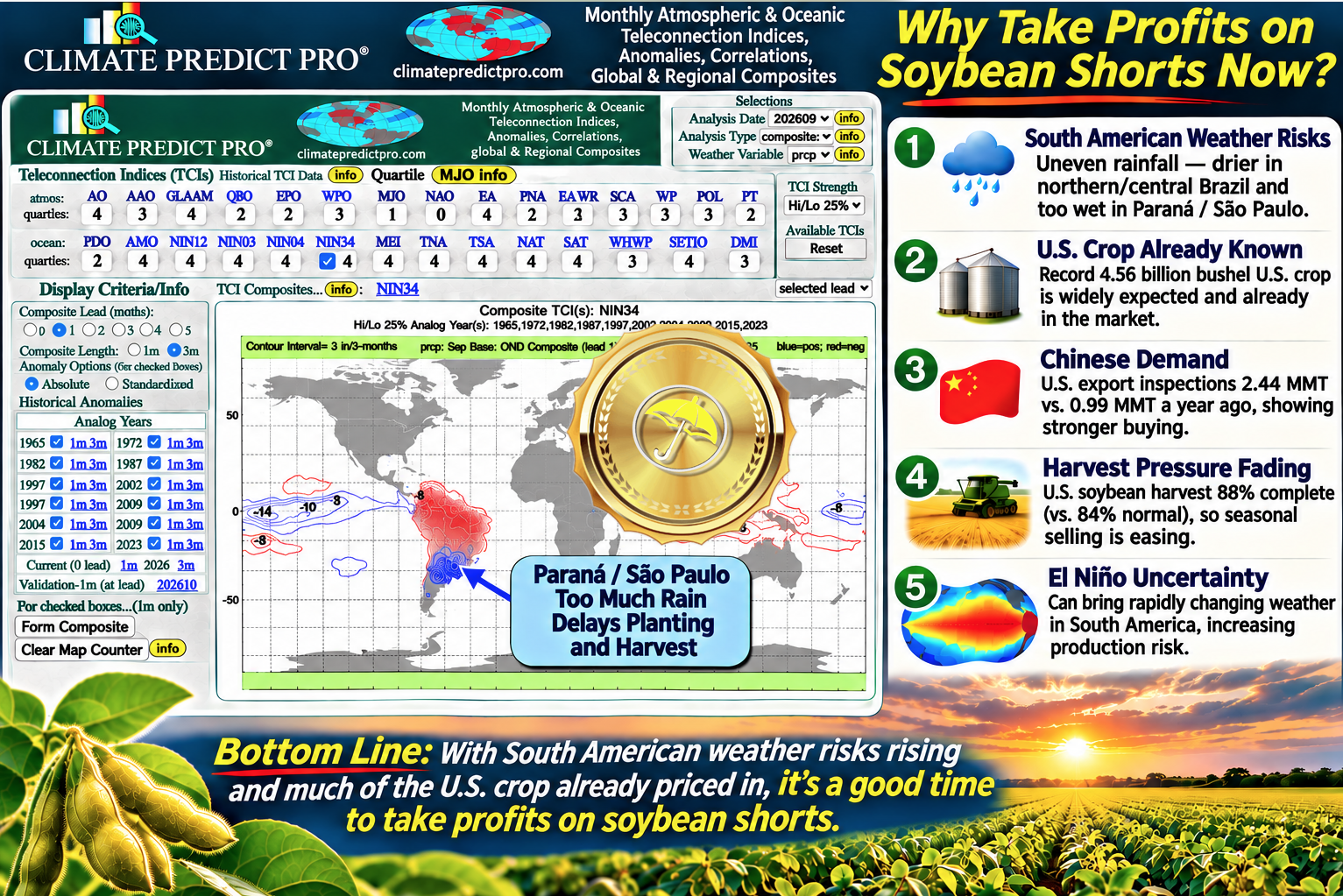
Our accompanying ClimatePredict Pro graphic (featured at the top of this page) illustrates five reasons we believe covering soybean shorts makes sense now.
- First, South American weather risks are becoming more complicated. While much of Brazil has experienced favorable early-season conditions, rainfall has been uneven. Drier areas of northern and central Brazil contrast with excessive moisture in Paraná and São Paulo. This creates potential delays in planting and fieldwork.
- Second, the enormous U.S. crop is no longer a surprise. Much of that bearish supply information has already been incorporated into futures prices.
- Third, Chinese demand has strengthened. Recent weekly U.S. soybean export inspections reached approximately 2.44 million metric tons, compared with roughly 0.99 million tons a year earlier.
- Fourth, harvest-related selling pressure should gradually diminish. By November 1, approximately 88% of the U.S. soybean harvest was complete, ahead of the historical average.
Finally, El Niño introduces additional uncertainty. Our teleconnection analysis suggests that South American rainfall patterns could become more volatile as the growing season progresses. However, El Niño alone does not guarantee drought or a bullish soybean market.
The Bottom Line: Knowing When to Change Direction
Our research helped us avoid becoming overly bullish during the summer's weather scares. The combination of a massive U.S. crop, harvest pressure, and initially favorable South American growing conditions subsequently supported our bearish outlook.
Now, after the substantial autumn sell-off, we believe the prudent strategy is to take profits on soybean shorts rather than become excessively bearish near the end of harvest.
A post-harvest recovery is increasingly possible as Chinese buying strengthens, seasonal selling diminishes, and South American weather becomes more important.
This does not necessarily mean a major new soybean bull market is beginning.
That is the advantage of combining long-range weather forecasting, historical teleconnections, fundamental analysis, and disciplined trading.
What to do next if you are a farmer or a grain trader?
GET A TWO-WEEK FREE TRIAL TO WEATHERWEALTH and/or a free sample issue
Also, find out (in one of our issues more than a month ago) how we guided our clients in finding the top of the wheat market.

https://www.bestweatherinc.com/membership-sign-up/
We greatly appreciate your interest in Commodity Weather Intelligence!
Jim Roemer, Scott Mathews, and the Best Weather Team
Mr. Roemer owns Best Weather Inc., offering weather-related blogs for commodity traders and farmers. He is also a co-founder of Climate Predict, a detailed long-range global weather forecast tool. As one of the first meteorologists to become an NFA-registered Commodity Trading Advisor, he has worked with major hedge funds, Midwest farmers, and individual traders for over 35 years. With a special emphasis on interpreting market psychology, coupled with his short-term and long-term trend forecasting in grains, softs, and energy markets, he commands a unique standing among advisors in the commodity risk management industry.