


EN
Is Tate & Lyle (LSE:TATE) Fully Priced After Its Half Year Results?
Tate & Lyle (LSE:TATE) just released half year results to 30 September 2026, reporting sales of £1,039 million, net income of £28 million, and basic earnings per share of £0.063 from continuing operations.
The latest half year update follows a strong run for Tate & Lyle, with the share price up 52.86% year to date and a 1-year total shareholder return of 51.77%. However, longer term total shareholder returns over 3 and 5 years have been slightly negative.
See how Tate & Lyle’s sharp year to date move compares with other potential breakout ideas across our curated list of 5 high quality undiscovered gems.
Tate & Lyle has surged this year while net income in the latest half looks more muted. Is the real opportunity still ahead in the valuation, or has most of the re rating already happened in the share price?
Most Popular Narrative: 1% Overvalued
The most followed view on Tate & Lyle pegs fair value at £5.54, almost level with the last close at £5.61. This puts far more weight on execution than on a large valuation gap.
The main thing that has to go right is that Tate & Lyle sustains its cost and productivity savings, including the CP Kelco synergies and broader efficiency pipeline, while managing muted demand in certain sweetener markets and the delayed bio-gums benefit.
The current valuation and the recommended Ingredion all-cash offer at about 8.8x FY2026 adjusted EBITDA together imply that the share price already reflects a fair value for Tate & Lyle, with a bullish skew on successful integration and synergy delivery.
See why 39 investors see Tate & Lyle as 1% overvalued.
Result: Fair Value of £5.54 (ABOUT RIGHT)
Still, muted demand in sweeteners and the 3% like for like decline in revenue and EBITDA leave Tate & Lyle exposed if execution on synergies slips.
Find out about the key risks to this Tate & Lyle narrative.
Another View: Tate & Lyle Through A Cash Flow Lens
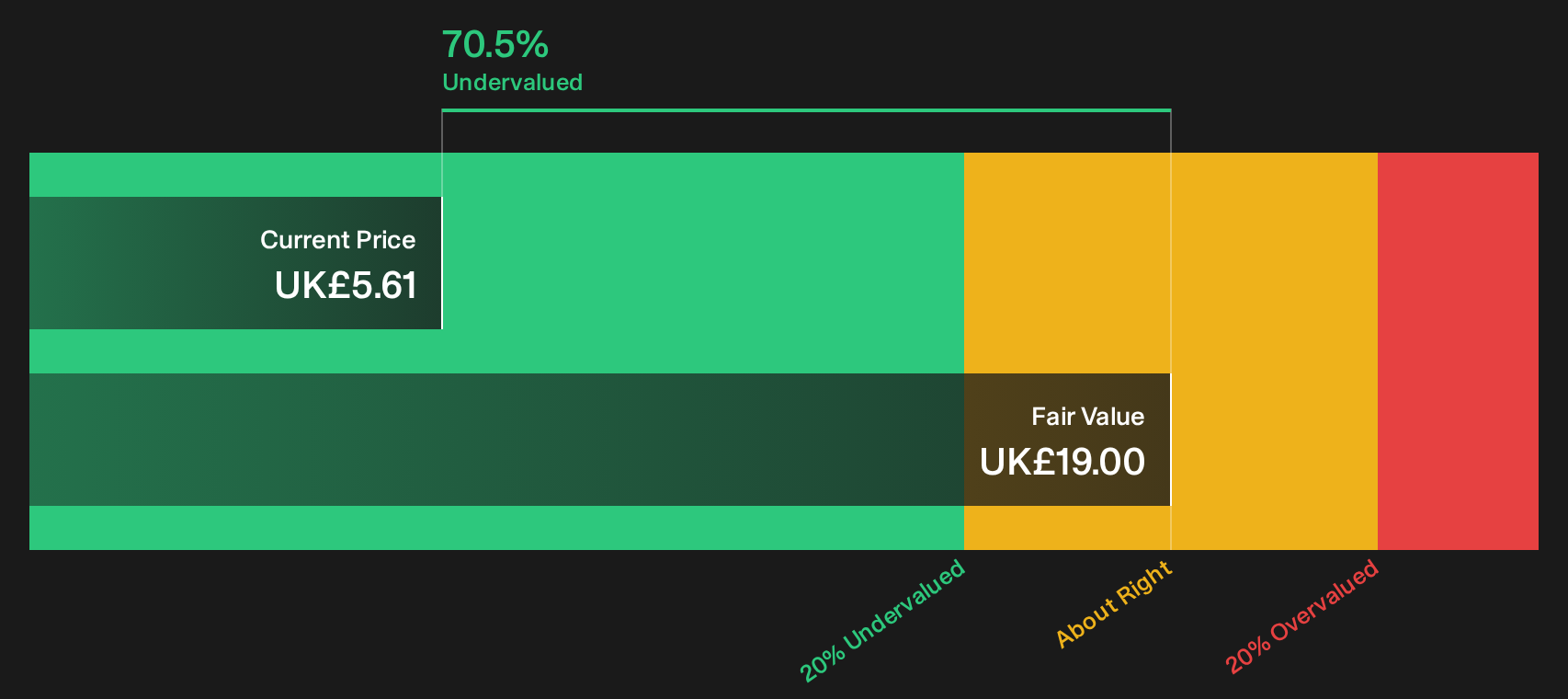
The earlier narrative framed Tate & Lyle as roughly fairly priced around £5.54 using analyst earnings and multiples. A different tool, the SWS DCF model based on future cash flows, signals something very different, with an estimated value of £19 per share and a very large implied discount.
That gap raises practical questions for investors weighing short term execution risk on synergies and cash conversion against a long term cash flow profile that, on this model, looks far stronger than the current share price suggests. Look into how the SWS DCF model arrives at its fair value.
Simply Wall St performs a discounted cash flow (DCF) on every stock in the world every day (check out Tate & Lyle for example). We show the entire calculation in full. You can track the result in your watchlist or portfolio and be alerted when this changes, or use our stock screener to discover 14 high quality undervalued stocks. If you save a screener we even alert you when new companies match - so you never miss a potential opportunity.
Next Steps
Mixed messages on Tate & Lyle’s value story today. If you want a firmer handle on the risk and reward trade off, walk through the full picture in 3 key rewards and 3 important warning signs.
Looking for more investment ideas beyond Tate & Lyle?
If you only focus on Tate & Lyle, you could miss other opportunities. Use the Simply Wall Street screener to spot ideas that better match your goals.
- Target robust income streams by scanning companies with resilient payouts and balance sheets through 4 dividend fortresses.
- Hunt for quality at a reasonable price by zeroing in on stocks that look attractively priced using 14 high quality undervalued stocks.
- Prioritise staying power in tougher markets by focusing on businesses flagged for stability through 4 resilient stocks with low risk scores.
Have feedback on this article? Concerned about the content? Get in touch with us directly. Alternatively, email editorial-team@simplywallst.com