


EN
Nvidia Stock Is Heavily Discounted. Here’s Why Analysts See 80% Upside.
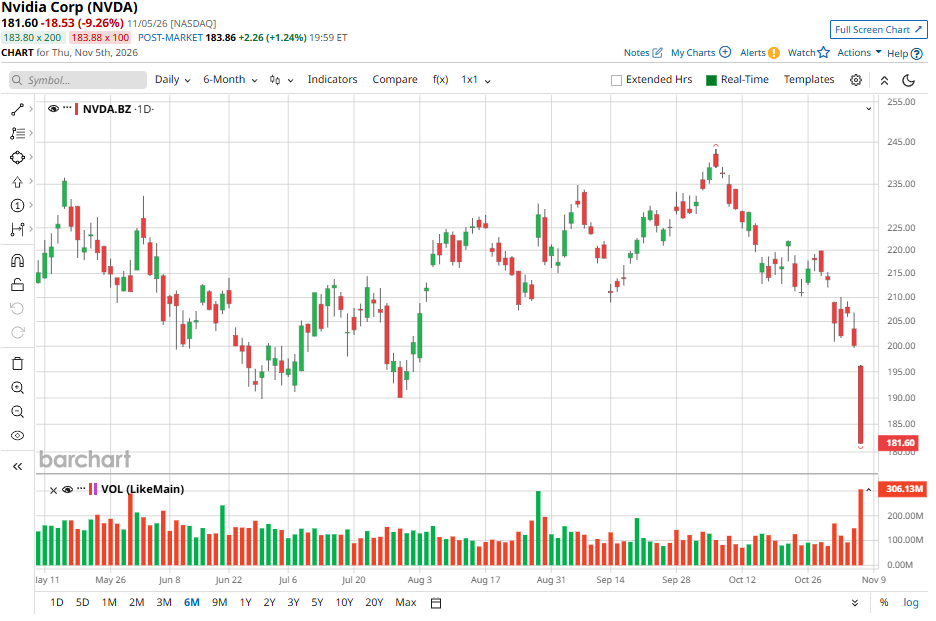
The recent selloff in technology, especially artificial intelligence (AI) stocks, eroded significant value from Nvidia’s (NVDA) market cap. NVDA stock has declined about 24% over the past month, wiping out its year-to-date gains amid growing concerns about elevated data center capital expenditure, increasing reliance on debt to finance AI infrastructure, and fears of regulatory shifts following the U.S. midterm elections.
Despite weak near-term market sentiment ahead of the company’s upcoming quarterly earnings announcement, Nvidia’s outlook remains compelling. Expectations of solid earnings per share (EPS) growth in the coming quarters suggest that NVDA stock is undervalued. Furthermore, Nvidia’s continued share repurchase program signals management’s confidence in its financial position and prospects. Its sustained revenue growth, particularly within the data-center segment, also strengthens its investment appeal.
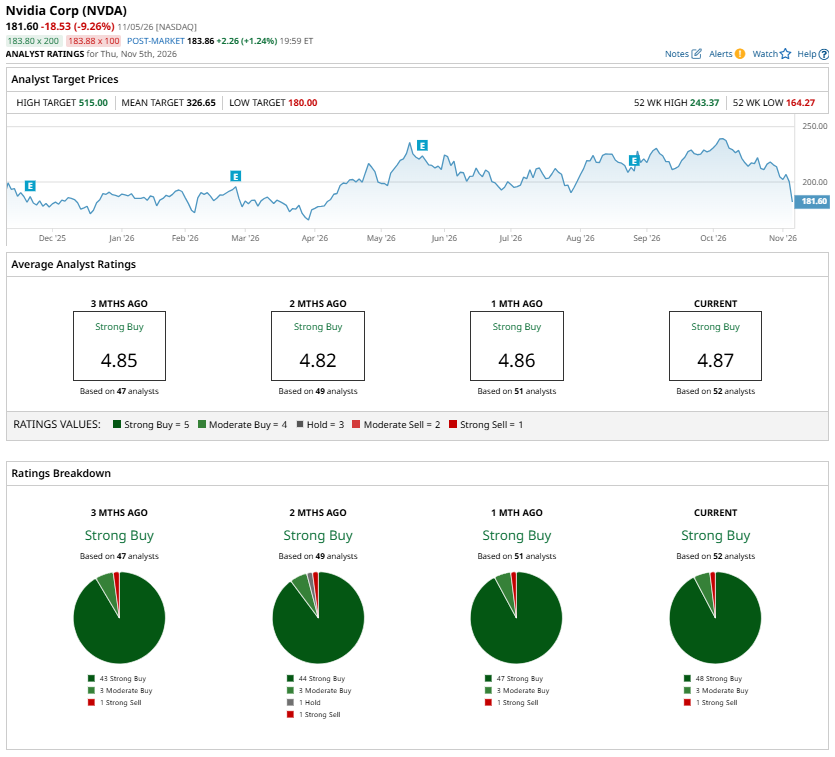
The analysts’ consensus price target of $326.65 represents about 80% upside from the November 5 closing price of $181.60. As Wall Street analysts see significant upside potential in NVDA stock, here are the factors that could push its share price higher.
Strong Demand Signals Solid Growth Prospects for Nvidia
Analysts remain optimistic about Nvidia’s growth prospects, supported by strong demand for its GPUs, CPUs, networking products, and broader AI computing platforms. Further, Nvidia’s growing addressable market and customer base strengthen the opportunity pipeline.
Nvidia’s strong financial performance reflects this demand. Nvidia reported an 85% year-over-year increase in revenue in the first quarter of fiscal 2027, followed by a 106% jump to $96.2 billion in the second quarter. For the third quarter, management expects revenue of approximately $108 billion, representing growth of 89% from the same period last year. Given the continued expansion in AI infrastructure spending, Nvidia is likely to beat its guidance.
The data center business will sustain momentum as customers continue adopting its Blackwell architecture. The upcoming transition to systems powered by its next-generation Vera Rubin architecture could provide another important boost to growth.
Another factor supporting analysts’ positive outlook is Nvidia’s expanding customer base beyond hyperscale cloud providers. Sovereign AI projects, regional NeoCloud operators, enterprises, and specialized data centers are increasingly investing in computing capacity. Governments, in particular, are placing greater emphasis on developing domestic AI infrastructure, creating a significant source of demand. Nvidia expects these non-hyperscaler customers to contribute around half of its data center revenue eventually.
Nvidia’s growth opportunity also extends beyond GPUs, with CPUs emerging as another promising business. As agentic AI applications become more advanced and can handle complex tasks, demand for general-purpose computing is expected to rise. Nvidia’s Grace CPU business has already generated more than $5 billion in trailing 12-month revenue, highlighting the growing importance of this segment. The company estimates that the server CPU market represents an approximately $20 billion opportunity in fiscal 2027 and expects its CPU revenue to more than double in fiscal 2028. Its next-generation Vera CPU, particularly as a standalone product, could further expand Nvidia’s addressable market.
Nvidia’s strong revenue is expected to support a substantial increase in earnings. Analysts expect Nvidia’s earnings to jump 103.5% in fiscal 2027. Moreover, momentum in its bottom line is projected to continue in fiscal 2028 as well, with EPS growing over 69% despite a tough year-over-year comparison.
Nvidia Stock is Heavily Discounted
Nvidia’s growth outlook remains compelling, supported by sustained demand for AI computing infrastructure, an expanding portfolio of next-generation products, and increasing adoption across a wider range of customers and industries. These factors provide a strong foundation for continued revenue and earnings growth. At the same time, Nvidia stock appears undervalued, signaling it has room to run.
Nvidia trades at 22.2 times forward earnings, a notable discount to its historical valuation levels and considerably below peers. By comparison, Advanced Micro Devices (AMD) trades at 74.5 times forward earnings, while Intel (INT) trades at 58.5 times.
Conclusion: Nvidia Stock Offers Significant Upside Potential
Nvidia’s strong earnings growth, expanding AI opportunities, and leadership in next-generation computing position it well to sustain its growth momentum. While concerns over AI infrastructure spending and market volatility could weigh on near-term sentiment, the company’s robust demand outlook and expanding customer base provide compelling long-term growth drivers.
Moreover, trading at 22.2 times forward earnings, Nvidia appears attractively valued relative to its peers and its growth prospects. With Wall Street’s consensus price target of $326.65 implying about 80% upside, the recent pullback presents an attractive entry point.
The majority of analysts maintain a “Strong Buy” rating on NVDA stock.
On the date of publication, Amit Singh did not directly have a position in any of the securities mentioned in this article. All information and data in this article is solely for informational purposes. For more information please view the Barchart Disclosure Policy here.