


EN
Arista Networks Is Tapping a $200 Billion AI Opportunity. Here’s Why Wall Street Sees 70% Upside.
AI stocks have had a rough October, as doubts grew over whether the billions poured into AI infrastructure would ever pay off. The State Street Technology Select Sector SPDR (XLK) ETF tumbled 6.8% for the month, marking its sharpest drop since March 2025. Yet amid the gloom, Arista Networks, a relatively smaller player in the AI infrastructure ecosystem, delivered a quarter that caught the market's attention.
The networking specialist delivered a blockbuster third quarter, boasting 58.5% revenue growth that easily surpassed expectations. But the real showstopper was management's ambitious 2027 outlook, hinting at a fresh surge of growth for its AI networking business.
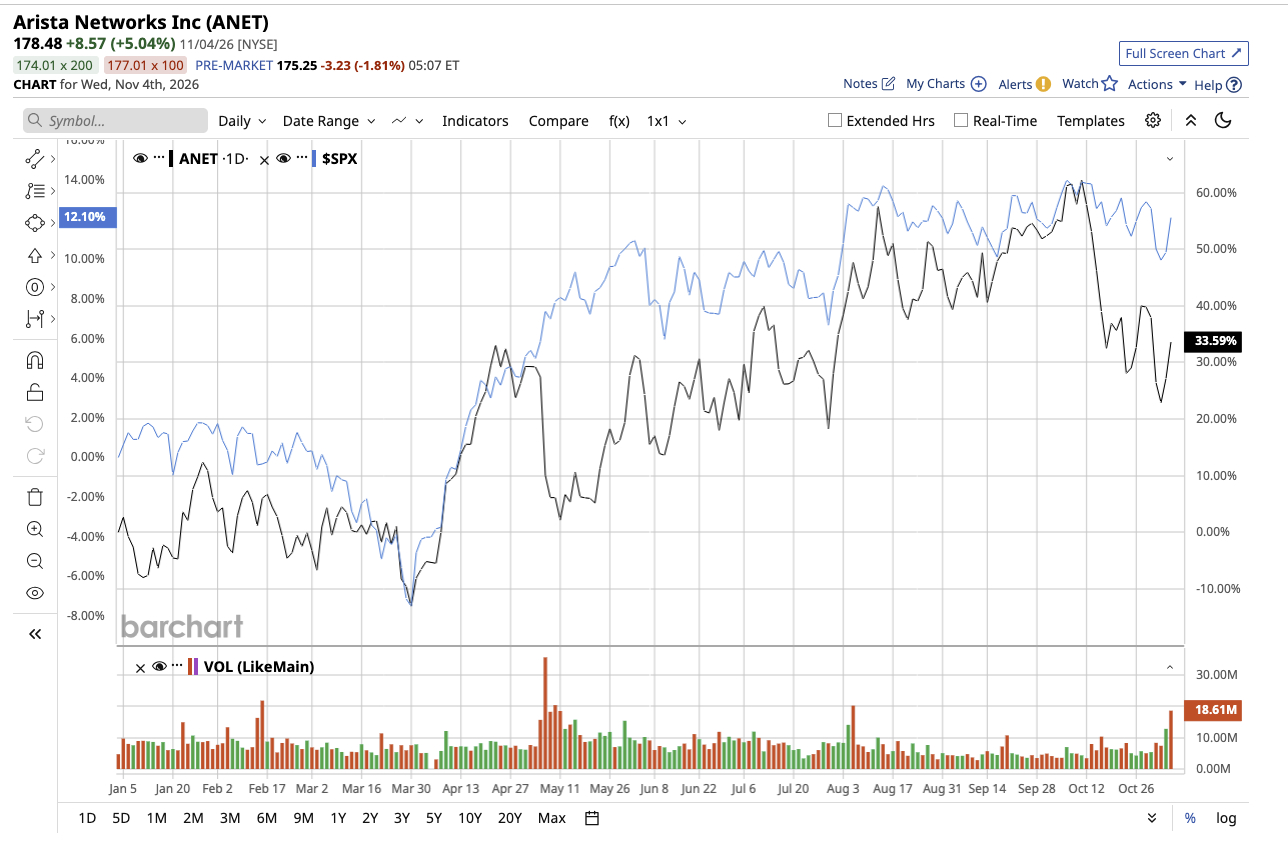
Arista stock jumped 5% on Nov. 4, following the Q3 earnings release, and is now up 34% year-to-date. Yet, Wall Street sees the stock skyrocketing another 70% from here. Could the $200 billion AI opportunity be the catalyst that sends the stock soaring?
AI Needs Powerful Networks, and Arista Has the Answer
The AI infrastructure boom is often discussed through the lens of Nvidia (NVDA) GPUs, advanced processors, and increasingly expensive data centers. However, networking, which is a key factor, gets overlooked. AI workloads need huge amounts of data to move between processors, storage, and servers. The bigger these AI systems become, the more critical it is to transfer information between processors without delays or bottlenecks.
Arista offers high-performance networking equipment and software that connect data centers, cloud setups, and enterprise networks. Its Ethernet-based platforms help customers handle traffic in more complex computing environments.
In the third quarter, revenue soared to $3.66 billion, marking a remarkable 58.5% year-over-year surge and a 20.5% sequential jump, easily surpassing management's $3.3 billion forecast. Product revenue jumped to $3.19 billion from $1.91 billion a year ago. In comparison, services revenue rose to $467.6 million from $396.6 million. This notable growth highlights solid demand from both AI infrastructure clients and enterprises keen to upgrade their networks.
The bottom line dazzled as well. Adjusted operating margin jumped up to 49.1% from 48.6% a year earlier, while adjusted diluted earnings per share rose 55.8% to $1.20 from $0.77, stressing how robust revenue gains are fueling even greater profitability. Both sales and earnings beat the consensus estimates.
Yet Arista's vision stretches far beyond this quarter. Management now projects its AI fabrics business will reach around $7 billion in 2027, doubling the $3.5 billion goal set for 2026. The Etherlink portfolio has already attracted over 100 customers, a dramatic jump from the mere handful of customers Arista had when it first entered the AI networking arena. Management also predicts that AI deployments powered by its networking platforms will surpass 10 gigawatts across at least 10 accelerator types by the close of 2027.
Meanwhile, the cognitive campus business, focused on enterprise networking, is on track to hit $2 billion in 2027, a solid 60% jump over its $1.25 billion target for 2026. Recent customer wins in healthcare, hospitality, and cloud services show that Arista's growth potential extends well beyond hyperscalers building AI data centers.
A $200 Billion Opportunity Is Taking Shape
Arista CEO Jayshree Ullal envisions the company riding a powerful wave of networking demand. On the Q3 earnings call, she projected that Arista’s total accessible market could soar past $200 billion by 2030, unlocking years of growth ahead. This vast opportunity stretches across AI, data centers, campus networking, and a range of other infrastructure markets.
Investors should note that Arista is not saying it will make $200 billion in revenue.
Rather, management believes the addressable spending pool for its products and solutions is expanding considerably. As AI adoption spreads beyond a handful of hyperscalers, demand could come from a wider range of customers building infrastructure for training and inference workloads. Ullal also spotlighted a key industry transformation. Rather than sticking with rigid, proprietary computing systems, customers are gravitating toward open networking architectures that welcome a variety of processors and accelerators. Arista’s Ethernet-based strategy stands to benefit from this shift, especially as customers favor flexibility in building large AI clusters.
Management Just Raised the Bar for 2027
Arista has once again lifted its 2026 revenue forecast, marking the fourth upward revision this year. Management now expects revenue to reach about $13.3 billion, an impressive 48% annual growth. Looking further ahead, the initial 2027 outlook points to around $18.5 billion in revenue, pointing to another year of robust 38% to 40% growth. Analysts think Arista’s earnings will jump 45.7% in 2027 and then rise another 24.3% in 2028.
For the fourth quarter, Arista expects revenue between $3.9 billion and $4 billion. The company also projects adjusted operating margins of 48% to 49% and diluted earnings per share between $1.26 and $1.30. These projections reveal management’s confidence that strong demand will carry forward beyond this quarter. Still, retaining this growth will depend on continued customer investment, sufficient component supply, and successful new product launches.
Investors still need to watch out for a few risks. The networking market is highly competitive, with big players like Cisco (CSCO) and Hewlett Packard Enterprise (HPE) fighting for leadership among data center and enterprise customers. Arista’s main challenge is to make its products stand out and win important AI infrastructure contracts. Supply shortages make things even more complicated. Management has acknowledged these shortages and pointed out that Arista is investing heavily to get the parts it needs. Inventory jumped to $3.2 billion from $2.5 billion last quarter, and purchase commitments rose to $11.4 billion from $9.7 billion. These steps help the company prepare for future demand, but they also require careful monitoring.
Can Arista Stock Deliver Another Big Rally?
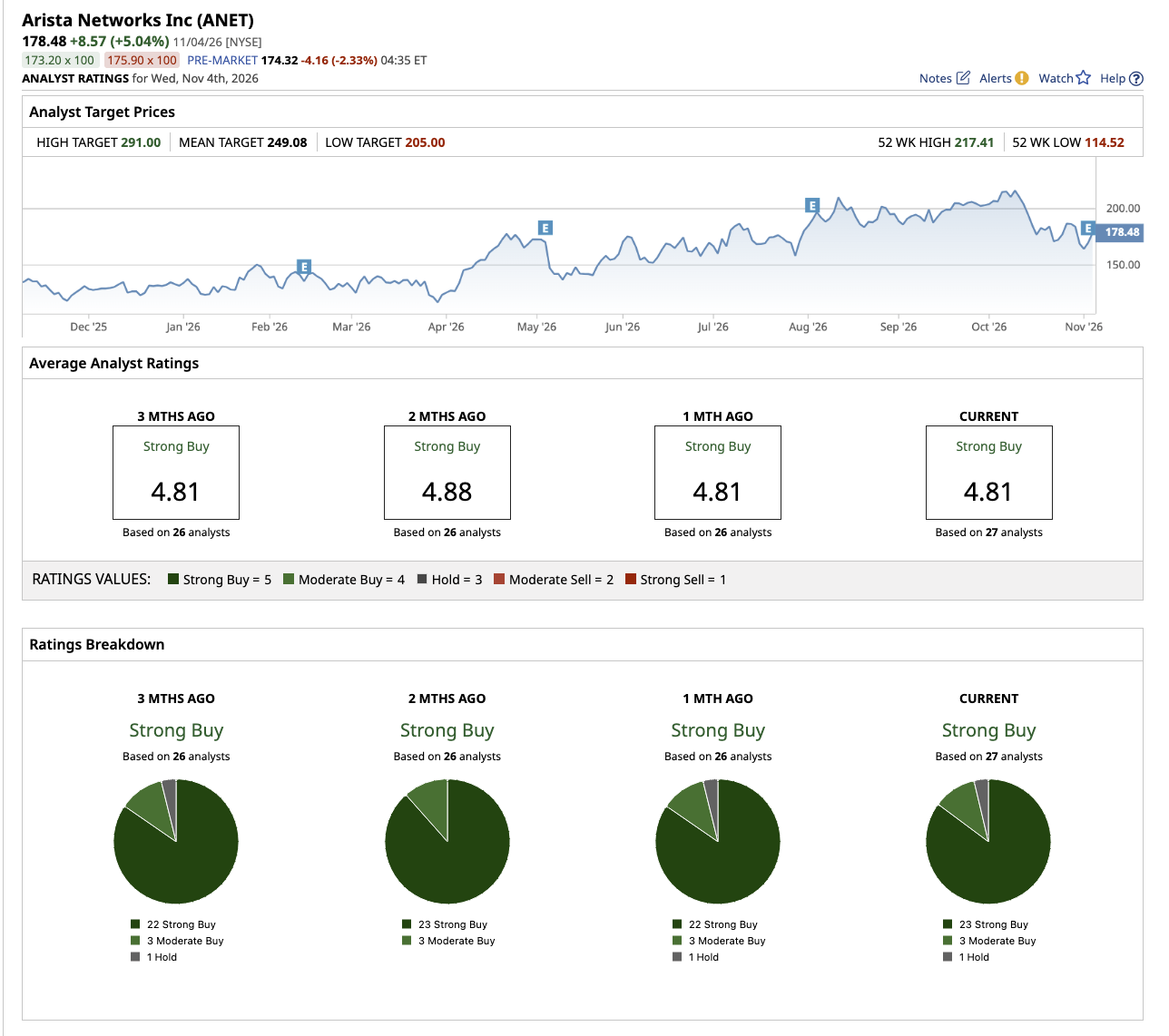
Arista’s Q3 results showed several factors working in its favor, including accelerating AI networking demand, a rapidly growing enterprise business, and management setting its sights ever higher with bold revenue projections. On top of that, a massive addressable market of over $200 billion ensures long-term potential that reaches far beyond the current AI investment surge. Following Arista's strong Q3 results and upbeat 2027 outlook, several Wall Street firms raised their price targets. UBS lifted its target to $291 from $259, while JPMorgan increased its target to $270 from $250. Piper Sandler raised its target to $261 from $240, and Morgan Stanley moved its target to $230 from $220.
Melius Research was even more bullish, raising its target to $305 from $275 on Nov. 4, citing strong growth prospects and improving demand visibility. This high price estimate of $305 hints at a potential 70.8% surge from current levels. Should Arista keep up its impressive growth streak, reaching these targets seems possible.
Overall, Wall Street rates Arista stock a “Strong Buy.” Out of the 27 analysts covering Arista stock, 23 have a “Strong Buy” recommendation, three rate it a “Moderate Buy,” and one suggests it’s a “Hold.”
On the date of publication, Sushree Mohanty did not directly have a position in any of the securities mentioned in this article. All information and data in this article is solely for informational purposes. For more information please view the Barchart Disclosure Policy here.