


EN
Is Liver Disease Trial Success Altering The Investment Case For Gilead Stock (GILD)?
- Gilead Sciences reported detailed Phase 3 IDEAL data showing Livdelzi helped a majority of primary biliary cholangitis patients reach the alkaline phosphatase normalization composite endpoint. HIV Glasgow 2026 presentations also highlighted twice-yearly lenacapavir and other programs across prevention, treatment and cure research.
- Together, the Livdelzi and lenacapavir updates highlight how Gilead Sciences is trying to broaden revenue sources beyond core HIV regimens into liver disease and long acting prevention, while still carrying meaningful safety, pricing and market access considerations.
- We will look at how Gilead Sciences’ investment narrative is influenced by Livdelzi’s Phase 3 success in primary biliary cholangitis.
Gilead Sciences Investment Narrative Recap
To own Gilead Sciences, you need to believe the HIV engine can stay resilient while newer areas like liver disease and oncology steadily carry more of the load. The recent Livdelzi IDEAL data and HIV Glasgow line up both speak to that goal, but the near term story is still shaped by earnings volatility, high debt and acquired R&D charges that keep GAAP results in loss territory.
The most important short term catalysts revolve around execution in HIV long acting prevention and treatment, plus how quickly Livdelzi usage can build within its current label. Key near term risks remain pricing pressure on core HIV regimens, the firm’s heavy dependence on that franchise and the possibility that newer programs scale more slowly than hoped. If investors judge the latest data as incremental rather than transformative, the impact on those near term drivers may be modest.
The Livdelzi IDEAL readout looks most relevant for this discussion. Gilead Sciences now has detailed Phase 3 evidence that 75.4% of treated PBC patients in the trial achieved the ALP normalization composite endpoint at Week 52 versus 16.1% on placebo, with a safety profile described as consistent with prior studies. For an investor, that expands the clinical backbone behind an emerging liver portfolio that sits alongside HIV and oncology as a potential third business leg.
Momentum in liver disease does not erase the execution risk flagged by analysts around diversification. Livdelzi carries real world constraints, from safety monitoring for transaminase elevations, fractures and cirrhosis to drug interaction management and reimbursement work in markets like Canada. The opportunity is that solid late stage data and ongoing regulatory dialogue gradually broaden physician confidence and label scope. That would support the narrative that Gilead Sciences can add meaningful non HIV revenue rather than relying on price or mix in established products.
Gilead Sciences’ analyst narrative points to revenues of US$36.4b and earnings of US$11.8b by 2029, based on an assumed 5.6% yearly revenue growth rate and an earnings swing of US$15.7b from a current loss of US$3.9b to that forecast profit level.
Uncover why Gilead Sciences' fair value indicates Gilead Sciences is roughly in line with its current price.
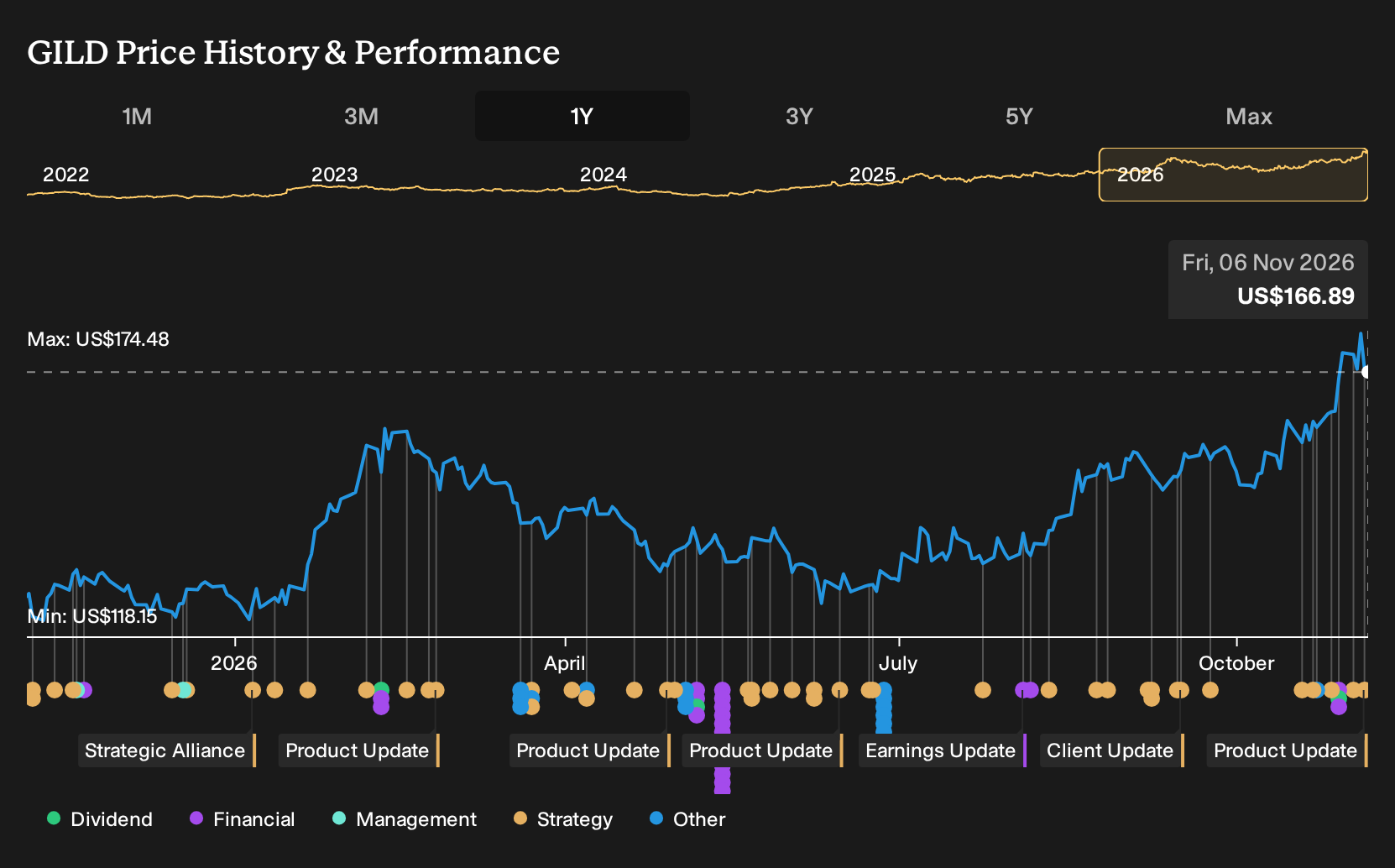
Exploring Other Perspectives
Some bullish analysts focus on HIV instead of liver disease. They were already pencilling in revenue of US$39.2b and earnings of US$18.8b by 2029 for Gilead Sciences, which is far more optimistic than the US$36.4b and US$11.8b consensus view. After the Livdelzi IDEAL data, those contrasting stories could shift again.
Explore 5 other Gilead Sciences fair value estimates, including one that suggests as much as 88% potential upside from the current price.
Decide For Yourself
Don't just follow the ticker. Dig into the data and build a conviction that's truly your own.
- A great starting point for your Gilead Sciences research is our analysis highlighting 3 key rewards and 2 important warning signs that could impact your investment decision.
- See our latest analysis for Gilead Sciences. The report includes a comprehensive fundamental analysis summarized in a single visual, the Snowflake, making it easy to evaluate Gilead Sciences' overall financial health at a glance.
Looking For More Ideas Beyond Gilead Sciences?
If the Gilead Sciences story has you thinking about where else durable cash flows and clear balance sheets might show up, the Simply Wall St Screener can help you widen the field quickly without losing focus on quality.
- For investors who want quality and value working together, scan a curated 38 high quality undervalued stocks that blend strong fundamentals with prices that may not fully reflect them yet.
- If capital preservation and steadier profiles matter most to you, focus on a 31 resilient stocks with low risk scores that filters for businesses with more resilient risk scores.
- When you care about financial strength first and everything else second, zero in on a list of solid balance sheet and fundamentals (25 results) to find companies with cleaner leverage and more robust fundamentals.
Have feedback on this article? Concerned about the content? Get in touch with us directly. Alternatively, email editorial-team@simplywallst.com