


EN
Why Mastercard Stock Could Benefit From the AI Banking Crackdown
AI agents are knocking on the door of regulated finance, and banks are slamming it shut. That clash between automation and control is quietly reshaping how money moves, who earns fees, and which listed payment and brokerage stocks feel the pressure or find a tailwind. This article walks through three stocks exposed to that AI banking crackdown and explains how the same news could help or hurt your portfolio decisions.
The three stocks below are just a sample of how regulated payment networks and custodians are reacting to AI agents, while the full screen surfaced 37 more listed businesses with equally detailed stories that are not covered here. If you want to identify where this AI banking crackdown could create durable winners or pressure points, head straight into the Regulated Payment Networks and Retail Brokerage Custodians screener to filter and analyze the highest conviction ideas.
Mastercard (MA)
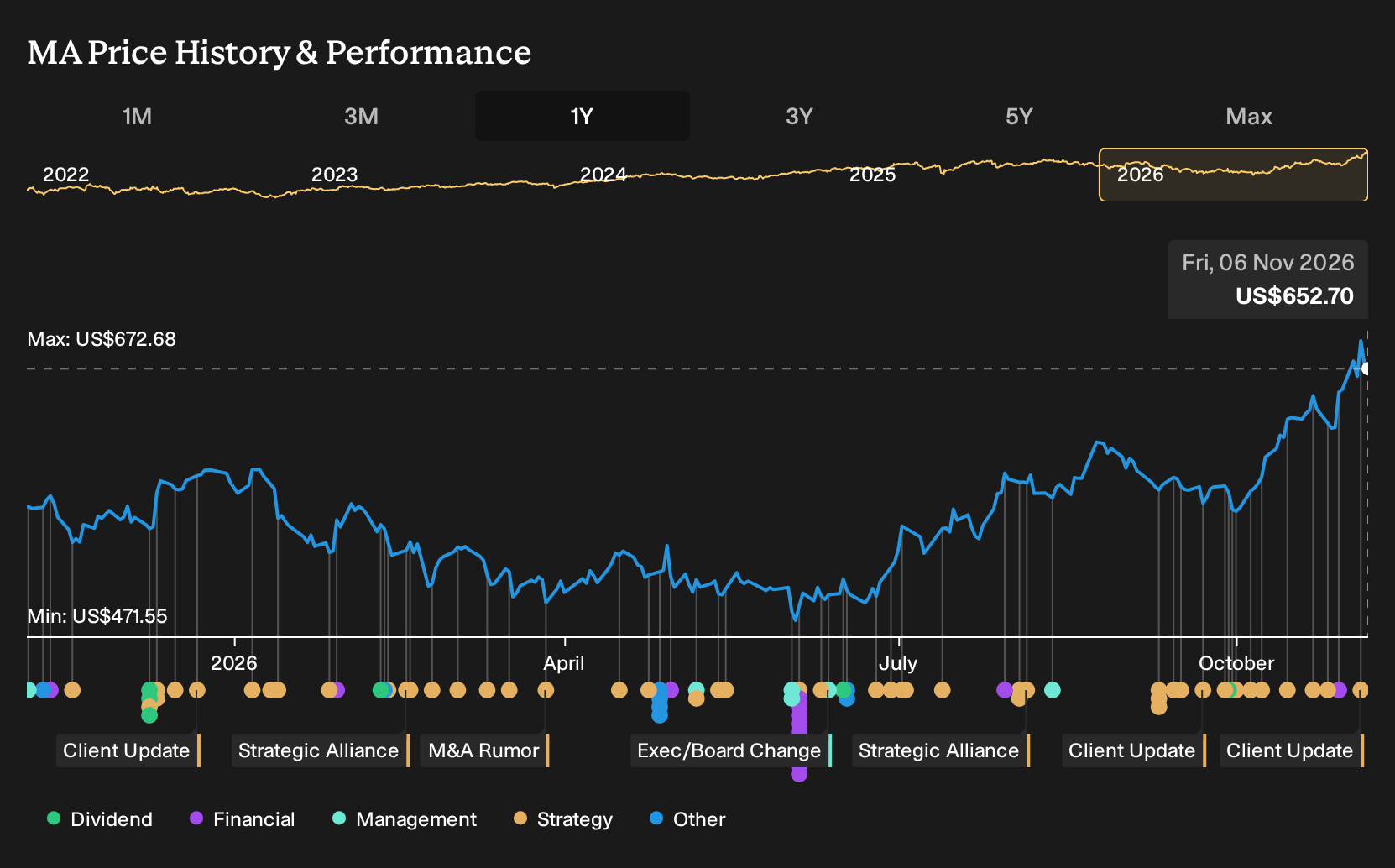
Mastercard is one of the clearest examples in this screener of how regulated payment rails can benefit when banks keep tight control over who moves customer money, especially as AI agents are pushed to the sidelines and transactions stay on supervised card networks.
Mastercard generates about US$36.3b in Payment Solutions revenue, largely from taking a small fee on each transaction across its network, and carries a market value of roughly US$568.6b.
"Whether that becomes a meaningful new revenue stream or just defends the existing one, it argues for the moat holding rather than eroding, and gives the company a second growth story to lean on if card volumes ever slow."
What happens to Mastercard’s pricing power and service margins if a single key assumption about how AI interacts with regulated rails eventually breaks?
If that assumption ever cracks, read the full narrative for Mastercard to see how Mastercard’s moat, pricing power and AI opportunity set could be quietly decoupling from the headline story.
Paysafe (PSFE)
Paysafe plugs directly into the screener theme by handling regulated digital payments for merchants and wallets rather than handing control to free roaming AI agents. This keeps its economics closely tied to transaction volumes across its two core franchises.
Paysafe runs two main engines: Merchant Solutions, which produced about US$932 million in sales from card acquiring and processing, and Digital Wallets, which added roughly US$848.7 million. That regulated volume driven profile sits on a compact US$348.8 million market cap.
Paysafe matters here because its digital wallets and alternative payment rails sit inside banked, regulated flows, which could benefit when large institutions restrict direct AI access to customer accounts.
"Rapid expansion of new products and digital wallet solutions, now including PaysafeWallet coverage across all euro-area markets and Poland together with continued growth in Latin America users, extends Paysafe’s reach into higher usage regions and can support future transaction volumes and revenue."
What really moves the needle for Paysafe from here depends on how one tight financial pressure plays out against that growing wallet reach.
That cross current is exactly why reading the full narrative for Paysafe can clarify whether Paysafe is quietly setting up for accelerating wallet economics or just masking deeper strain.

WEX (WEX)
WEX runs a regulated payments and benefits platform that plugs directly into the screener theme, because its fuel cards, corporate payments and health accounts all ride on controlled transaction rails where banks and regulators still set the rules for how money moves.
WEX generates about US$1.5b from Mobility, US$834.7 million from Benefits and US$498.5 million from Corporate Payments, and the business carries a roughly US$6 billion market value.
For investors watching how AI is being pulled into on rails payments rather than left roaming in bank accounts, WEX offers a clear test case of whether smarter software on tightly controlled networks can turn regulation from a hurdle into a tailwind.
"Expanding investments in product innovation and AI based tools, including the claims automation engine that now processes over 600,000 FSA claims with 95% accuracy and the SecureFuel fraud product that screens transactions across roughly 95% of U.S. fuel stations, point to an ongoing shift toward higher value software and data services that can support margin expansion and earnings growth."
What could matter most for WEX from here is how one quiet shift in where it earns each incremental dollar affects both pricing power and resilience.
That quiet shift is exactly what the full narrative for WEX lays out, showing where WEX’s regulated payments engine could be accelerating or quietly stalling next.

Curious About Alternative Market Opportunities
Fresh ideas move first, and slower money often gets caught chasing momentum after prices start flying. Scan these under the radar lists before the crowd moves in and act now.
- Spot powerful income streams before yields get compressed by late buyers and review the 7 dividend fortresses while the strongest payers are still under the radar for now.
- Track where real earnings power meets AI momentum and scan the 40 profitable AI stocks that aren't just burning cash before valuations fully reflect that mix of cash flow and growth potential.
- Pinpoint resilient balance sheets before stress tests become headlines and work through the list of solid balance sheet and fundamentals (25 results) while credit conditions still reward stronger fundamentals.
Have feedback on this article? Concerned about the content? Get in touch with us directly. Alternatively, email editorial-team@simplywallst.com