


EN
Learn Why The Bull Case For Nasdaq (NDAQ) Could Change Following Board Reshuffle
- Nasdaq appointed Andrew Murray as Senior Vice President for Financial Technology in Asia-Pacific and added former Ericsson CEO Börje Ekholm to its Board, while Holden Spaht plans to step down at the end of 2026.
- These leadership moves concentrate senior decision makers in Singapore and restore Ekholm’s prior board influence, which could reshape how Nasdaq prioritizes technology spending, risk oversight and capital allocation across regions.
- We will now look at how Nasdaq's investment narrative could shift as Ekholm rejoins the board and Asia-Pacific leadership deepens.
Nasdaq Investment Narrative Recap
To own Nasdaq, investors need to believe it can keep turning its exchange footprint, data franchises and Financial Technology platforms into durable recurring revenue while managing a higher cost base. In the short term, the key swing factor is execution on AI, financial crime tools and tokenization projects, where client adoption and pricing need to support the existing spend.
The main risk remains that operating expenses, already guided higher to US$2.530b to US$2.570b, continue to rise faster than revenue. That would squeeze margins just as some models flag the stock as expensive, which could matter if earnings growth or returns on new projects fall short of expectations.
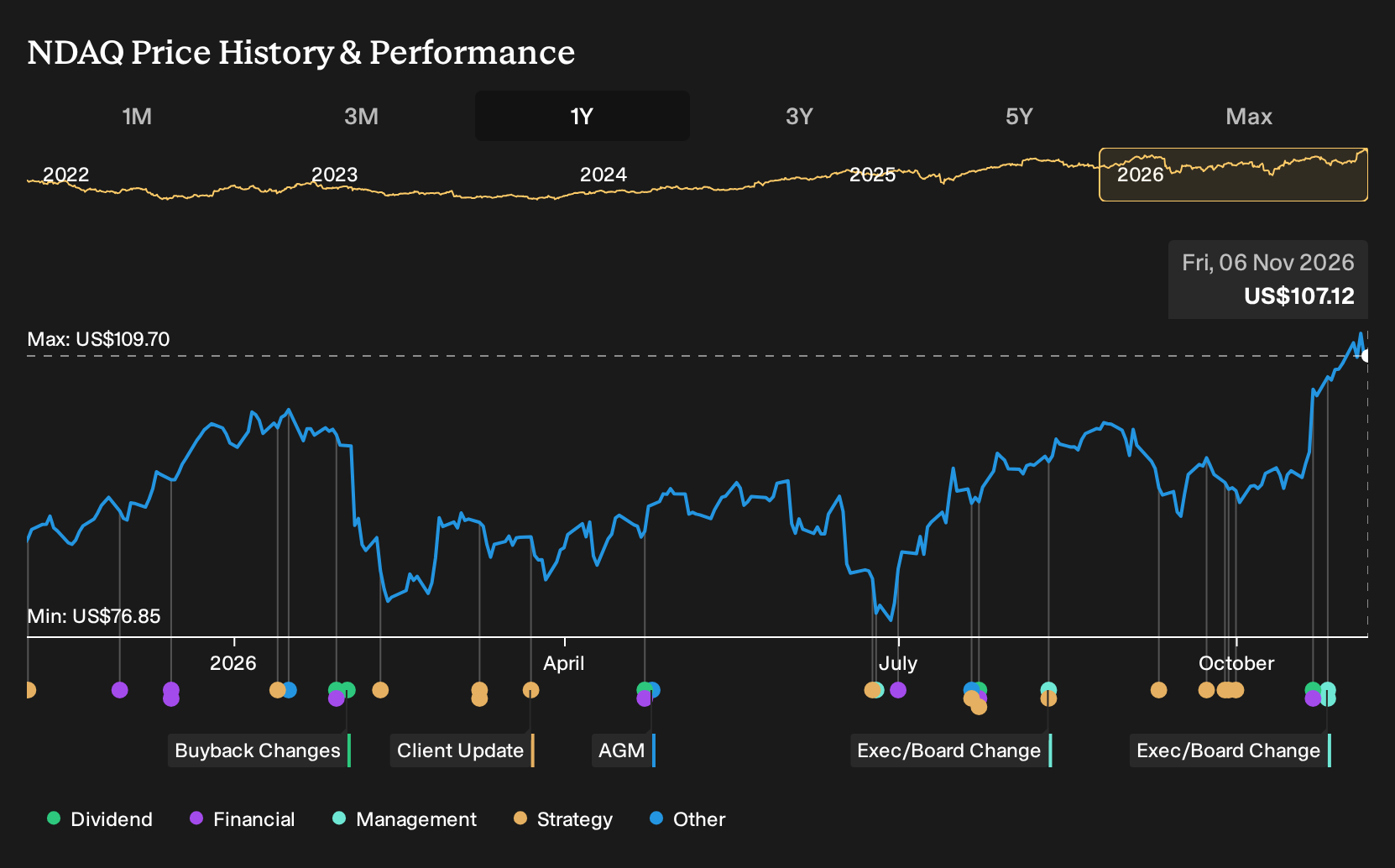
The appointment of Börje Ekholm to Nasdaq’s board, and his role on the Audit & Risk Committee, is the announcement that ties closest to the current debate about capital allocation and valuation. Investors are watching how a board with deep telecom and infrastructure experience oversees investments in 23/5 trading, AI platforms and tokenized collateral.
This board change sits alongside existing catalysts such as Verafin’s AI driven growth, AxiomSL’s cloud uptake and the broader Financial Technology division’s expansion. Execution on these products, combined with disciplined spending and use of free cash flow, will likely shape whether Nasdaq can justify any premium to estimated intrinsic value over time.
Nasdaq's current analyst storyline points to revenues of US$7.3b and earnings of US$2.6b by 2029, based on an assumed 8.2% yearly revenue growth rate and an earnings increase of about US$500m from US$2.1b today to the US$2.6b forecast.
Uncover why Nasdaq's fair value indicates a 7% potential upside to its current price that could narrow quickly.
Exploring Other Perspectives
Five fair value estimates from the Simply Wall St Community cluster between about US$90.75 and US$114.25, which shows how wide Nasdaq opinion can run among private investors. When you set those views against rising spend on AI platforms, tokenized collateral and Asia-Pacific expansion, you get very different takes on how current pricing reflects execution risk. Readers should test several of these viewpoints before deciding how Nasdaq fits their own thesis.
Explore 4 other Nasdaq fair value estimates, including one that suggests as much as 7% upside from the current price.
Reach Your Own Conclusion
Disagree with existing narratives? Extraordinary investment returns rarely come from following the herd, so go with your instincts.
- A great starting point for your Nasdaq research is our analysis highlighting 3 key rewards and 2 important warning signs that could impact your investment decision.
- See our latest analysis for Nasdaq. The report includes a comprehensive fundamental analysis summarized in a single visual, the Snowflake, making it easy to evaluate Nasdaq's overall financial health at a glance.
Looking for more investment ideas beyond Nasdaq?
Once you have a view on Nasdaq, it can help to compare it with other opportunities that line up with your own risk tolerance, income needs and time horizon. The Simply Wall St Screener lets you quickly filter the market using fundamentals so you can build a watchlist that actually reflects how you like to invest.
- If capital preservation sits high on your priority list, start with a group of companies that have resilient balance sheets and dependable fundamentals through our list of solid balance sheet and fundamentals (25 results).
- For readers hunting for mispriced opportunities, consider a curated set of companies that combine stronger fundamentals with valuations that look more modest using the 38 high quality undervalued stocks.
- If income is a key part of your plan, focus on businesses with higher yields that still aim for stability by scanning the 7 dividend fortresses.
Have feedback on this article? Concerned about the content? Get in touch with us directly. Alternatively, email editorial-team@simplywallst.com