


EN
Learn Why The Bull Case For Flex (FLEX) Could Change Following Raised Revenue Guidance
- Flex Ltd. reported second quarter sales of US$8.491b and net income of US$263m, with diluted EPS from continuing operations at US$0.70. The company also reported higher figures for the first half of fiscal 2027 compared with the same period a year earlier.
- The company raised its full year fiscal 2027 net sales outlook to a range of US$34.9b to US$35.9b, indicating that management currently expects firmer demand than previously assumed across its manufacturing and services programs.
- This article will examine how Flex's raised full year revenue guidance may influence the investment narrative focused on margins, cash flow and AI.
Compare how Flex's earnings guidance and AI ambitions stack up against other manufacturing and automation plays by scanning our curated list of 90 robotics and automation stocks.
Flex Investment Narrative Recap
To own Flex, you need to believe that its heavier tilt into AI infrastructure, higher value manufacturing and automation can support better margins and cash generation over time, without stretching the balance sheet. The latest quarter, with higher sales and earnings year on year, keeps that thesis intact and supports management’s confidence in the operating plan.
The raised full year revenue outlook and Q3 sales guidance put the near term spotlight on execution in Cloud and Power Infrastructure and on integrating EPC Power, while capital spending remains high. The most immediate risk is that AI related demand or large customer programs become choppy, which would pressure utilization, margins and free cash flow conversion.
The updated fiscal 2027 outlook for net sales of US$34.9b to US$35.9b, up from US$33.7b to US$35.2b, is the clearest near term marker for your thesis. It indicates that Flex is still planning around strong workloads in data center and power, even as it works through a capital intensive build out for AI manufacturing and grid tied hardware.
For catalysts, that higher sales range ties directly into the planned spin off of the Cloud and Power Infrastructure segment and the integration of EPC Power. If Flex delivers on the top line while holding discipline on separation costs and capex, the story around margin mix, AI exposure and future balance sheet flexibility becomes cleaner. If it stumbles, the same moving pieces become the main operational risk.
Flex's narrative assumes revenues reach US$62.3b and earnings climb to US$5.2b by 2029, which represents 26.3% yearly top line growth and an earnings increase of about US$4.2b from roughly US$1.0b today.
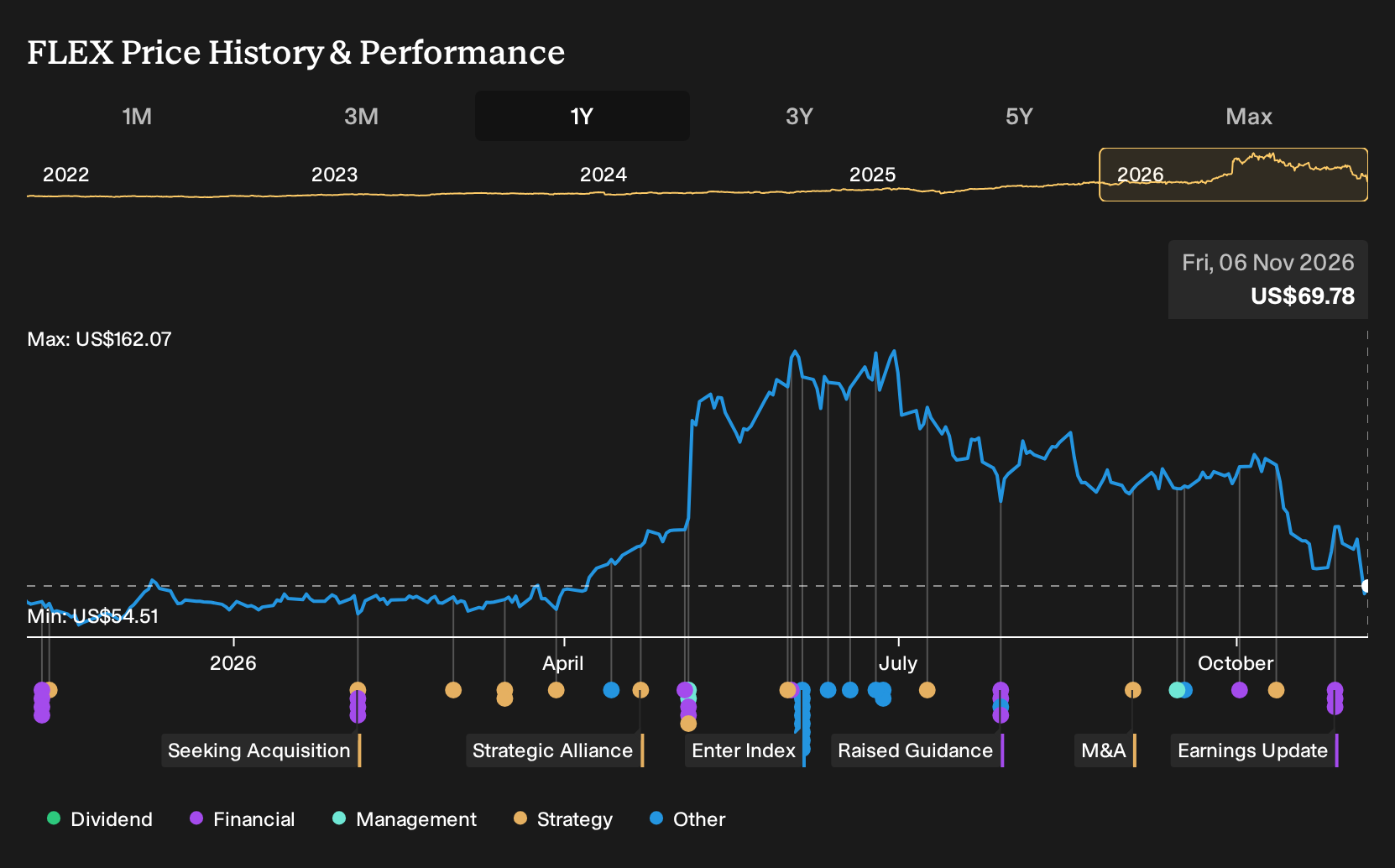
Uncover why Flex's fair value indicates a 124% potential upside to its current price that may not last much longer.
Exploring Other Perspectives
One alternate view says the real swing factor is free cash flow, not Flex’s higher revenue guidance. Before this earnings release, the most cautious analysts were still modeling revenue of about US$58.4b and earnings near US$5.6b by 2029, but only on an 11.5x P/E. That points to a much more skeptical story about how AI spending and the Axiom spin might ultimately translate into cash. You can treat this quarter’s raised outlook as a potential trigger for those forecasts to shift, then explore which narrative you find more convincing.
Explore 5 other Flex fair value estimates, including one that suggests it could be worth just $128.00!
The Verdict Is Yours
Don't just follow the ticker; dig into the data and build a conviction that's truly your own.
- A great starting point for your Flex research is our analysis highlighting 4 key rewards and 1 important warning sign that could impact your investment decision.
- See our latest analysis for Flex. The report includes a comprehensive fundamental analysis summarized in a single visual, the Snowflake, making it easy to evaluate Flex's overall financial health at a glance.
Looking For More Investment Ideas Beyond Flex?
If Flex has sharpened your interest in how different businesses turn guidance, capital spending and cash flow into long term value, it can help to set it alongside a wider watchlist built from clear, rules based screeners.
- For readers who want potential mispricing combined with quality fundamentals, start with a curated set of 36 high quality undervalued stocks that already clear basic balance sheet and cash flow checks.
- If resilience matters more to you than excitement, focus on businesses screened for sturdier finances using a list of solid balance sheet and fundamentals (25 results) that can handle tougher conditions without stressing their capital structure.
- Income focused investors can zero in on cash return potential by scanning 7 dividend fortresses that pair 5%+ yields with an emphasis on stability and sustainability.
Have feedback on this article? Concerned about the content? Get in touch with us directly. Alternatively, email editorial-team@simplywallst.com