


EN
Harley Davidson (HOG) Stock Looks Fully Valued After Its 58% Run
Harley-Davidson has ridden to a much higher share price this year, and that kind of move naturally prompts the question of whether the current valuation is still grounded in its sales base. With the brand in the spotlight after mixed recent results and fresh decisions around its electric business, the link between revenue and market value matters more than ever.
- The stock is up 58.2% year to date, which puts real pressure on the question of whether the current price can still be explained by what Harley-Davidson generates in sales.
- Recent news around lower reported revenue alongside growth in retail unit volumes and reduced dealer inventories can shape how investors think about the durability and profitability of Harley-Davidson's future sales stream.
- Your read on Harley-Davidson is one view; the desks covering it have another. See what analysts think Harley-Davidson's shares could be worth.
The stock's next move may depend on whether Harley-Davidson's current share price can be squared with the level and quality of sales the business is producing today.
If you are weighing Harley-Davidson at 58.2% year to date and want a wider set of ideas built on similar discipline, start a comparison list with companies in the solid balance sheet and fundamentals stocks screener (24 results) list.
Has Harley-Davidson Run Too Far on Sales?
P/S is a useful lens for Harley-Davidson because investors are weighing how much value the market puts on each dollar of motorcycle and related revenue while earnings swing around restructuring choices.
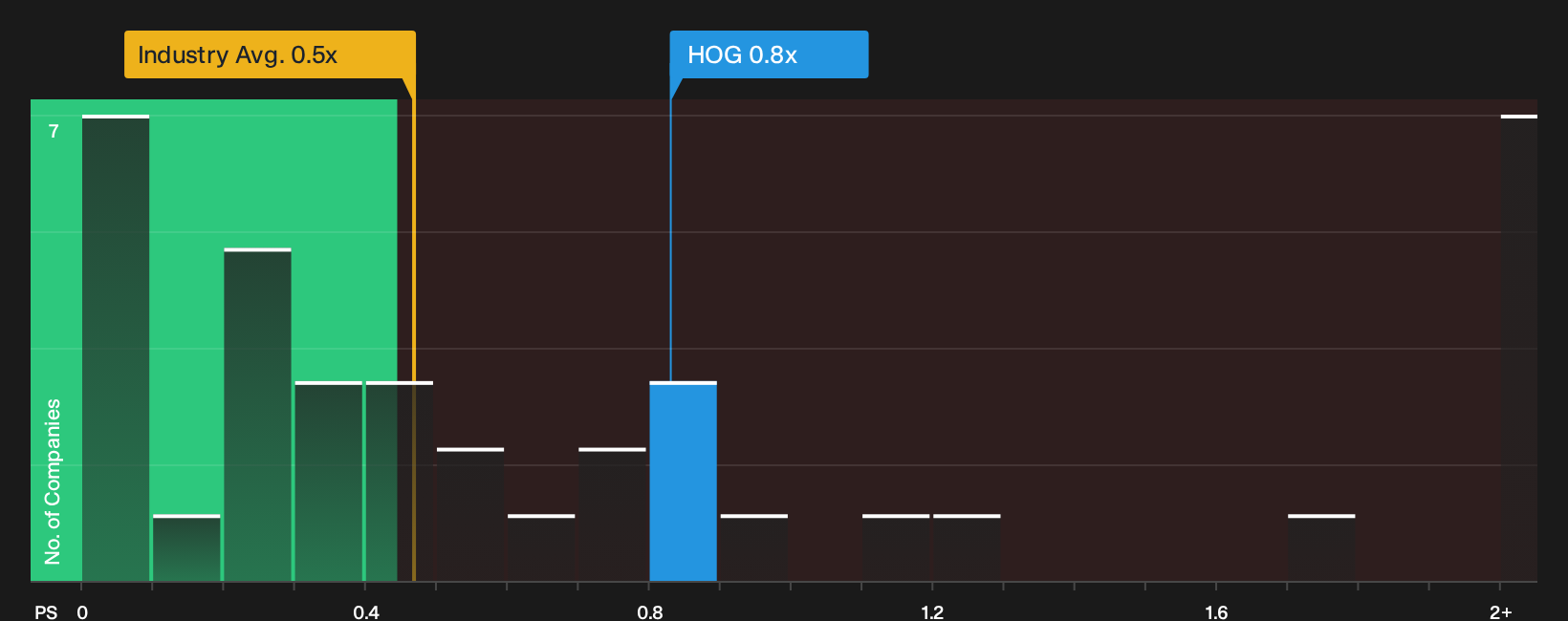
On this measure, Harley-Davidson trades at a P/S of 0.8x, compared with an Auto industry average of about 0.5x and a peer group average of roughly 1.0x. The tailored fair multiple points to a lower ratio than the market is currently paying, so the stock screens overvalued on this sales based yardstick. Because the fair figure already bakes in factors like the group’s margins, growth profile, size and risk, the current premium suggests investors are paying up for Harley-Davidson’s brand, product mix and perceived resilience of its revenue base.
Despite the recent Q3 2026 revenue miss and margin pressure, the P/S multiple still reflects a valuation that leans rich relative to what comparable Auto businesses fetch for their sales. That sets the bar higher for future reported revenues to justify the pricing implied by today’s P/S tag. Explore the numbers behind Harley-Davidson's P/S valuation.
The Harley-Davidson Narrative: What Would Justify Today's Price?
Simply Wall St Narratives pick up where Harley-Davidson's valuation puzzle leaves off by spelling out which combinations of future growth, margins and earnings would line up with a meaningfully higher or lower share price than today. Each one links its headline number to a clear view on how Harley-Davidson's revenue mix, profitability and risk profile might evolve, giving you a reference point you can revisit as new information comes through.
Harley-Davidson investors are essentially weighing one upbeat turnaround script against a more restrained read on how much progress is already in the share price.
Bull case: 12% undervalued
"The plan to re-enter key accessible segments with Sprint shipping in late 2026 and the Sportster 883 returning in 2027, tied to what management describes as a historically large mid-capacity market, gives Harley-Davidson a path to rebuild unit volume and related revenue beyond what current guidance sets out…"
Discover why this Narrative puts Harley-Davidson at 12% undervalued.
Bear case: 10% overvalued
"Tariffs remain a direct pressure on Harley-Davidson earnings, with new or increased charges of US$45 million in Q1 2026 and US$22 million in Q2 2026 and full year incremental costs for 2026 still guided at US$75 million to US$90 million versus 2024, which could continue to compress gross margin and operating margin and limit net income…"
Explore why this Narrative puts Harley-Davidson at 10% overvalued.
One more Harley-Davidson piece to check before you move on
Before you act on where Harley-Davidson trades today, it can help to see how professional analysts map out its earnings and revenue profile over the next few years, then compare that view with the current market price. Explore where analysts expect Harley-Davidson to be in a few years.
Have feedback on this article? Concerned about the content? Get in touch with us directly. Alternatively, email editorial-team@simplywallst.com