


EN
CFO Exit Might Change The Case For Investing In AutoZone Stock (AZO)
- AutoZone reported that its Chief Financial Officer Jamere Jackson resigned effective November 25, 2026, with Vice President and Controller J. Scott Murphy now serving as both principal accounting officer and principal financial officer under U.S. securities regulations.
- The leadership reshuffle lands as AutoZone leans on store generated cash and borrowing to fund sizeable share repurchases, while domestic DIY customers defer spending and trade down on repairs.
- We will now examine how AutoZone's executive reshuffle, including the CFO change, could influence the investment narrative built around earnings growth.
Scan how AutoZone's leadership reshuffle compares with other retailers leaning on buybacks and cash flow strength by reviewing list of solid balance sheet and fundamentals (24 results)
AutoZone Investment Narrative Recap
An investor in AutoZone needs to be comfortable with a story built on store generated cash, heavy use of borrowing, and a business mix that leans more on commercial customers while DIY traffic stays soft. The key short term swing factor is whether deferred DIY repairs stabilize and commercial programs continue to post positive comparable performance that supports earnings per share math built on share repurchases.
The biggest current risk is straightforward. Prolonged pressure on DIY customers, combined with high debt and negative equity, could make ongoing buybacks harder to support at the recent pace. The CFO change appears manageable from an operational perspective and does not materially alter those demand and balance sheet questions in the near term.
The most relevant recent data point is AutoZone’s continued focus on buybacks funded by store cash flow and incremental borrowing. This approach has reduced the diluted share count and supported earnings per share growth in recent years. It also raises the bar on execution in the underlying business, particularly as DIY customers defer purchases and trade down.
That same capital allocation playbook now intersects directly with the finance leadership reshuffle. Investors watching this news are essentially tracking whether cash generation, high single digit commercial growth ambitions, and the Mega Hub rollout remain on track, while capital spending rises and DIY softness and Brazil moderation continue to weigh on operating momentum and valuation multiples.
What The AutoZone Forecasts Assume
Analyst models around AutoZone hang on a relatively tight set of numbers. The consensus blueprint points to revenues of US$24.9b and earnings of US$3.2b by 2029, compared with earnings of US$2.6b today. That path is built on 7.0% yearly revenue growth and an earnings increase of about US$0.6b from current levels.
Uncover why AutoZone's fair value indicates a 16% potential upside to its current price, before that discount to AutoZone closes.
Exploring Other Perspectives
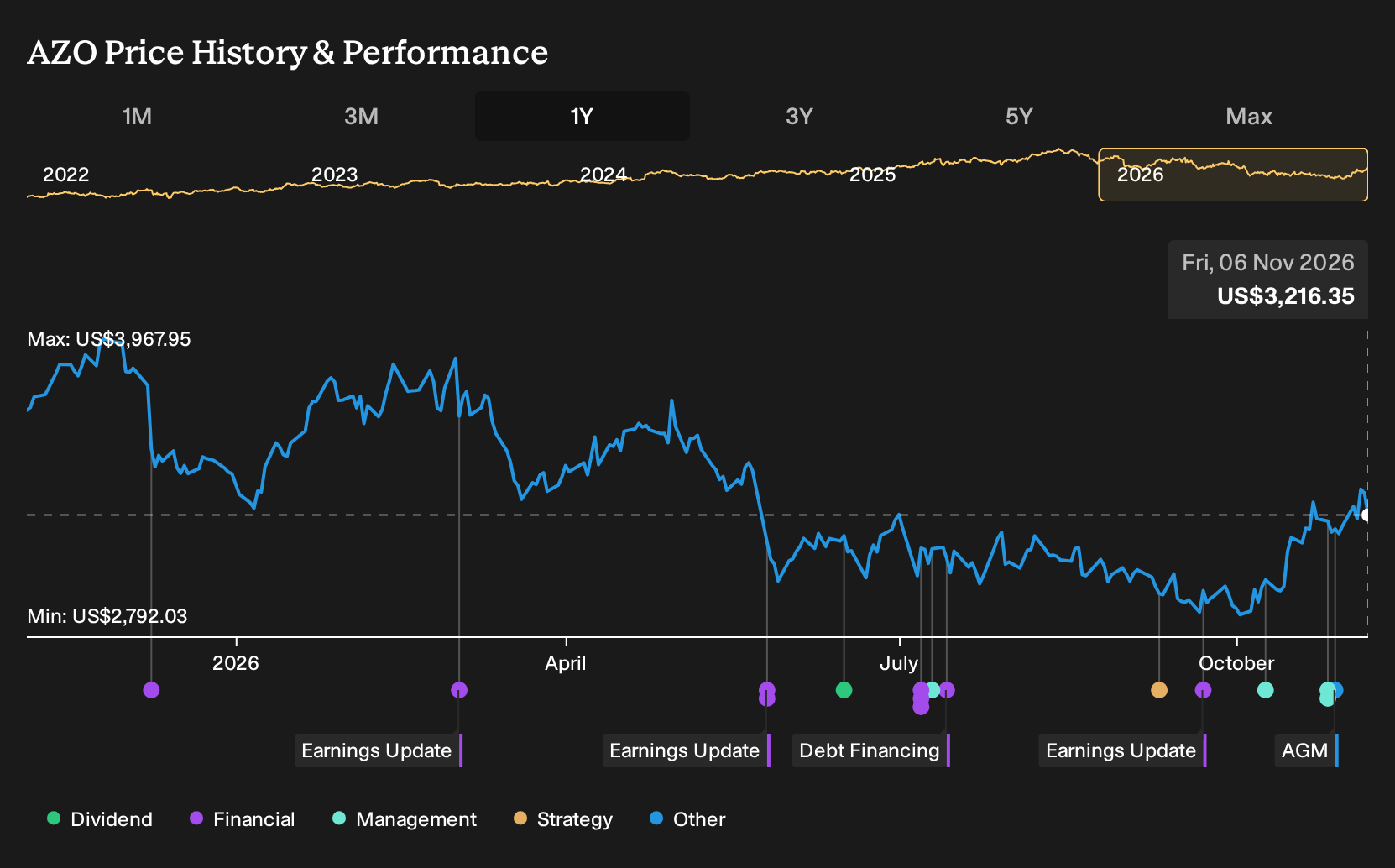
Four fair value estimates from the Simply Wall St Community cluster between US$2,829 and US$3,720, so some retail investors see AutoZone as materially mispriced. These views were set before the CFO transition and the DIY pressure outlined above. This gives you a reason to compare their optimism with current trading, execution risks and capital allocation sensitivities.
Explore 3 other AutoZone fair value estimates, including one that suggests potential upside of as much as 16% from the current price.
Reach Your Own Conclusion
Disagree with existing narratives? Extraordinary investment returns rarely come from following the herd, so rely on your own analysis and judgment.
- A great starting point for your AutoZone research is our analysis highlighting 3 key rewards and 2 important warning signs that could impact your investment decision.
- See our latest analysis for AutoZone. The report includes a comprehensive fundamental analysis summarized in a single visual, the Snowflake, making it easy to evaluate AutoZone's overall financial health at a glance.
Looking For More Ideas Beyond AutoZone?
If the AutoZone story leaves you wanting a broader watchlist, it can help to scan a few structured sets of companies that share clear financial traits rather than trawling ticker by ticker.
- For investors who want potential upside without sacrificing balance sheet quality, start with a focused 19 high quality undiscovered gems that already pass fundamental checks.
- If your priority is capital preservation and steadier profiles, filter for companies in a 29 resilient stocks with low risk scores so you can concentrate on resilience first.
- Income focused investors can zero in on reliable cash generators by reviewing a curated 8 dividend fortresses that offer higher yields with supporting fundamentals.
Have feedback on this article? Concerned about the content? Get in touch with us directly. Alternatively, email editorial-team@simplywallst.com