


EN
Why Michael Burry Says Fiserv Stock Could Surge as Much as 94% From Here
Michael Burry, the legendary investor portrayed in “The Big Short,” made his name by spotting the subprime mortgage bubble in the U.S. housing market before it triggered the 2008 financial crisis. Now, the famed contrarian investor is turning his attention to another beaten-down stock, Fiserv (FISV), a major U.S. payment processor, that could have significant upside potential. While this is not the first time Burry has backed an out-of-favor company, his investment moves tend to attract Wall Street's attention.
In a Nov. 2 Substack post, he suggested that the stock could be worth $100 to $120 per share in a hypothetical buyout scenario, implying a potential upside of roughly 61.2% to 93.4% from current levels as of writing. Burry believes Fiserv's weak share price reflects not just business challenges but also a loss of investor confidence following the previous management's overly ambitious growth targets and inadequate disclosures surrounding the benefits of Argentina's hyperinflation.
Yet, despite Fiserv's recent struggles, Burry continues to hold a full position, seeing its depressed valuation as an opportunity. His bullish thesis points to significant upside in a hypothetical buyout scenario, putting the stock back on investors' radar. So, is Fiserv an overlooked bargain or a risky turnaround bet? Let’s take a closer look.
About Fiserv Stock
Fiserv, founded in 1984 and headquartered in Milwaukee, Wisconsin, is a Fortune 500 financial technology company operating at the intersection of banking and commerce. It provides a wide range of technology solutions to financial institutions and businesses worldwide, spanning digital payments, account processing, digital banking, merchant acquiring, network services, and e-commerce. Its portfolio also includes Clover, an all-in-one platform that enables businesses to manage payments and day-to-day operations.
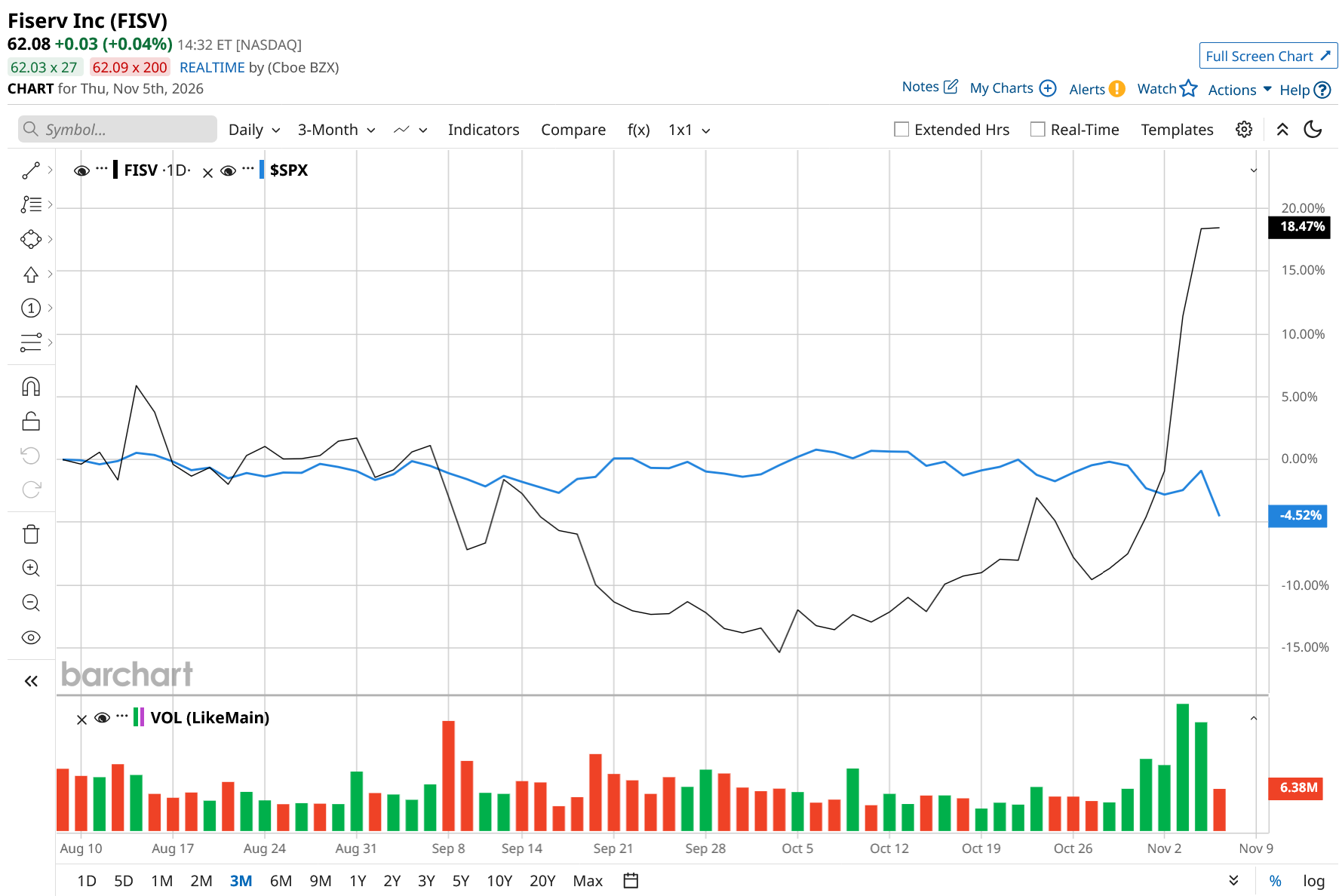
Fiserv, now valued at about $32.99 billion, has spent the past year in a Wall Street storm amid leadership instability, slashed financial guidance, weaker-than-expected segment growth, and margin compression. A new CEO took over in mid-2026, and activist investor Jana Partners is demanding deeper cost cuts, slamming the company’s “serial mis-forecasting and guidance reductions.” The long-term chart still looks grim. Shares are down a little over 69% over the past two years, 3% over the past year, and 7% so far in 2026. But the momentum has flipped.
Michael Burry’s bullish investment thesis put the stock’s depressed valuation back on Wall Street’s radar. Then the latest earnings report added fuel, clearing the low bar analysts had set. The beat came amid cautious analyst sentiment and a mixed broader market. The reaction was explosive. FISV is up 35% in the past month and soared an impressive 28% in just the last five trading sessions, while the S&P 500 Index ($SPX) posted marginal declines over both periods.
Q3 Earnings Snapshot
When Fiserv released its fiscal 2026 third-quarter report on Nov. 3, the bar Wall Street had set was low, and the company cleared it. Investors noticed right away, sending shares up a notable 12.5% the same day. Looking at the numbers, the quarter appeared steady rather than spectacular. GAAP revenue came in at $5.2 billion, down 1% from the third quarter of 2025. Adjusted revenue was $4.85 billion, also down 1% year-over-year (YoY), but right in line with analyst consensus.
Organic revenue was flat, with Merchant Solutions slipping 2% and Financial Solutions growing 2%. The real win came on the bottom line. Adjusted earnings per share landed at $1.75, down from $2.04 in the year-ago quarter, yet ahead of the $1.71 Wall Street had forecast. CEO Takis Georgakopoulos argued that the turnaround is gaining real traction.
He said his team is executing with urgency and pointed to net attrition in banking falling by more than 25% so far this year, major client wins that are now ramping up, steady underlying growth at Clover, and a modern merchant platform that is picking up momentum. The CEO added that as the company simplifies and sharpens its organization with an AI-everywhere mindset, he has growing confidence it can drive greater efficiency while still investing in innovation and delivering differentiated value to clients.
Beyond the headline beat, two announcements amplified the market’s enthusiasm. First, Project Elevate, the comprehensive operational efficiency program, just got twice as big. Management doubled the projected savings to $1 billion from a prior target of $500 million, citing a broader portfolio review and the identification of new cost levers. Second, buybacks are back, and earlier than anyone expected.
Plans call for repurchasing $500 million of common stock in the fourth quarter of 2026, a move management described as reflecting growing confidence in the business trajectory. Meanwhile, the full-year 2026 outlook holds steady, with Fiserv still expecting organic revenue to land anywhere from a 1% decline to flat and adjusted EPS of $7.20 to $7.40 for the year.
Why Michael Burry Sees Upside in Fiserv Stock
Michael Burry's bullish case rests on a hypothetical buyout scenario. In his latest Substack post, he argued that Fiserv could command $100 to $120 per share if an acquisition materializes. His valuation is based on reported takeover interest in Global Payments, using it as a benchmark to estimate what a buyer might pay for Fiserv.
Burry believes Fiserv offers a more attractive acquisition proposition than Global Payments. It is more profitable, has better assets, and would cost only slightly more to acquire. In his words, “Fiserv is far more profitable, only slightly more costly as an acquisition target, and has better assets, relative to Global Payments.” But there is a catch. Fiserv's share-price weakness is not simply a reflection of operational challenges.
Burry believes the company is also paying for the loss of investor confidence under its previous management. He pointed to overly ambitious growth targets and inadequate disclosures about the benefits Fiserv received from Argentina's hyperinflation. These issues damaged the company's credibility, making investors more skeptical of its financial performance and growth projections.
As Burry put it, “This credibility gap is not easily restored on Wall Street, even with new management.” In other words, even if Fiserv's underlying business remains attractive, winning back investors could take time. That has not shaken Burry's conviction. He said he continues to hold a full position in Fiserv and believes fresh deal activity could bring forward the potential payoff.
He also highlighted significant insider buying at the stock's depressed levels, suggesting that people within the company see value at current prices. “Altogether, I find this circumstance an opportunity,” he said. A potential private-equity acquisition could provide a route to unlocking that value.
A new owner might reshape Fiserv's strategy, cut unnecessary costs, streamline operations, and put its cash flows to more productive use. These changes could improve profitability and help close the gap between the company's underlying value and its market valuation.
How Do Analysts View FISV Stock?
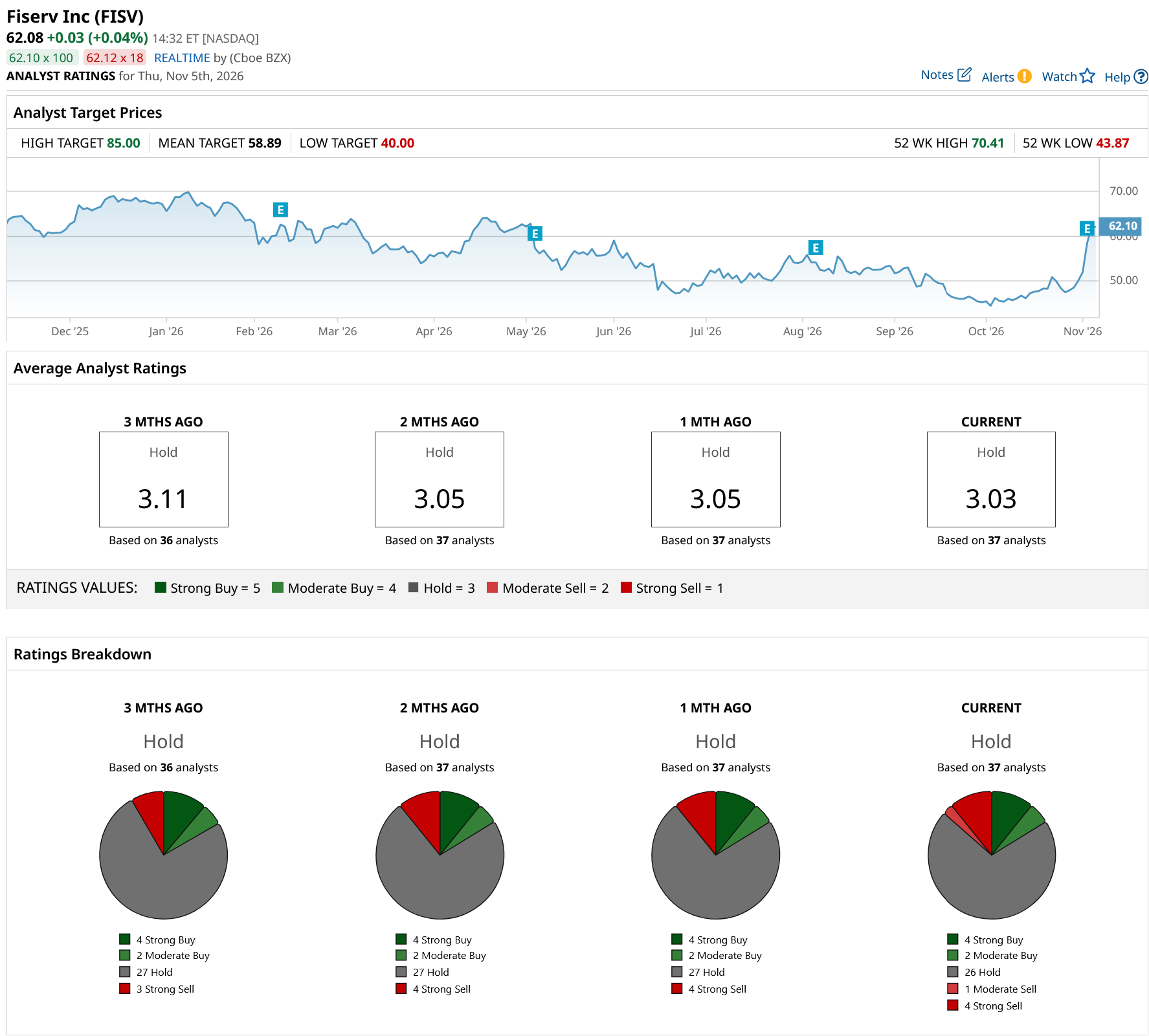
Wall Street remains cautious on FISV, with the stock carrying a consensus “Hold” rating. Of the 37 analysts offering recommendations, four assign a “Strong Buy” rating, two suggest a “Moderate Buy,” 26 maintain a “Hold,” one assigns a “Moderate Sell,” and four recommend “Strong Sell.” While the stock is trading at a premium to its average analyst price target of $58.89, the Street-high target of $85 suggests a potential upside of approximately 37%, indicating that some analysts still see considerable room for a rebound.
On the date of publication, Anushka Mukherji did not directly have a position in any of the securities mentioned in this article. All information and data in this article is solely for informational purposes. For more information please view the Barchart Disclosure Policy here.