


EN
Every Humanoid Robot Needs Rare-Earth Magnets. Here's the American Stock Positioned to Sell Them -- and It's Down 62%.
Key Points
Humanoid robots are built using significant amounts of rare-earth magnets.
China's control of the rare-earth minerals market presents significant risks.
MP Materials is positioned to be an alternative source for these critical minerals.
The rise of humanoid robots could be one of the next decade's most important technology trends. Tesla is betting heavily on its Optimus robots and expects humanoid robotics to become its most important product category. Meanwhile, Chinese pure plays including Unitree Robotics are also aiming to build leading positions in the fledgling tech category.
Rising demand for humanoid robots is set to push demand for rare-earth minerals and magnets even higher because these elements and composites are crucial foundations for some of the capabilities that make these robots special. There's a catch, though. Geopolitical dynamics and broader supply constraints mean that sourcing rare-earth materials and magnets could be very difficult -- especially for U.S.-based companies.
Missed Nvidia in 2009? This Rare Signal Is Flashing Again. In 2009, a "Double Down" signal flashed for a little-known chipmaker called Nvidia. For the first time in years, that same "Total Conviction" signal is flashing for a company 1/100th the size of Nvidia. Continue »
The good news is that MP Materials (NYSE: MP) is positioning itself to address this potentially huge supply chain issue, and it could wind up delivering big wins for patient investors.
Image source: Getty Images.
Rare-earth materials have become a crucial supply chain variable
While the U.S. and China maintain formal diplomatic relations, it's no secret that the two countries are the foremost competing world powers and are taking steps to gain an edge over each other. Along those lines, China's control over the extraction, refinement, and production of usable rare-earth minerals and magnets is a strength that the country is leveraging against the U.S. and its allies.
According to some estimates, China is responsible for roughly 60% of global rare-earth mining and 90% of processing. China is already using its stranglehold on the rare-earth market as a trade and geopolitical bargaining chip, and it could completely block exports if relations with the U.S. worsen. That could deal a crushing blow to U.S.-based manufacturers of humanoid robots.
According to MP Materials CEO James Litinsky, each humanoid robot will need between 8 and 10 pounds of rare-earth-magnet content in order to facilitate movement across various articulated joints. On a comparative basis, this works out to between double and triple the amount found in electric vehicles.
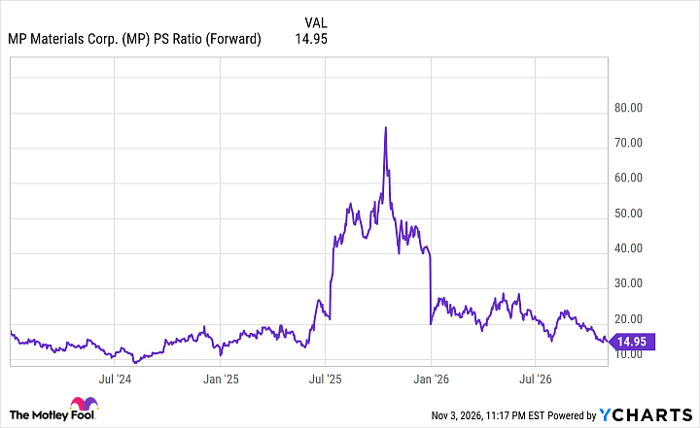
Litinsky believes that humanoid robots will become a major economic and defense sector resource for the U.S., and that means that his company could be poised to enjoy surging demand and pricing power. Meanwhile, the company's share price is down roughly 62% from its high amid concerns about whether the company's growth bets will come to fruition and doubts about just how much pricing power MP will actually be able to command in the rare-earth magnets space.
MP PS Ratio (Forward) data by YCharts
Even after a big valuation pullback, MP Materials isn't a low-risk stock. The company is valued at approximately 15 times this year's expected sales, which is a highly growth-dependent valuation, and a potential shift into profitability likely hinges on continued operational scaling and securing higher prices for its rare-earth magnets.
So, while the stock offers an intriguing combination of growth prospects and defensive characteristics if U.S. production of humanoid robots accelerates rapidly and dynamics in the rare-earth magnet market see dramatic shifts connected to geopolitical developments, investors should approach the stock with the understanding that it's a speculative play.
Keith Noonan has no position in any of the stocks mentioned. The Motley Fool has positions in and recommends MP Materials and Tesla. The Motley Fool has a disclosure policy.