


EN
3 Penny Stocks With Revenue Growth Up To 72%
Wall Street’s all in rush into AI stocks just hit a wall, with a $3.2tn sell off shaking confidence in crowded trades and expensive tech giants. When big money pulls back, smaller, financially healthier low priced shares can quietly move from the sidelines into the spotlight. This article discusses three financially solid penny stocks that screen for balance sheet strength to help you look for potential value away from the AI stampede.
The three stocks highlighted here offer a compelling starting point if you want exposure to lower risk early-stage businesses with an emphasis on financial strength. However, if you want the pick of this theme, these 9 elite penny stocks are the best of the best.
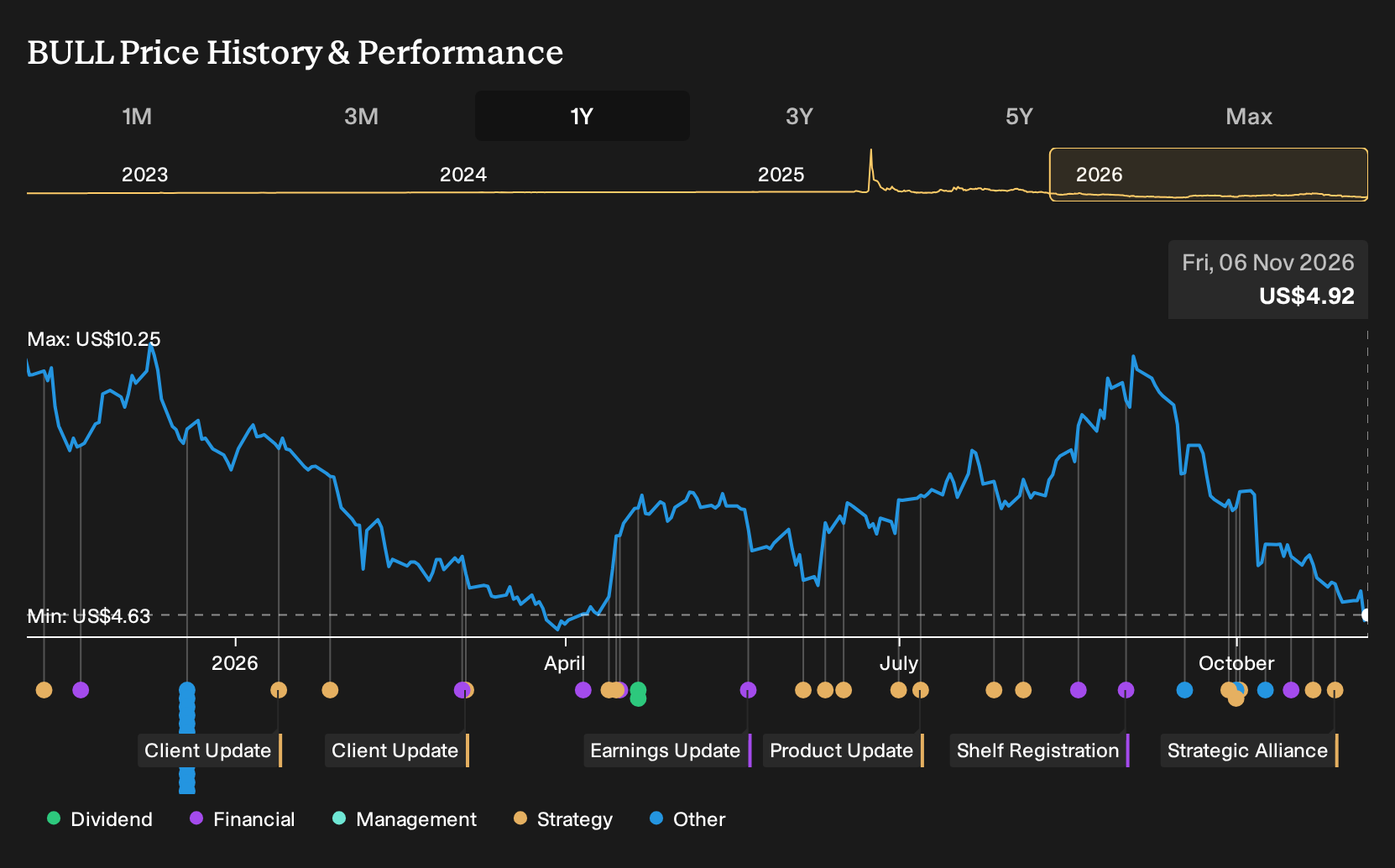
Webull (BULL)
Overview: Webull runs a global digital trading platform that lets retail investors access low priced equities and other securities with real time tools.
Operations: Webull generates about $672 million from brokerage services, with roughly $603 million from the USA and smaller contributions from Canada and other regions.
Market Cap: $2.6b
For the Financially Fit Penny Stocks theme, Webull matters because it sits where many retail traders actually access sub $5 shares and decide how to use them.
"Ongoing expansion into new international markets, including recent launches in Canada, Latin America, and Europe, is rapidly diversifying Webull's customer base and driving robust growth in assets under management (AUM), which supports future revenue and top-line growth."
The real test for Webull is how one unresolved regulatory and governance pressure shapes future pricing power and profitability on that expanding base.
How that pressure reshapes Webull’s pricing power and AUM growth sits at the heart of the full narrative for Webull, where accelerating user trends meet unresolved regulatory risk.
Aurora Innovation (AUR)
Overview: Aurora Innovation develops the Aurora Driver platform, combining self driving hardware, software, and data services to power commercial autonomous trucks.
Operations: Aurora Innovation currently records about $7 million of revenue from computer services in the United States tied to its autonomy platform.
Market Cap: $8.1b
Aurora Innovation gives this screener a pure play on commercial-ready autonomous freight, with a product built for recurring usage rather than one-off experimentation.
"Aurora Innovation is currently operating driverless trucks in daily commercial freight without safety drivers and has accumulated more than 500,000 commercial miles. This can position the company as a preferred partner for carriers that want proven autonomy at scale and can support higher subscription style revenue as additional fleets seek similar deployment."
What matters now is how one hard to ignore shift in per mile economics ultimately filters through into margins and long term demand.
Those economics only tell part of the story, and the full narrative for Aurora Innovation lays out how Aurora Innovation’s commercial miles, capital needs, and scaling plans could reshape that equation.

Clover Health Investments (CLOV)
Overview: Clover Health Investments runs Medicare Advantage PPO and HMO plans for Medicare-eligible members and supports doctors with its Clover Assistant software.
Operations: Clover Health Investments generates about US$2.7b of revenue from insurance operations in the United States, fully tied to Medicare Advantage.
Market Cap: US$2.4b
Clover Health Investments fits this Financially Fit Penny Stocks theme because its Medicare Advantage insurance engine already carries meaningful scale while still trading in low price territory. As a result, the quality of its healthcare economics matters far more than short term share swings.
"The company's differentiated technology-driven care model, particularly the Clover Assistant platform, positions it to benefit from the healthcare industry's accelerated shift toward technology adoption and data-driven, value-based care, supporting lower medical costs and higher medical margins, with positive implications for both revenue and net margins."
For investors watching Clover Health Investments, everything now turns on how one emerging pressure on medical costs ultimately feeds through to those margins.
As that pressure builds on medical costs, the full narrative for Clover Health Investments shows how Clover Health Investments could turn its data engine into accelerating cash flow and margin resilience ahead.

Seeking Alternatives Before The Crowd Moves
Fresh themes can move quickly when momentum builds, and early entries often matter most. Scan these curated ideas before they stop flying under the radar, then consider your options.
- Spot income opportunities early and review 8 dividend fortresses that aim to balance yield with balance sheet strength.
- Track potential developments in enterprise automation and assess 89 robotics and automation stocks that relate to demand for cost control and efficiency.
- Review opportunities linked to infrastructure upgrades and evaluate 42 power grid technology and infrastructure stocks that are connected to spending on grid resilience and smarter energy networks.
Have feedback on this article? Concerned about the content? Get in touch with us directly. Alternatively, email editorial-team@simplywallst.com