


EN
Does Fiber Expansion Change The Bull Case For Comcast Stock (CMCSA)?
- Comcast has recently extended multi gigabit, symmetrical fiber and full Xfinity and Comcast Business services to previously unserved communities across West Virginia, New Hampshire, Indiana and California, often supported by public funding and county partnerships.
- The buildout pushes Comcast deeper into rural and edge markets where broadband access has been limited, which reshapes its cost base, mix of customers and long term connectivity demand profile.
- We will look at how Comcast's investment narrative is affected by this fiber expansion into underserved regions and its broader connectivity footprint.
See how Comcast’s rural fiber build compares with other connectivity plays by reviewing the hand picked list of 52 AI infrastructure stocks.
Comcast Investment Narrative Recap
To own Comcast, you need to believe its connectivity engine, helped by wireless bundling along with Peacock and parks as side businesses, can offset pressure from cheaper fiber, fixed wireless and streaming rivals. In the short term, broadband and mobile stability are key swing factors, as revenue is forecast to drift slightly lower and earnings growth to remain modest.
The rural fiber push in West Virginia and other states matters more for long term relevance than for near term numbers, so it likely does not change the biggest current risk. That remains competitive and pricing pressure on broadband, along with the need to manage high debt and softer margins without eroding cash generation.
The Monongalia County build in West Virginia is most closely tied to this story. Comcast is using public private funding to light up multi gigabit, symmetrical fiber for thousands of unserved homes and businesses, while layering in Xfinity Mobile, entertainment and home security alongside low cost Internet Essentials offers for eligible households.
For investors, this kind of project sits directly on the list of potential catalysts related to network upgrades, converged connectivity and bundled ARPU. Execution risk is real, since fiber competition is rising and Comcast already carries significant borrowing, but each completed rural build slightly broadens the addressable base that supports broadband, wireless and advertising economics over time.
Comcast's analyst narrative points to US$119.0b in revenue and US$10.9b in earnings by 2029, based on an assumed yearly revenue decline of 1.1% and earnings moving from US$11.3b today to that US$10.9b forecast, which is a decrease of US$0.4b.
Uncover why Comcast's fair value indicates a 15% potential upside to its current price, which could narrow quickly as sentiment catches up.
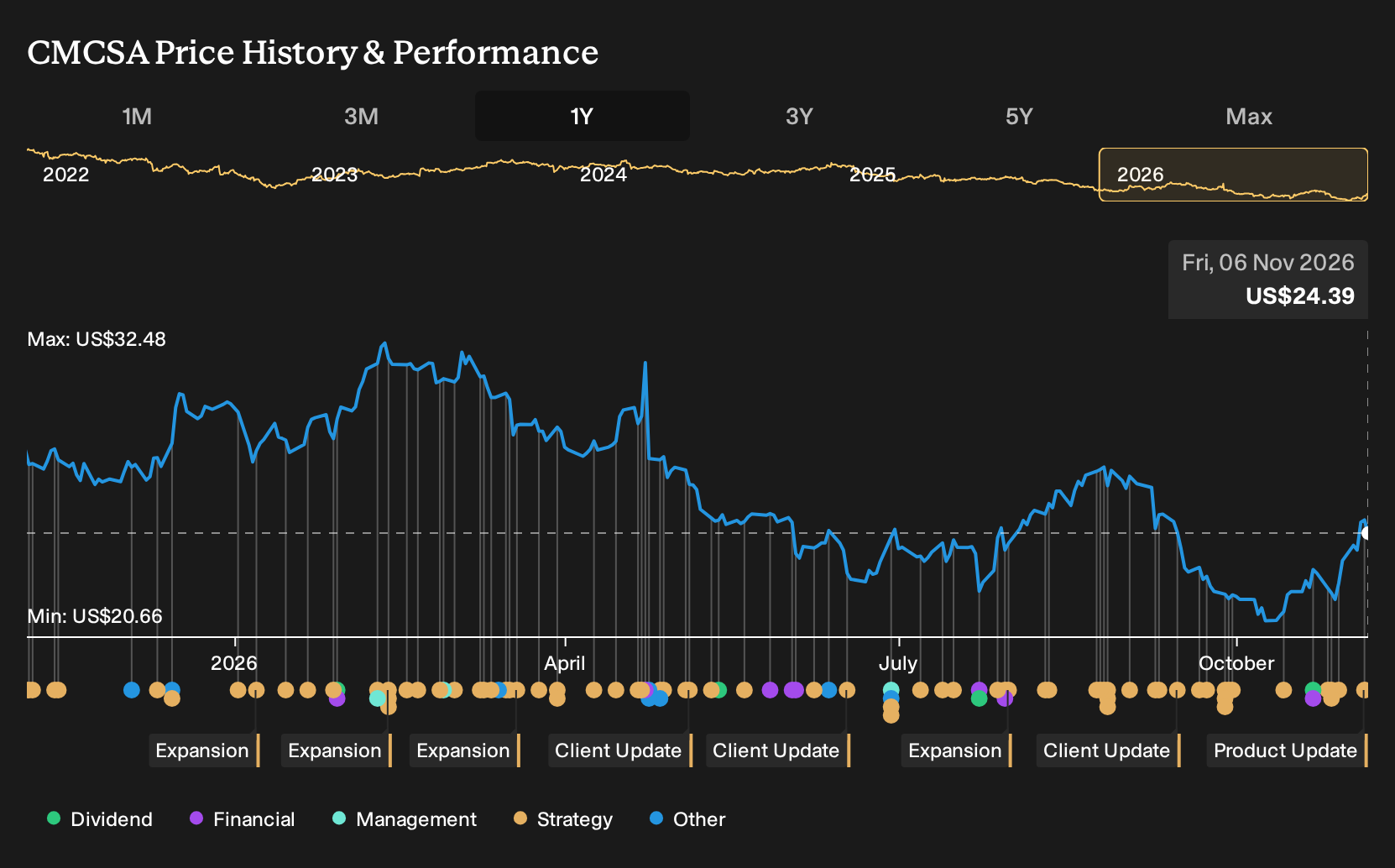
Exploring Other Perspectives
Some of the lowest Comcast forecasts lean hard into the risk that rural fiber builds earn weak returns. Those analysts were penciling in revenue of about US$116.6b and earnings of roughly US$9.8b by 2029, well below consensus. You can use today’s Monongalia County news to test which story you find more convincing.
Explore 5 other Comcast fair value estimates, including one that suggests there could be as much as 30% downside from the current price.
The Verdict Is Yours
Disagree with existing narratives? Extraordinary investment returns rarely come from following the herd, so consider your own analysis and judgment.
- A great starting point for your Comcast research is our analysis highlighting 3 key rewards and 2 important warning signs that could impact your investment decision.
- See our latest analysis for Comcast. The report includes a comprehensive fundamental analysis summarized in a single visual, the Snowflake, making it easy to evaluate Comcast's overall financial health at a glance.
Looking For More Investment Ideas Beyond Comcast?
If Comcast's rural fiber story has you thinking about where else long term connectivity and cash flow resilience could show up in your portfolio, it can help to scan a wider set of candidates with similar or stronger fundamentals.
- If stability and balance sheet strength matter most to you, start with companies on the list of solid balance sheet and fundamentals (24 results) to see which businesses pair financial resilience with room to grow.
- If you want potential mispricing on your side, review the 39 high quality undervalued stocks to find stocks where quality fundamentals and current pricing may be out of sync.
- If you prefer businesses that already throw off income, use the 8 dividend fortresses to focus on companies targeting yields of 5% or more with a focus on durability.
Have feedback on this article? Concerned about the content? Get in touch with us directly. Alternatively, email editorial-team@simplywallst.com