


EN
Intel Stock What Oracle AI Deals Mean After The Selloff
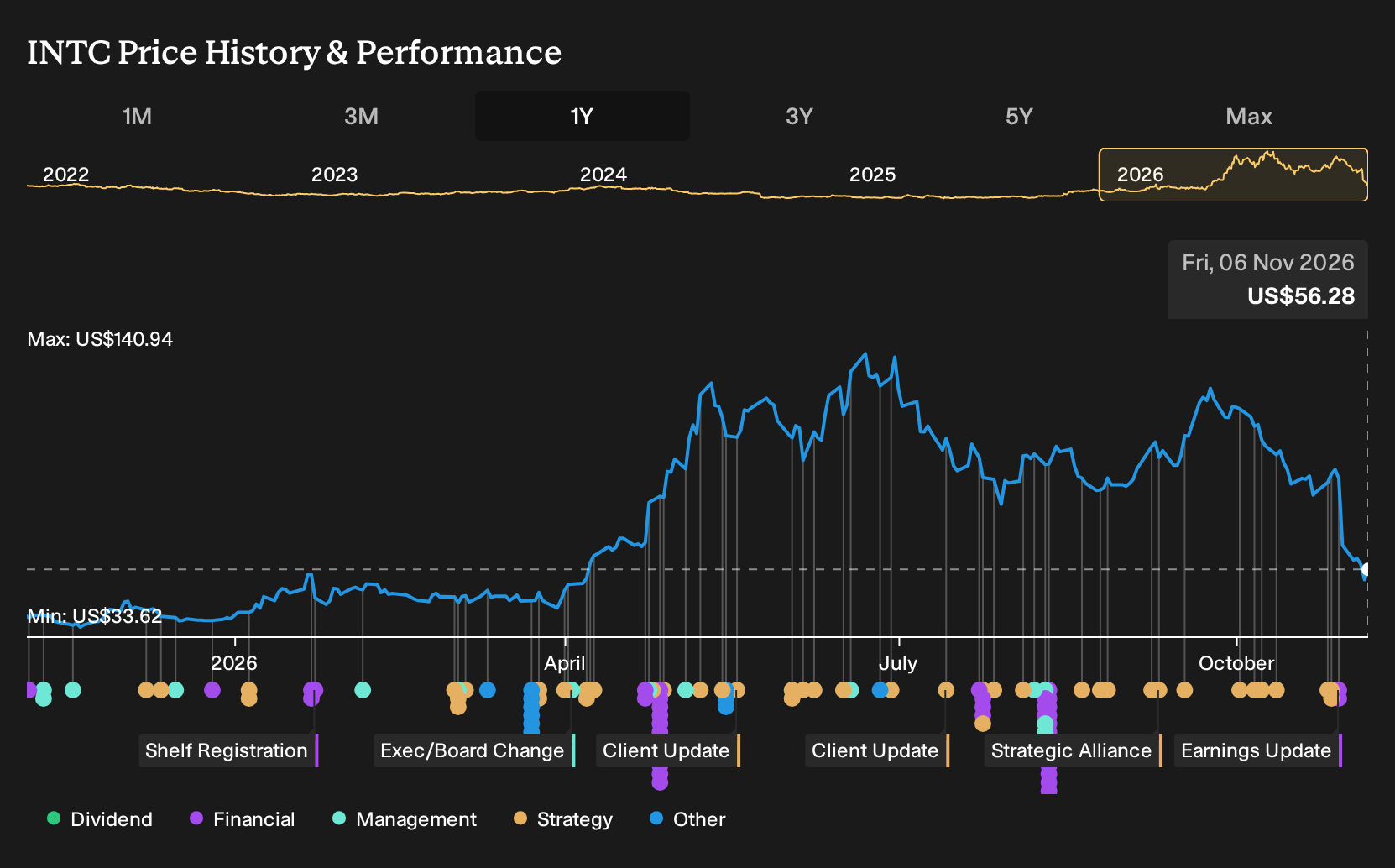
- Intel reported third quarter 2026 sales of US$16,513 million with net income of US$3,320 million, while guiding fourth quarter revenue to a range of US$15.0 billion to US$16.0 billion and diluted EPS attributable to Intel to US$0.10.
- Partnerships with Oracle and Symbolic Mind put Intel Xeon processors at the center of new AI and cloud workloads, highlighting how demand for enterprise and agentic AI is interacting with Intel's foundry buildout and heavy capital spending plans.
- We will look at how Intel's AI focused Oracle cloud collaboration shapes the existing investment narrative around fabs, foundry and data centers.
Compare Intel's AI push with other chipmakers by scanning 52 AI infrastructure stocks that are also racing to power the next wave of data center demand.
Intel Investment Narrative Recap
To stay a shareholder in Intel, you need to believe the heavy spending on fabs, foundry and AI centric products eventually turns today’s losses into profitable scale. The latest quarter shows US$16,513 million of sales and US$3,320 million of net income, but guidance for Q4 revenue and US$0.10 of diluted EPS points to near term pressure.
The near term catalyst is clear. Investors are watching whether data center and AI demand can offset a weaker PC market and keep factory utilization moving in the right direction. The biggest current risk is that large 2026 and 2027 CapEx runs ahead of customer uptake, which would keep Intel Foundry losses high for longer.
Among the recent announcements, the multiyear Oracle Cloud Infrastructure collaboration is the one that ties most closely to the current earnings story. Intel and Oracle plan to coordinate roadmaps and capacity so that current and future Xeon platforms, including Diamond Rapids based X14 offerings, are included in Oracle’s AI heavy cloud buildout.
This matters because the key short term question is whether Intel can fill its server and future foundry capacity with real AI workloads. If Oracle’s Xeon based instances capture more enterprise and agentic AI activity, that would support utilization and pricing power, though execution risk remains around delivery timelines, cost control and competitive pressure from GPU focused rivals.
Intel's current analyst narrative points to US$97.1b of revenue and US$22.0b of earnings by 2029, built on assumed yearly revenue growth of 17.5% and an earnings shift of about US$34.0b from today’s loss of US$12.0b.
Uncover why Intel's fair value indicates a 91% potential upside to its current price, a discount that could close faster than many investors expect.
Exploring Other Perspectives
One alternate view focuses on dilution risk rather than fabs. The most pessimistic Intel analysts already assumed revenue of about US$80.7b and earnings of US$13.4b by 2029, with shares on roughly 47.5x P/E, before this Oracle and Symbolic Mind AI news. That group sees heavy equity issuance and foundry losses as reasons to stay cautious, which is exactly why it helps to compare several narratives, not just the headline consensus.
Explore 13 other Intel fair value estimates, including one that suggests as much as 22% downside from the current price.
The Verdict Is Yours
Don't just follow the ticker. Dig into the data and build a conviction that's truly your own.
- A great starting point for your Intel research is our analysis highlighting 3 key rewards and 1 important warning sign that could impact your investment decision.
- See our latest analysis for Intel. The report includes a comprehensive fundamental analysis summarized in a single visual, the Snowflake, making it easy to evaluate Intel's overall financial health at a glance.
Looking For More Investment Ideas Beyond Intel?
Once you have a view on Intel, it can help to compare that thesis with other opportunities that line up with your risk tolerance, income needs, and return goals. The Simply Wall St Screener gives you a structured way to do that without getting lost in thousands of tickers.
- If capital preservation sits high on your list, start with companies that score well on resilience by reviewing 29 resilient stocks with low risk scores that may better match a steadier approach.
- For investors who care about balance sheet strength before anything else, filter for businesses with robust finances and cash support using the list of solid balance sheet and fundamentals (24 results).
- Those hunting for overlooked opportunities can scan for under-the-radar prospects with strong fundamentals through the 19 high quality undiscovered gems.
Have feedback on this article? Concerned about the content? Get in touch with us directly. Alternatively, email editorial-team@simplywallst.com