


EN
Is Earnings Beat Altering The Investment Case For New York Times Stock?
- The New York Times Company reported third quarter 2026 revenue of US$768.54 million and net income of US$97.36 million, with basic and diluted earnings per share from continuing operations of US$0.60.
- An interesting detail for readers is how digital only subscription and advertising performance supported higher earnings per share, while nine month results showed revenue of US$2.24b and net income of US$278.70 million.
- We will now look at how The New York Times investment narrative is influenced by this earnings beat and digital subscription momentum.
New York Times Investment Narrative Recap
To own New York Times, you need to believe the digital bundle can keep pulling in subscribers and hold pricing power even as general news feels more commoditized by generative AI tools. The recent quarter, with higher revenue, earnings and EPS than a year ago, supports that subscription driven story rather than changing it.
The short term swing factor stays the same: can digital only subscriptions and digital advertising keep growing fast enough to justify higher spending on video, technology and marketing? The main risk is that these costs run ahead of revenue, which would pressure margins even if subscriber counts keep rising.
The fresh data point that really matters here is the third quarter and nine month 2026 earnings print. Revenue and net income for both periods were higher than a year earlier, and basic and diluted EPS from continuing operations also stepped up, helped by digital only subscriptions and online ad performance.
For catalysts, that report reinforces the idea that New York Times can still monetise its large audience through recurring digital revenue. It also puts more focus on execution risk around tech and content investment. If cost growth stays elevated without the same level of subscription and advertising support, the earnings story becomes harder to maintain.
New York Times' current earnings of US$392.8 million are set against analyst expectations of US$525.1 million by 2029, which implies a revenue path toward US$3.6b on 6.9% yearly top line growth and an earnings increase of about US$132 million by that same 2029 forecast year.
Uncover why New York Times' fair value indicates a 12% potential upside to its current price and why that discount could narrow quickly.
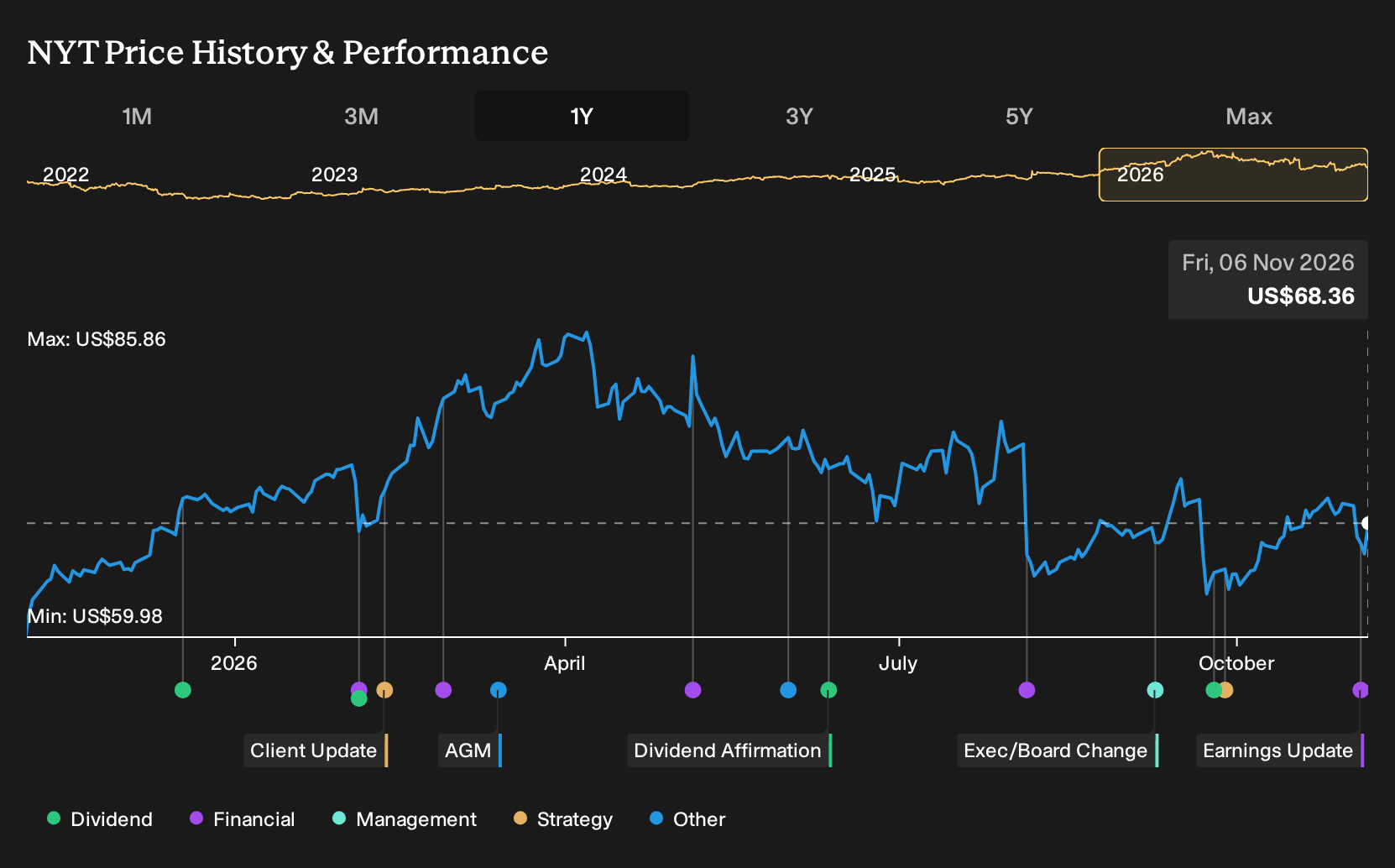
Exploring Other Perspectives
Some of the most optimistic analysts frame The New York Times through a different lens. They focus on digital advertising as the key catalyst, with pre earnings models built around revenue reaching about US$3.7b and earnings near US$532.5 million by 2029. Those projections came before this Q3 update, so their view might shift. You can use that gap between the consensus and bullish case to test where your own expectations sit.
Explore 2 other New York Times fair value estimates, including one that suggests potential upside of as much as 13% from the current price.
Decide For Yourself
Disagree with existing narratives? Extraordinary investment returns rarely come from following the herd, so rely on your own judgment.
- A great starting point for your New York Times research is our analysis highlighting 3 key rewards that could impact your investment decision.
- See our latest analysis for New York Times. The report includes a comprehensive fundamental analysis summarized in a single visual, the Snowflake, making it easy to evaluate New York Times' overall financial health at a glance.
Looking for more New York Times style investment ideas?
If the New York Times setup has sharpened your thinking on recurring revenue and quality earnings, you can broaden that framework across a wider watchlist using the Simply Wall St Screener. You can scan for different angles on resilience, yield, and valuation in just a few minutes.
- For investors who want income that does more of the heavy lifting, focus on companies with stronger cash returns through the 8 dividend fortresses.
- If capital preservation sits higher on your list, you can temper risk by filtering for businesses with sturdier financial profiles using the 29 resilient stocks with low risk scores.
- When you want quality at a reasonable entry point, search for opportunities trading below their assessed value through the 39 high quality undervalued stocks.
Have feedback on this article? Concerned about the content? Get in touch with us directly. Alternatively, email editorial-team@simplywallst.com