


EN
What Everest Group (EG)'s Dividend Declaration Means For Shareholders
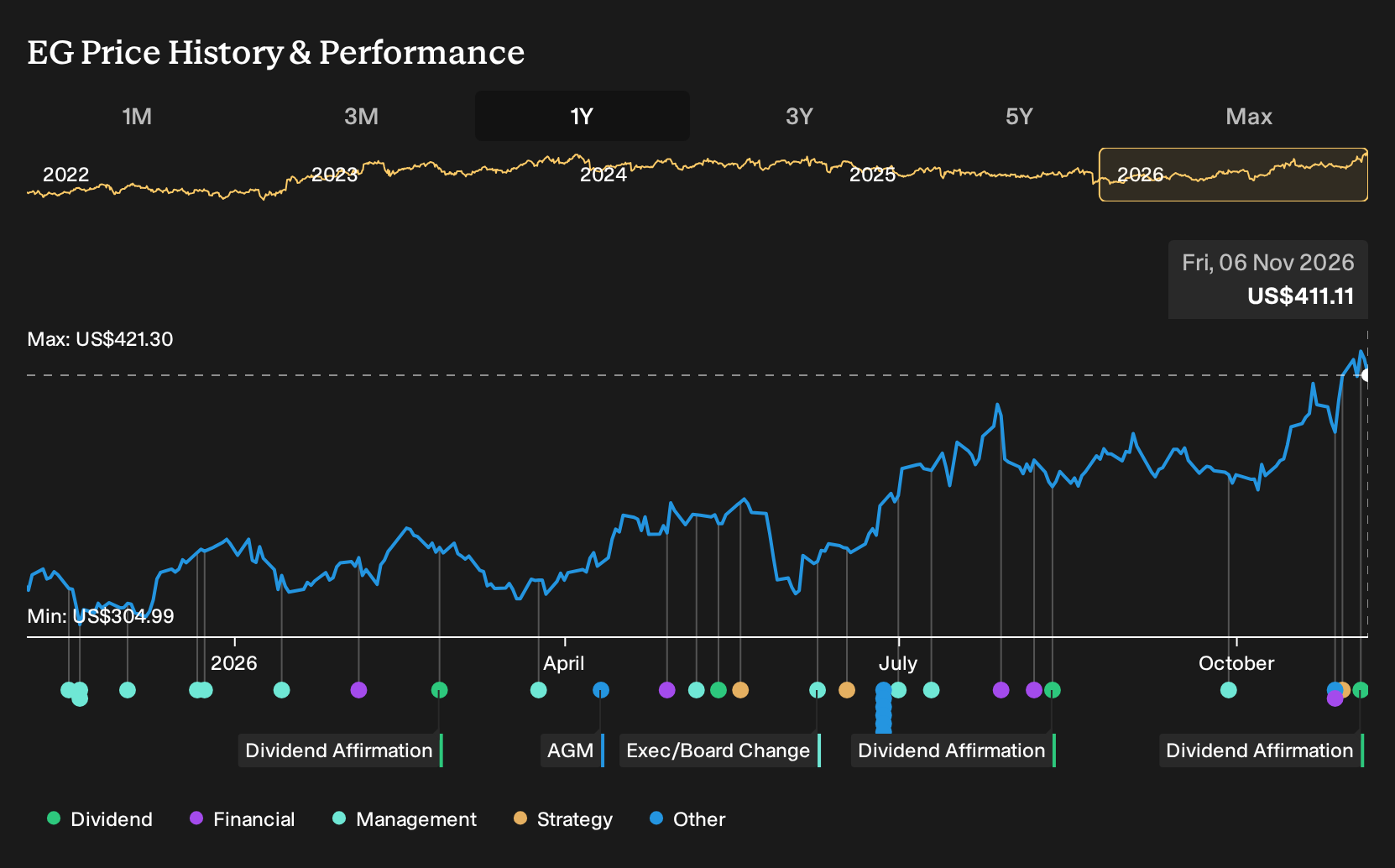
- Everest Group has declared a dividend of US$2.00 per common share payable by December 18, 2026, alongside third quarter 2026 results that show US$3,713 million in revenue and US$233 million in net income.
- The securities class action targeting Everest Group’s casualty reserving and risk disclosures highlights how reserve assumptions and pricing decisions feed directly into reported earnings quality.
- We will now look at how Everest Group's dividend decision and legal scrutiny could reshape the existing investment narrative around reserves.
Compare Everest Group’s mix of dividend income and reserving risk with a curated set of insurers and financials screened for 29 resilient stocks with low risk scores, which aim for resilience when legal and balance sheet questions surface.
Everest Group Investment Narrative Recap
To own Everest Group, you need to be comfortable with a reinsurance and insurance platform that is still working through casualty reserve questions while leaning harder into short tail and specialty lines. The big near term swing factor is whether loss trends stay within existing assumptions so that reserve charges do not keep eating into earnings momentum.
The latest quarter showed revenue of US$3,713 million and net income of US$233 million, with profit still supported by a broad portfolio, but the securities class action keeps attention firmly on reserving. That legal overhang sits alongside the runoff of the Legacy segment as the most important risk, especially if older accident years keep throwing up adverse loss development.
The most relevant update for this story is the reaffirmed US$2.00 per share dividend payable in December 2026. For you, the signal is less about income and more about management indicating comfort with regulatory capital and their ability to keep funding both payouts and balance sheet clean up after the US$1.7b reserve strengthening and adverse development cover.
In that context, the class action around casualty exposure and alleged reserve understatements directly touches the main operational catalyst. Everest Group is trying to tilt the book toward shorter tail and specialty risks, use vehicles like Mt. Logan and Annapurna Re to share risk, and let the Legacy portfolio run off. How cleanly that transition proceeds, and how much more reserving noise appears, will likely frame the story around this stock for some time.
Everest Group's narrative projects US$10.6b revenue and US$2.4b earnings by 2029. This assumes revenue declines of 13.2% per year and an earnings increase of about US$500m from US$1.9b today.
Uncover why Everest Group's fair value indicates Everest Group is roughly in line with its current price.
Exploring Other Perspectives
Four fair value estimates from the Simply Wall St Community range from roughly US$419 to about US$1,406 per Everest Group share, so some private investors see limited upside while others expect very large appreciation. Set that against ongoing casualty reserve risk and the fresh class action, and you have sharply different narratives that are worth exploring in detail.
Explore 3 other Everest Group fair value estimates, including one that suggests potential upside of 242% from the current price.
Form Your Own Verdict
Disagree with existing narratives? Extraordinary investment returns rarely come from following the herd, so go with your instincts.
- A great starting point for your Everest Group research is our analysis highlighting 5 key rewards that could impact your investment decision.
- See our latest analysis for Everest Group. The report includes a comprehensive fundamental analysis summarized in a single visual: the Snowflake, making it easy to evaluate Everest Group's overall financial health at a glance.
Looking for more investment ideas beyond Everest Group?
Once you have a view on Everest Group, it can help to pressure test that thinking against other opportunities using the Simply Wall St screener, especially if you want a watchlist that matches your risk and income preferences.
- If you care most about capital preservation and steadier profiles, scan through a 29 resilient stocks with low risk scores that are built to hold up when conditions get harder to read.
- If value is your priority, weigh Everest Group against a 39 high quality undervalued stocks where earnings quality and balance sheet strength both matter.
- If income is central to your plan, round out your research with a 8 dividend fortresses that aim to pair higher yields with resilient cash flows.
Have feedback on this article? Concerned about the content? Get in touch with us directly. Alternatively, email editorial-team@simplywallst.com