


EN
Tokenization Move Might Change The Case For Investing In Morgan Stanley (MS)
- Morgan Stanley has issued several fixed-rate notes, including 5.00% notes due 2030 and 5.4% notes due 2036, alongside unsecured offerings maturing between 2031 and 2033, all priced at 100% of face value.
- The bank has moved from piloting to actively using DTCC's tokenization service for U.S. equities and Treasuries, signalling a push to integrate blockchain-based infrastructure into its capital markets operations.
- The next area of focus is how Morgan Stanley's investment narrative could shift as it embeds DTCC-driven tokenization into its securities platform.
Scan how Morgan Stanley's tokenization push and fresh bond issues compare with peers by zeroing in on banks and capital-market players inside the list of solid balance sheet and fundamentals (24 results)
Morgan Stanley Investment Narrative Recap
An investor in Morgan Stanley needs to believe the wealth and institutional model can keep converting its US$10t of client assets and 20 million workplace relationships into steady fee based revenue. The immediate story is about execution. Adviser retention, fee pressure from passive products and shifting capital rules sit in the foreground.
The fresh fixed rate bond issues look more like routine funding than a swing factor for near term catalysts. They do not directly change the key risk that higher regulatory capital or adviser churn could cap returns or earnings. For now, the operating debate still centers on fee durability and cost efficiency.
The most relevant update here is Morgan Stanley becoming a live user of DTCC’s tokenization service for U.S. equities and Treasuries, with plans to support tokenized equities on its alternative trading system in early 2027. That step plugs digital assets infrastructure directly into its securities machinery.
For you, the question is execution. If tokenized securities trading settles smoothly, it could reinforce Morgan Stanley’s pitch to institutional and wealth clients who want more complex products without sacrificing market plumbing. If operational or regulatory snags arise, tokenization could add cost and compliance friction on top of existing margin and adviser competition pressures.
Morgan Stanley's current analyst story points to revenues of US$91.4b and earnings of US$19.4b by 2029, based on an assumed 4.6% yearly revenue growth rate and a forecast earnings decline of US$0.4b from US$19.8b today.
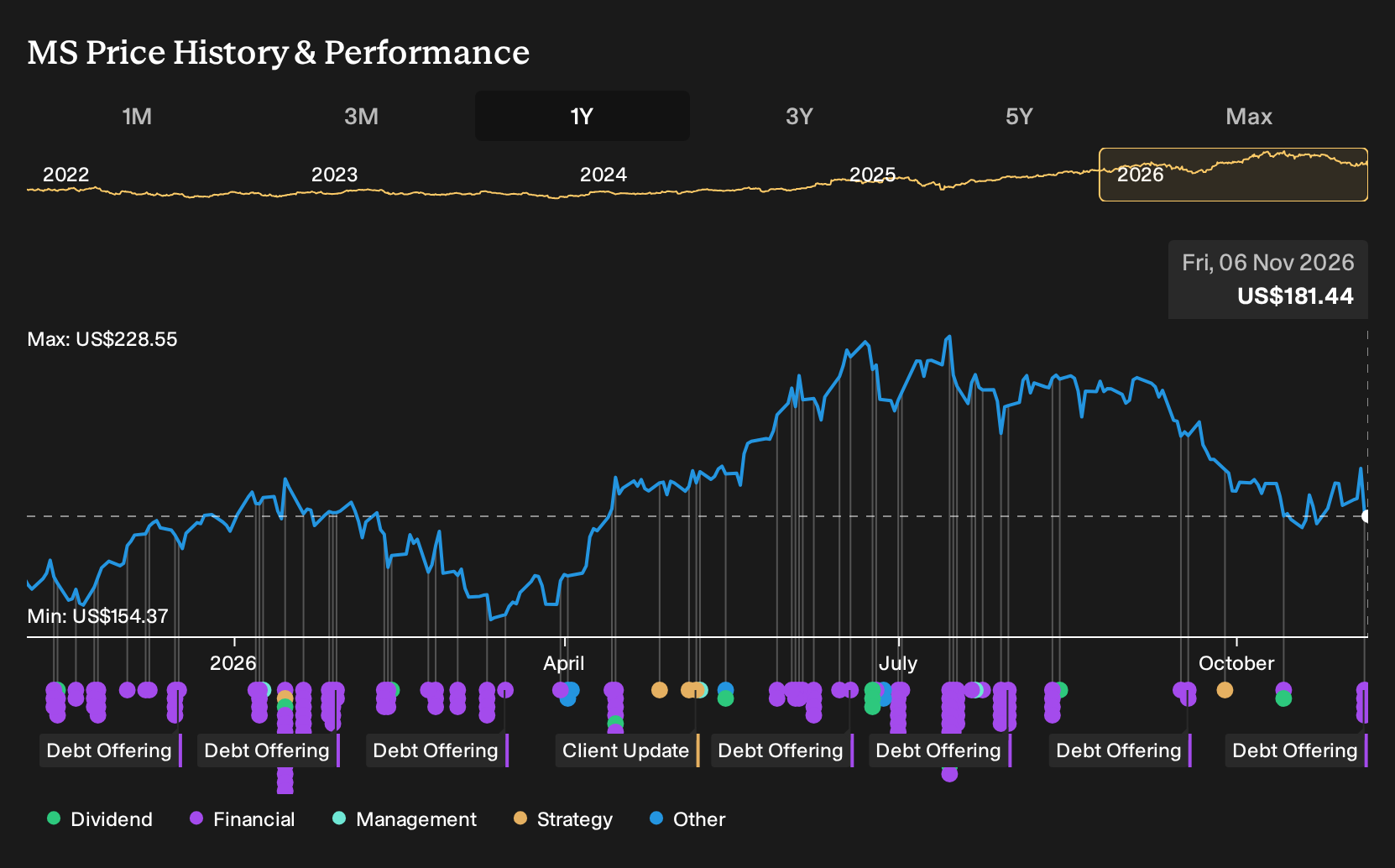
Uncover why Morgan Stanley's fair value indicates an 18% potential upside to its current price that could narrow quickly.
Exploring Other Perspectives
One alternate view treats Morgan Stanley’s Digital Asset Lab as the real swing factor. In that story, tokenization is the bridge to higher fee pools on top of the expected US$97.9b of 2029 revenue and US$24.3b of earnings that bullish analysts were already modeling before this news. You can read those forecasts as a much more optimistic starting point, then consider how this week’s bond deals and DTCC progress might shift that outlook in either direction.
Explore 3 other Morgan Stanley fair value estimates, including one that suggests potential upside of up to 40% from the current price.
Decide For Yourself
Disagree with existing narratives? Extraordinary investment returns rarely come from following the herd, so go with your instincts.
- A great starting point for your Morgan Stanley research is our analysis highlighting 3 key rewards and 1 important warning sign that could impact your investment decision.
- See our latest analysis for Morgan Stanley. The report includes a comprehensive fundamental analysis summarized in a single visual, the Snowflake, making it easy to evaluate Morgan Stanley's overall financial health at a glance.
Looking For More Investment Ideas Beyond Morgan Stanley?
Once you have a view on Morgan Stanley, it can help to widen the lens and see how other businesses with different profiles line up on quality, income and balance sheet strength.
- For investors hunting for quality at a discount, scan companies that combine solid fundamentals with room for a re rating through the 39 high quality undervalued stocks.
- If reliable income is a priority, focus on businesses that aim to pair higher yields with resilience by using the 8 dividend fortresses.
- To prioritise financial resilience first and potential returns second, filter for companies with robust finances and low leverage using the 29 resilient stocks with low risk scores.
Have feedback on this article? Concerned about the content? Get in touch with us directly. Alternatively, email editorial-team@simplywallst.com