


EN
What Investors Overlooked Before Grupo Casas Bahia Fell 79%
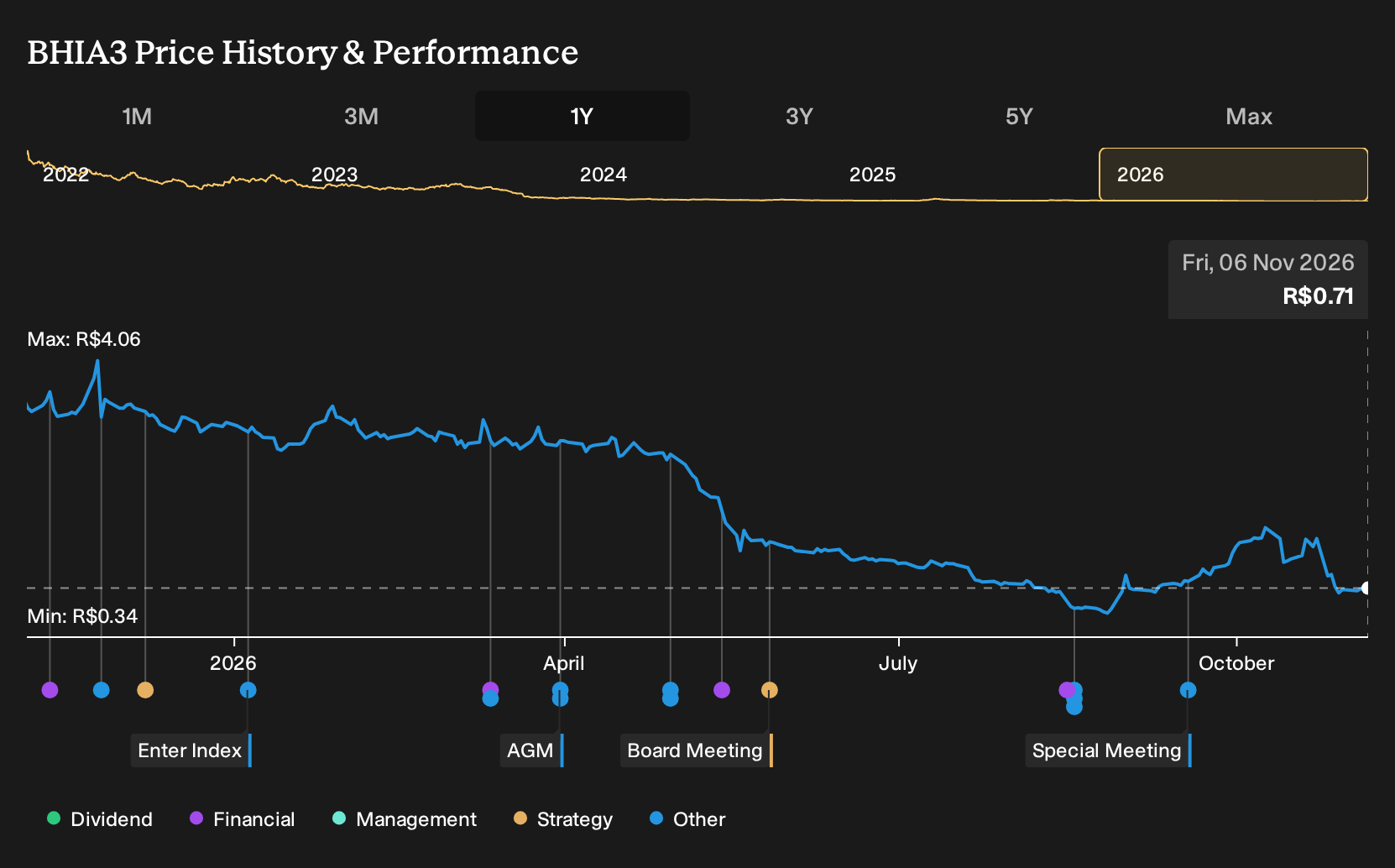
When Grupo Casas Bahia released its Q2 2026 update showing R$6,977 million in revenue alongside a net loss of R$10,117 million, the numbers framed a stark year for holders. Holding Grupo Casas Bahia over the past year would have meant a 78.5% loss, including dividends. If you had put money in on 6 November 2025, how should this outcome reshape expectations about whether the digitalization story can offset legacy store pressures?
Narratives are how investors here put a case on the record, with explicit assumptions about revenue, margins and the multiple. Those assumptions imply an estimated Fair Value.
If the move has made Grupo Casas Bahia harder to judge, start where the gap is still open and scan 224 high quality undervalued stocks.
The Two Stories Investors Were Choosing Between On Grupo Casas Bahia
The shares cost R$3.36 at the start of the period, and anyone looking at Grupo Casas Bahia then had to decide which of two stories felt more credible.
The bullish narrative put Fair Value at R$7.96, anchored in a view that digitalization and Latin American demand would support revenue growth of 5.9% a year and lift profit margin to 6.2% within three years.
The bearish case set Fair Value at R$3, stressing that legacy stores and high fixed costs might keep pressure on profitability even if revenue rose 4.9% annually and margin only reached 6.0%.
What The Results Changed For The Grupo Casas Bahia Thesis
The Q2 2026 figures gave investors a hard reference point. Grupo Casas Bahia reported revenue of R$6,977 million compared with R$6,867 million in Q2 2025. However, the loss deepened from R$555 million to R$10,117 million and net margin moved from a loss of 8.1% to a loss of 145.0%. That combination challenged both the optimistic and cautious profitability paths.
The key lesson is simple. When any retailer sells more but sees the loss widen sharply, it is important to watch the net margin line as closely as the growth claim, then decide what you are really paying for.
What You Are Really Paying For In Grupo Casas Bahia Today
Grupo Casas Bahia now trades at R$0.71 after a 78.5% loss over the past year, and the selected Narrative’s Fair Value sits above that quote based on its own framework rather than any proven benchmark.
The Narrative leans on digital channels, credit products, and a reshaped balance sheet. A buyer today would need to believe that cost cuts and online scale can eventually turn current losses into sustained positive margins.
"Accelerated digital transformation, credit solutions expansion, and operational efficiencies are strengthening revenue growth, profitability, and market share. Improved capital structure and cost reductions are supporting growth initiatives, margin expansion, and stronger long-term financial stability."
One Narrative has put a figure on that disagreement. → See the Narrative with its higher Fair Value, assumptions and all
Another Digital Retail Angle
Grupo Casas Bahia shows how hard omnichannel retail can be when losses build. You might still like Latin American shoppers steadily moving online.
One step away from that story is a business built around unified commerce and payments. It connects buyers and sellers while also handling money flows.
The same customer who wants easy delivery on a fridge also wants simple checkout and straightforward credit options.
This other platform leans into that bundle, tying marketplace activity, payments, credit and shipping into one loop.
The unresolved question is how that deep integration could reshape who captures more value from each digital transaction.
That argument has a Narrative and a number behind it. → See the company one Narrative values 50% above its price
Have feedback on this article? Concerned about the content? Get in touch with us directly. Alternatively, email editorial-team@simplywallst.com