


EN
Our Pick Of The Best British Dividend Stocks In November 2026
Interest rates look set to climb again after a strong US jobs report strengthened the case for a December Federal Reserve hike, and that kind of backdrop often pushes investors toward cash returns they can actually see. Reliable UK dividend payers yielding more than 3% start to look especially appealing when cash flows feel uncertain. This piece highlights three high income stocks from that universe worth a closer look.
The three stocks highlighted here offer a compelling starting point if you want exposure to high yield dividend payers with solid, visible cash payouts. However, if you want the absolute best, these 4 dividend aristocrats stocks are the cream of the crop.
Man Group (LSE:EMG)
Overview: Man Group is a global investment manager that earns recurring fees by running liquid and alternative strategies, supporting regular and special dividends.
Operations: The business generates around $1.7 billion in revenue from its Investment Management Business segment, which collects management and performance fees.
Market Cap: £3.3 billion
Man Group matters for a dividend screen like this because it turns a broad, fee earning investment platform into visible cash distributions for shareholders.
"Continued build out of the credit and private credit platform, including over $60b of credit AUM and $17.6b in private credit by mid 2026 plus $4.9b of uncalled committed capital, gives scope for further deployment that can support fee revenue and diversify profit drivers."
What really moves the dial for Man Group’s dividend profile now is how one unseen pressure ultimately shapes margins and future cash generation.
That margin pressure is only half the story, and the full narrative for Man Group shows how Man Group’s fee engine and capital returns could be quietly decoupling from it.

Kingfisher (LSE:KGF)
Overview: Kingfisher runs B&Q, Screwfix and other home improvement chains that sell products and services to households and trade professionals, generating cash flows that support its dividend.
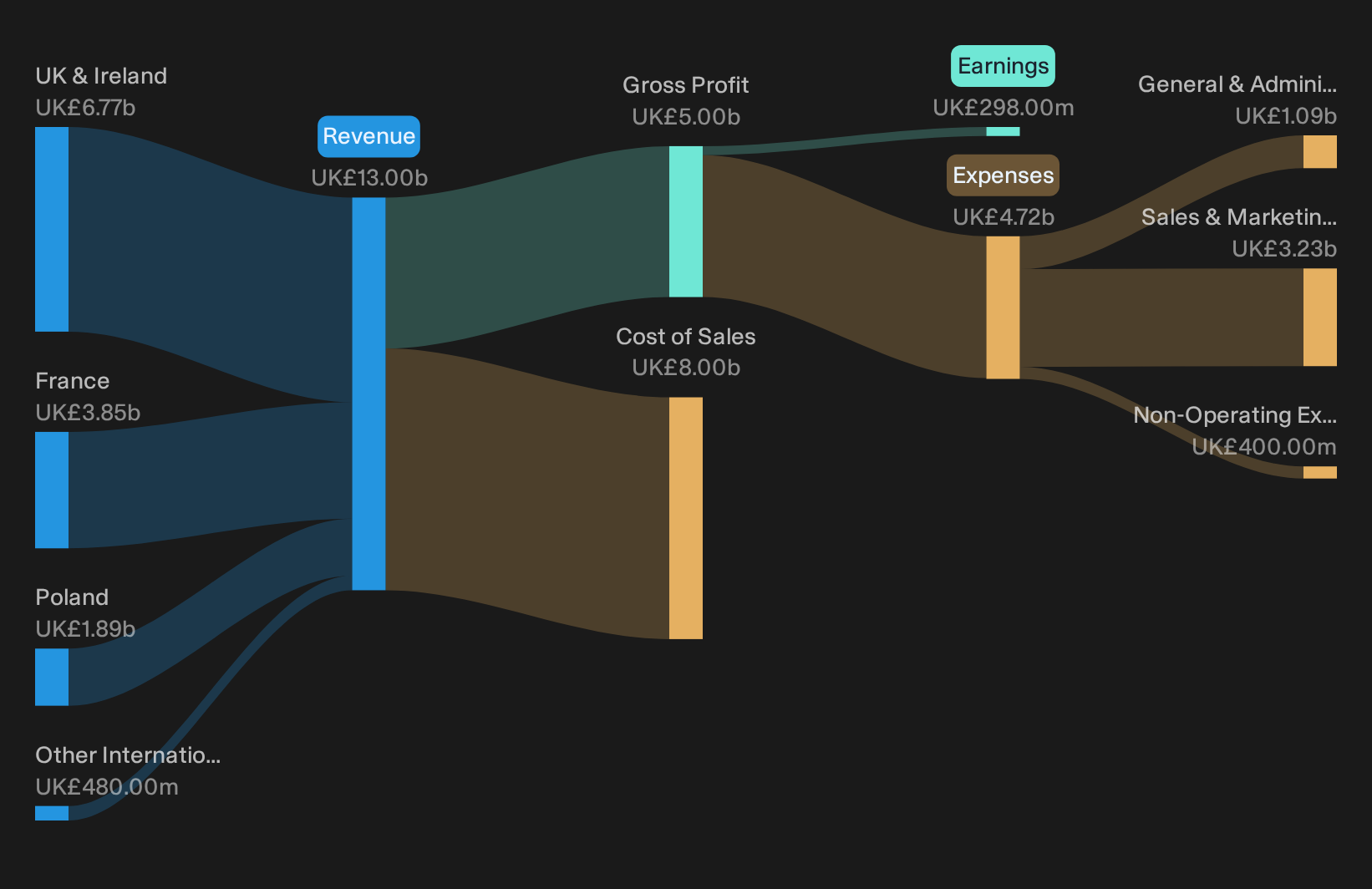
Operations: Kingfisher generates £13.0b from supplying home improvement products and services, mainly in the UK and Ireland, France, Poland and other international markets.
Market Cap: £6.2b
Kingfisher matters for a Dividend Powerhouses screen because its big box stores, its fast growing Screwfix format and its online channels turn everyday home improvement spending into recurring cash that can underpin a 3% plus payout.
"Kingfisher's focus on growing higher value trade customers, with trade sales of £2.1b and trade penetration at 31% of group sales, supports the view that further mix shift towards trade can lift revenue density and margin per transaction."
What really decides how durable that dividend looks is whether one quietly evolving part of the business keeps pushing those margins in the right direction.
If that shift in mix is what you care about now, the full narrative for Kingfisher explains in detail where Kingfisher’s trade push could accelerate returns and where risks might still lurk.
HSBC Holdings (LSE:HSBA)
Overview: HSBC Holdings is a global bank that uses its Hong Kong and UK retail and commercial franchises to generate dividend supporting profits.
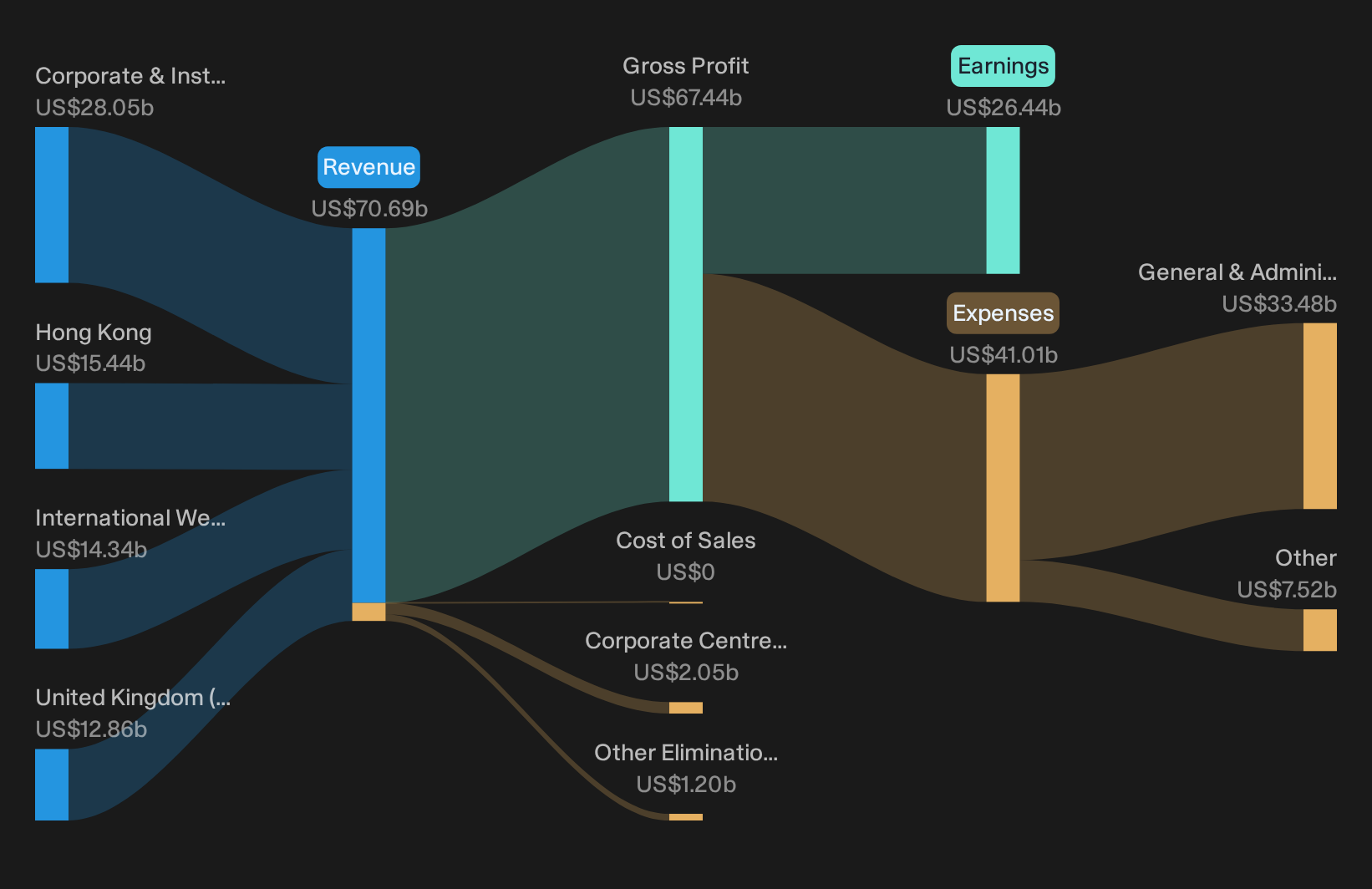
Operations: HSBC generates about $15.4b from Hong Kong, $12.9b from the UK, $28.1b from Corporate & Institutional Banking and $14.3b from International Wealth & Premier Banking.
Market Cap: £223.2b
HSBC Holdings matters for a Dividend Powerhouses screen because its everyday banking, from current accounts to mortgages and business lending, funds a regular dividend stream backed by broad based earnings.
"Intensifying investment in Asian wealth management and private banking remains central, with over 1 trillion US dollars of Asian wealth balances and strong net new money in Hong Kong and India."
What happens if one emerging pressure on funding costs starts to squeeze those otherwise dependable cash flows will be critical for income focused investors.
That funding squeeze question is exactly what the full narrative for HSBC Holdings unpacks, highlighting where HSBC Holdings’ Asia focused wealth engine could keep accelerating despite rising deposit costs.
Seeking Alternatives Before Momentum Builds
Fresh ideas often move first, and once momentum builds, the clean entry points can disappear quickly. Scan these curated stock sets before the crowd notices and consider your options early.
- Review durable income-focused companies before yields potentially get compressed by demand with a curated set of 4 dividend fortresses designed to keep paying when others pause.
- Explore early movers at the intersection of medicine and algorithms by scanning 9 healthcare AI stocks while they may still be under the radar.
- Monitor the physical backbone of AI before infrastructure costs are fully reflected by tracking 52 AI infrastructure stocks that could benefit as data traffic increases.
Have feedback on this article? Concerned about the content? Get in touch with us directly. Alternatively, email editorial-team@simplywallst.com