


EN
Is Sector Selloff Altering The Investment Case For Tidewater Stock?
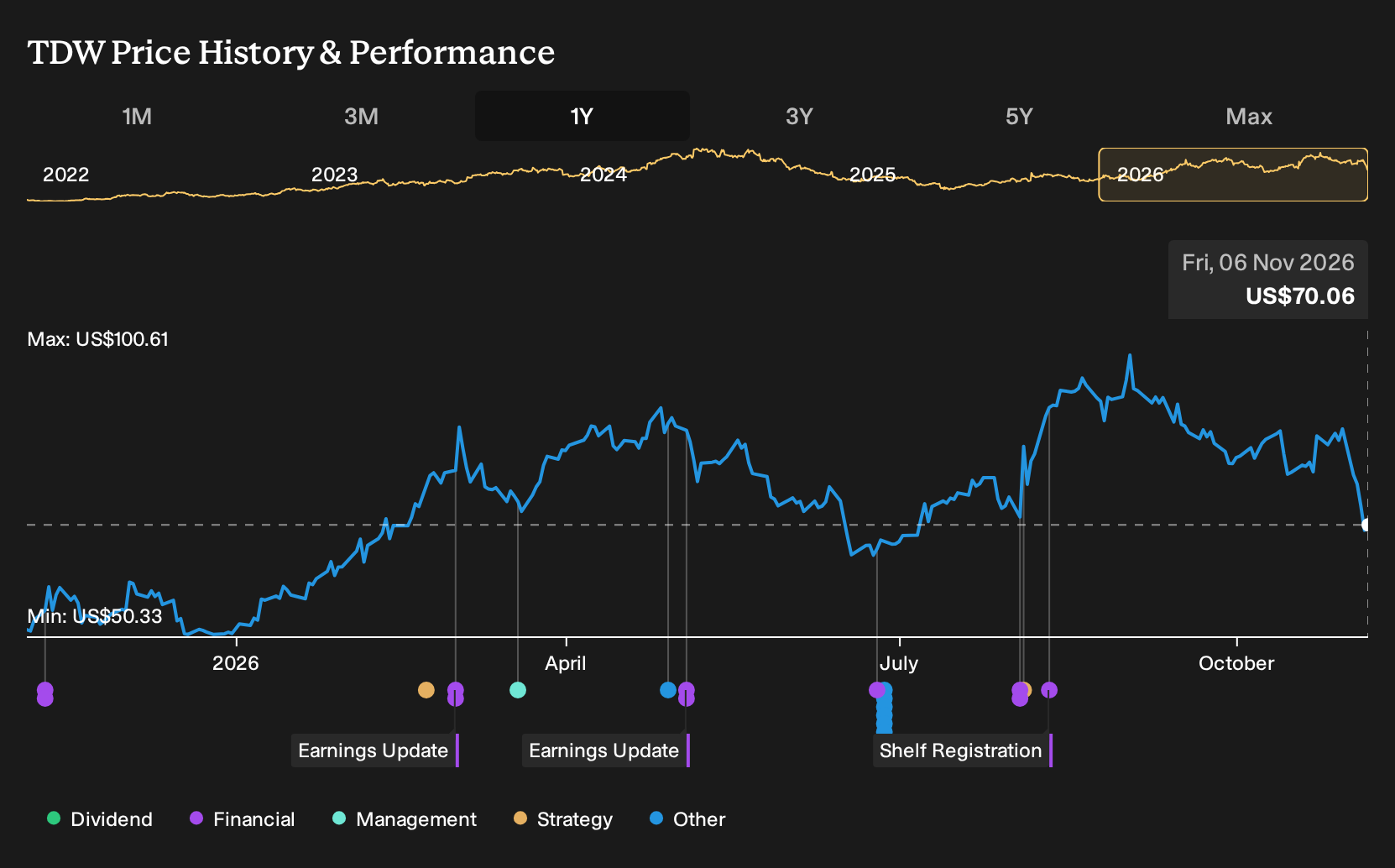
- Tidewater recently faced a sector wide pullback as oil and gas equipment and services stocks reacted to higher geopolitical risks and rising offshore operating costs.
- The same conflicts that are lifting Tidewater’s crew, insurance and fuel expenses are also encouraging offshore energy security projects that could influence vessel utilization and pricing.
- We will look at how Tidewater's investment narrative around vessel tightness intersects with rising conflict driven operating costs and sector risk.
Compare Tidewater's conflict driven offshore story with other potential opportunities by scanning our hand picked 41 high quality undervalued stocks with resilient cash flows and solid balance sheets.
Tidewater Investment Narrative Recap
Tidewater is a bet on tight offshore vessel supply translating into firm day rates and healthy utilization, even as conflict related costs keep creeping higher. For a shareholder, the key short term swing factor is whether offshore project activity across regions like Brazil, West Africa and the Mediterranean continues to absorb the enlarged fleet.
The recent sector selloff does not by itself change that operating backdrop. The bigger near term risk still sits with under recovery of Operation Epic Fury costs and any delay in customer spending that leaves vessels idle. If project timings hold up, the pullback has limited fundamental impact.
One development that ties directly into this story is Tidewater’s acquisition of Wilson Sons Ultratug. This adds 22 platform supply vessels and lifts the Brazilian fleet from six to 28 ships. This deal shifts more exposure toward a region where offshore work has been active and where tight supply could matter most.
The flip side is execution risk. Management must absorb these vessels without letting conflict driven expenses and integration costs erode margins more than already reflected in the trimmed 2026 guidance. For you as an investor, vessel utilization on the enlarged fleet and realized day rates remain the real catalysts to watch.
Tidewater Forecasts, Earnings Path and What Has To Go Right
Tidewater's narrative projects US$1.9b revenue and US$416.5 million earnings by 2029. This implies 12.6% yearly top line growth and an earnings increase of about US$169.6 million from the current US$246.9 million base.
Analysts are effectively saying the conflict driven offshore story only holds together if Tidewater grows into those 2029 earnings while margins move from 18.3% to 21.7%. That is a bigger shift than it sounds because a few extra points of profitability on a US$1.9b revenue line can add more than US$50 million to the bottom line. For investors, the question is not whether the model looks clean on paper. The question is whether vessel utilization, day rates and cost recovery on items like Operation Epic Fury can actually support that kind of earnings build without constant guidance resets.
The current consensus ties the fair value debate to a P/E of 14.3x on those forecast earnings, compared with about 16.6x today and a sector level closer to 23.1x. In simple terms, the analyst framework assumes Tidewater earns more money in 2029 yet trades on a lower multiple than it does now and a lower multiple than the broader US Energy Services group. That mix, higher profits but a cheaper P/E, is what underpins the idea that the stock could still be pricing in some discount for conflict risk, vessel concentration in offshore hot spots and the execution work left on the consolidation story.
For anyone tracking this, the critical bridge between today and the 2029 figures runs through a few concrete markers. Revenue growth needs to roughly match the 12.6% path baked into consensus. Profit margins need to lift toward the low 20s without conflict related fuel, crew and insurance costs swallowing the gain. Earnings need to step from US$246.9 million to the US$416.5 million area without relying solely on multiple expansion. If those items drift, the 14.3x implied P/E and the US$94.88 target range become harder to defend.
Disagreement across the analyst set also matters here. The gap between US$292.7 million and US$585.3 million in possible earnings around 2029 is wide enough that you should treat the US$416.5 million figure as a midpoint, not a promise. The lower end effectively builds in softer offshore activity, weaker day rates or heavier conflict expenses that are slow to pass through to customers. The upper band, by contrast, lines up more with a world where Tidewater wrings better pricing from a tight fleet, integrates acquisitions smoothly and sees conflict driven work offset most of the extra costs.
When you strip out the noise, the forecast track lays out a simple checklist. Tidewater needs offshore project demand across Brazil, West Africa, the Mediterranean and other basins to keep pulling in vessels from the enlarged fleet. It needs charter contracts that share more of the Operation Epic Fury type costs rather than leaving them trapped in operating expenses. It also needs capital allocation on M&A and potential buybacks that keeps earnings per share moving in line with, or faster than, headline earnings. The closer real world results stick to that script over the next few years, the more credible the 2029 revenue and earnings path becomes.
Uncover why Tidewater's fair value indicates a 35% potential upside to its current price, a discount that could narrow more quickly than many expect.
Exploring Other Perspectives
One bullish twist on Tidewater focuses on margins, not just vessel tightness. The most optimistic analysts were modeling profit margins climbing to 28.9% and earnings around US$584.6 million by 2029, versus the US$416.5 million consensus track, all before this selloff and conflict driven news, which could reshape both stories.
Explore 4 other Tidewater fair value estimates, including one that suggests there could be as much as 198% upside from the current price!
Decide For Yourself
Don't just follow the ticker. Dig into the data and build a conviction that's truly your own.
- A great starting point for your Tidewater research is our analysis highlighting 4 key rewards and 1 important warning sign that could impact your investment decision.
- See our latest analysis for Tidewater. The report includes a comprehensive fundamental analysis summarized in a single visual, the Snowflake, making it easy to evaluate Tidewater's overall financial health at a glance.
Looking for more Tidewater-sized investment ideas?
If Tidewater has sharpened your thinking about risk, reward and sector specific stories, broaden that lens by screening for other companies with balance sheets, cash flows and dividend profiles that match your comfort zone.
- For investors who want sturdier finances through the cycle, focus on resilient businesses with strong liquidity and low leverage using our list of solid balance sheet and fundamentals (24 results).
- If your priority is protecting the downside, narrow your list to companies with more measured volatility and financial risk scores by starting with the 30 resilient stocks with low risk scores.
- When you are hunting for lesser known opportunities with robust fundamentals and cleaner balance sheets, run a filter using our 19 high quality undiscovered gems.
Have feedback on this article? Concerned about the content? Get in touch with us directly. Alternatively, email editorial-team@simplywallst.com