


EN
Did Job Cuts Just Shift Wells Fargo's (WFC) Investment Narrative?
- Wells Fargo is cutting a further 173 roles in Iowa and Virginia as part of an ongoing push to streamline operations and concentrate resources in technology and other growth areas, while continuing to simplify its wider business footprint.
- The bank is pairing these workforce reductions with business exits and process simplification. This signals a sharper focus on long term cost efficiency and profit durability, even as it reports strong revenue and earnings.
- Now the focus turns to how Wells Fargo's investment narrative absorbs these latest workforce cuts and what that means for the efficiency story.
Scan how Wells Fargo’s efficiency push compares with peers that already screen well on balance sheet strength and fundamentals using this curated list of solid balance sheet and fundamentals (24 results)
Wells Fargo Investment Narrative Recap
To own Wells Fargo, you need to be comfortable with a bank leaning into a larger balance sheet, expanding fee driven businesses and tightening its cost base through workforce cuts and process simplification. The recent fixed income offerings sit alongside that story, adding term funding while management keeps pushing efficiency as a key near term execution focus.
In the short term, the main swing factor remains how net interest margin and credit costs evolve as Markets financing, credit cards and investment banking build out. The biggest operational risk still sits in weaker than expected returns from newer card vintages and lower spread Markets assets, and these bond deals do not materially change that.
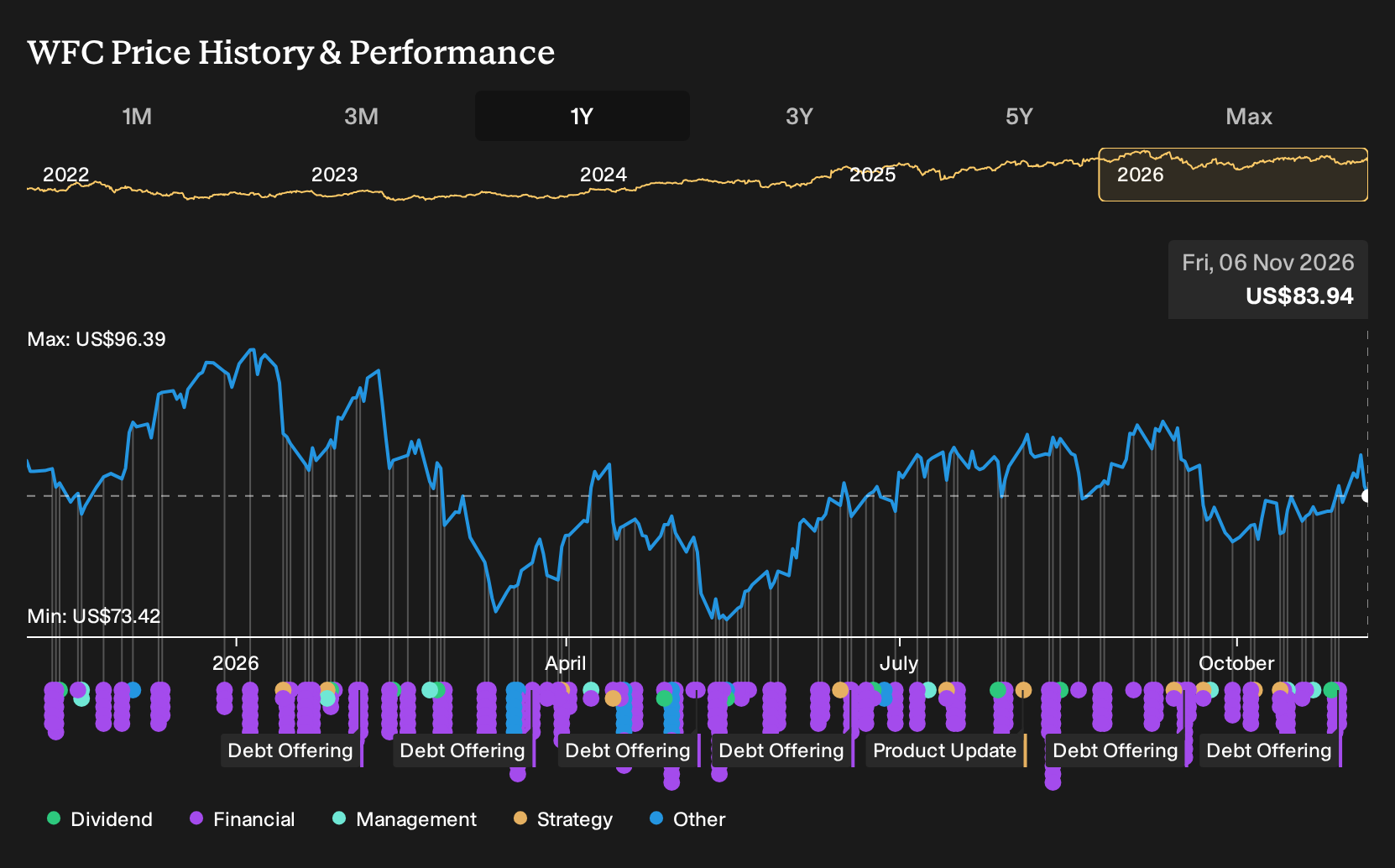
The most relevant fresh data point for this story is the board’s decision to affirm a US$0.50 quarterly common dividend, payable on December 1, 2026. For an investor, that matters because it signals Wells Fargo is comfortable maintaining cash returns while it issues new fixed rate senior notes and reshapes its cost base.
Those new callable senior unsecured notes, with coupons between 5.55% and 6.45% across 2030 to 2046 maturities, add another layer to the funding mix that supports loan growth, Markets activity and corporate and investment banking ambitions. The key question for you is whether that capital can be deployed in a way that offsets net interest margin pressure and card profitability risks.
What The Current Forecasts Assume For Wells Fargo
Analysts are effectively asking investors to underwrite a bigger Wells Fargo that earns more on a slightly slimmer margin profile. The current set of projections leans on mid single digit loan and fee growth, cost cuts from headcount reductions and technology, and a capital plan that keeps buybacks and dividends in the mix.
On these projections, revenue is expected to compound at 7.7% a year over the next three years, while profit margins soften from 26.4% today to 23.1% by 2029. Together, those figures outline a business that grows the overall profit pool through volume and mix, even as each dollar of sales converts into a bit less bottom line than it does now.
Earnings are forecast to reach US$24.0b by 2029, compared with US$22.0b today. This is an uplift of US$2.0b in absolute profit on the consensus view, with some analysts pencilling in as much as US$27.4b if fee businesses and efficiency gains are closer to the upper end of expectations.
These assumptions sit alongside a share count that analysts expect to decline by about 4.38% a year over the next three years. If that occurs, per share figures such as earnings and dividends would be supported by fewer shares outstanding even if the total earnings pool only edges higher.
On valuation, the same consensus assumes Wells Fargo trades on a P/E multiple of 13.7x by 2029, compared with 11.0x today and 11.4x for the broader US banks group. This reflects a market view that could be willing to pay more per dollar of profit for a cleaner, more fee weighted and more efficient institution than the one investors see today.
Wells Fargo's current analyst narrative points to US$103.9b in revenue and US$24.0b in earnings by 2029. This is based on 7.7% yearly revenue growth and an earnings increase of about US$2.0b from US$22.0b today.
Discover why Wells Fargo's fair value indicates a 15% potential upside to its current price, which could materialize faster than many investors expect.
Exploring Other Perspectives
Fair value estimates for Wells Fargo from four members of the Simply Wall St Community stretch from about US$97 to roughly US$142 a share, so you are looking at a wide gap between the most cautious and the most optimistic views. Layer in the funding shift from recent fixed income offerings, plus the ongoing credit card and net interest margin risks, and it becomes clear that opinions can diverge sharply. Use that spread as a prompt to explore several alternative viewpoints before deciding how this efficiency and fee income story fits into your own portfolio framework.
Explore 3 other Wells Fargo fair value estimates, including one that suggests potential upside of up to 67% from the current price.
Form Your Own Verdict
Don't just follow the ticker. Dig into the data and build a conviction that's truly your own.
- A great starting point for your Wells Fargo research is our analysis highlighting 3 key rewards and 1 important warning sign that could impact your investment decision.
- See our latest analysis for Wells Fargo. The report includes a comprehensive fundamental analysis summarized in a single visual, the Snowflake, making it easy to evaluate Wells Fargo's overall financial health at a glance.
Looking For More Investment Ideas Beyond Wells Fargo?
Once you have formed a view on Wells Fargo, it helps to set it alongside other opportunities that match different risk and return profiles. The Simply Wall St Screener lets you do that quickly by filtering for quality, value and balance sheet strength in a structured way.
- If you want potential mispricing with quality to back it up, you can scan a curated group of 42 high quality undervalued stocks that combine stronger fundamentals with supportive valuations.
- For investors who care most about durability and capital preservation, you can focus on companies in our 32 resilient stocks with low risk scores that score well on financial resilience.
- If you prefer to hunt for less crowded ideas, you can cast a wider net across 21 high quality undiscovered gems that pair healthier financial profiles with lower market attention.
Have feedback on this article? Concerned about the content? Get in touch with us directly. Alternatively, email editorial-team@simplywallst.com