


EN
Earnings Miss Could Be A Key Test For Lincoln National Stock (LNC)
- Lincoln National reported past third quarter 2026 results with US$5.06b in revenue and US$1.72 in EPS, pairing higher sales with weaker profitability versus prior expectations.
- Beneath the headline numbers, negative net flows in Retirement Plan Services and Annuities, along with a higher Group Protection loss ratio, point to pressure on recurring fee income and insurance claims costs.
- Attention now turns to how Lincoln National's mixed earnings, especially the EPS shortfall against expectations, may reshape the broader investment narrative.
Compare how Lincoln National's mixed quarter stacks up against other insurers by scanning a curated set of 32 resilient stocks with low risk scores that may better balance earnings quality with balance sheet resilience.
Lincoln National Investment Narrative Recap
To own Lincoln National, you need to be comfortable with a reshaping story that leans on cleaner capital, higher quality earnings and less reliance on legacy guarantees. The latest quarter delivered higher revenue but an EPS miss, with pressure from negative net flows in Retirement Plan Services and Annuities and a tougher Group Protection loss ratio. The near term swing factor is whether management can steady those flows while keeping underwriting discipline.
The biggest operational risk right now remains persistent outflows from older annuity and retirement blocks, which can cap fee based income and keep earnings choppy. On the flip side, completed reinsurance deals, alternative investment returns and progress on capital actions from earlier in 2026 support the idea that Lincoln National has more flexibility to absorb softer quarters without changing the core thesis.
The most relevant recent announcement is management’s update that adjusted operating income, excluding the assumption review, rose 10% year on year, helped by strong alternative investment returns and by closing the Talcott and Fortitude Re transactions. Those moves shifted around 60% of guaranteed universal life reserves to reinsurance partners and retired more than 40% of preferred stock through tender offers.
For you, the link to catalysts is direct. Less capital tied up in legacy life blocks and fewer high cost preferreds can support steadier subsidiary remittances, give management room to keep investing in technology and distribution, and underpin ordinary dividends and buybacks. The trade off is that the earnings mix leans more on execution in spread based annuities and Group Protection pricing, so any stumble there would matter more over time.
What The Lincoln National Forecasts Are Telling You
Lincoln National's consensus story is surprisingly simple once the headline targets are stripped down to their moving parts. Analysts are working with a picture of modest top line expansion, slimmer profitability and a lower earnings base by the time forecasts roll into the next decade. That mix matters if you are weighing whether the recent earnings miss is a short term wobble or a sign that the profit pool itself is shrinking over time.
On the revenue side, the current models build in 4.1% yearly growth for the next three years. That is tied to the same themes already in focus this year: a larger tilt toward fee and spread income in retirement and annuities, plus steadier contributions from Group Protection. The expectation is that premium, deposit and fee volumes keep inching higher as the product mix reshapes, not that Lincoln National suddenly sources a new line of business.
Earnings tell a different story. Analysts estimate profit of US$2.3b today and project that figure to sit at US$1.9b by 2029. That is a decline of about US$0.4b in total income even as revenue rises, which reflects lower assumed net margins as the firm leans into lower guarantee designs and a different capital structure. For you as an investor, the key question is whether that smaller earnings base still supports the balance sheet and capital returns you care about.
Profitability assumptions make that trade off clear. Forecasts bake in margins stepping down from 11.7% today to 8.5% in three years. Shrinking margins with still growing revenue suggest a model where pricing, hedging costs, and mix all pull against headline sales. If that plays out, reported profit can feel underwhelming even if top line trends look steady on the surface.
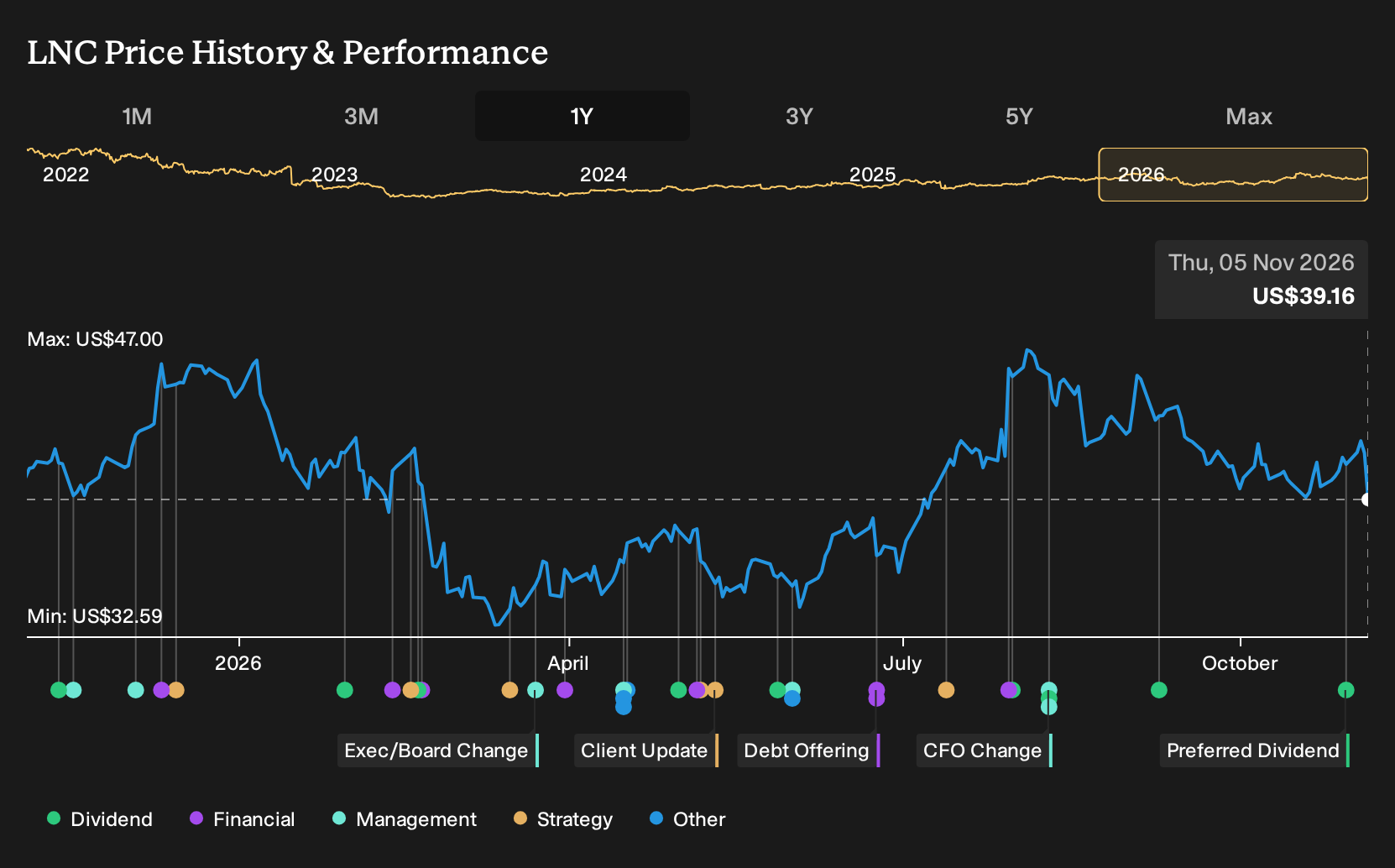
Valuation inputs in the report simply apply a P/E multiple to these lower earnings forecasts. Analysts assume Lincoln National would trade at 6.3x on 2029 consensus profit, compared with 3.4x today and against a reported 10.7x for the broader US insurance peer group. That required re rating is doing a lot of the work in closing the gap between a current share price of US$40.3 and the US$47.92 average target.
Price targets themselves are spread out. The top end sits at US$60.0, the low at US$35.0, with the US$47.92 mid point about 15.9% above where the stock is quoted now. That range tells you analysts do not share a single clean view on how much the earnings base, margin profile and capital release story are worth when pulled together.
Lincoln National's narrative projects US$21.9b revenue and US$1.9b earnings by 2029. This requires 4.1% yearly revenue growth and an earnings decrease of about US$0.4b from US$2.3b today.
For your own work, the useful exercise is to reverse engineer those same numbers. Ask whether 4.1% annual revenue growth looks realistic given the recent pressure in Retirement Plan Services flows and annuity outflows. Then decide if an 8.5% margin feels conservative or generous in light of Group Protection loss ratios normalizing and the mix shift away from rich legacy guarantees.
The discount rate assumptions round out the framework. Analysts reference a 7.58% rate in the underlying company report and use 7.6% in the valuation summary when translating future earnings into a present value. Those figures sit in a middle ground that neither heavily penalizes nor aggressively rewards future cash flows, so any change in your own required return can quickly move your sense of fair value away from the consensus mark.
All of this leaves you with a clear checklist. Lincoln National needs to keep nudging revenue higher, stop margin slippage from overshooting the 8.5% assumption, and keep delivering on the capital light, reinsured model that is meant to smooth earnings. If any one of those pieces drifts materially off course, the path that ties the current share price to the 2029 analyst playbook becomes harder to line up.
Uncover why Lincoln National's fair value indicates a 22% potential upside to its current price that could narrow quickly.
Exploring Other Perspectives
Some of the most optimistic analysts focus on capital returns as the swing factor for Lincoln National, not just earnings levels. Before this quarter, the bullish camp was working off roughly US$22.9b of 2029 revenue and US$1.7b of earnings, and a US$57.0 price target. Those projections did not reflect the fresh Q3 EPS miss or the very strong GAAP results, so views across the analyst spectrum may change from here. Investors can then decide which storyline they find more convincing.
Explore 3 other Lincoln National fair value estimates, including one that suggests up to 187% upside from the current price.
Decide For Yourself
Don't just follow the ticker. Dig into the data and build a conviction that's truly your own.
- A great starting point for your Lincoln National research is our analysis highlighting 4 key rewards and 2 important warning signs that could impact your investment decision.
- See our latest analysis for Lincoln National. The report includes a comprehensive fundamental analysis summarized in a single visual, the Snowflake, making it easy to evaluate Lincoln National's overall financial health at a glance.
Looking For More Investment Ideas Beyond Lincoln National?
If Lincoln National's story has sharpened your thinking but you want a broader watchlist, a few focused stock sets can help you stress test your approach across different business models and risk profiles.
- If capital preservation and smoother returns matter most to you, scan a curated group of companies through the 32 resilient stocks with low risk scores.
- For investors hunting for quality at a measured entry point, compare Lincoln National with a wider bench of potential bargains by reviewing the 42 high quality undervalued stocks.
- If balance sheet strength is your first filter before anything else, start with a list of solid balance sheet and fundamentals (24 results) to see which businesses clear that hurdle.
Have feedback on this article? Concerned about the content? Get in touch with us directly. Alternatively, email editorial-team@simplywallst.com