


EN
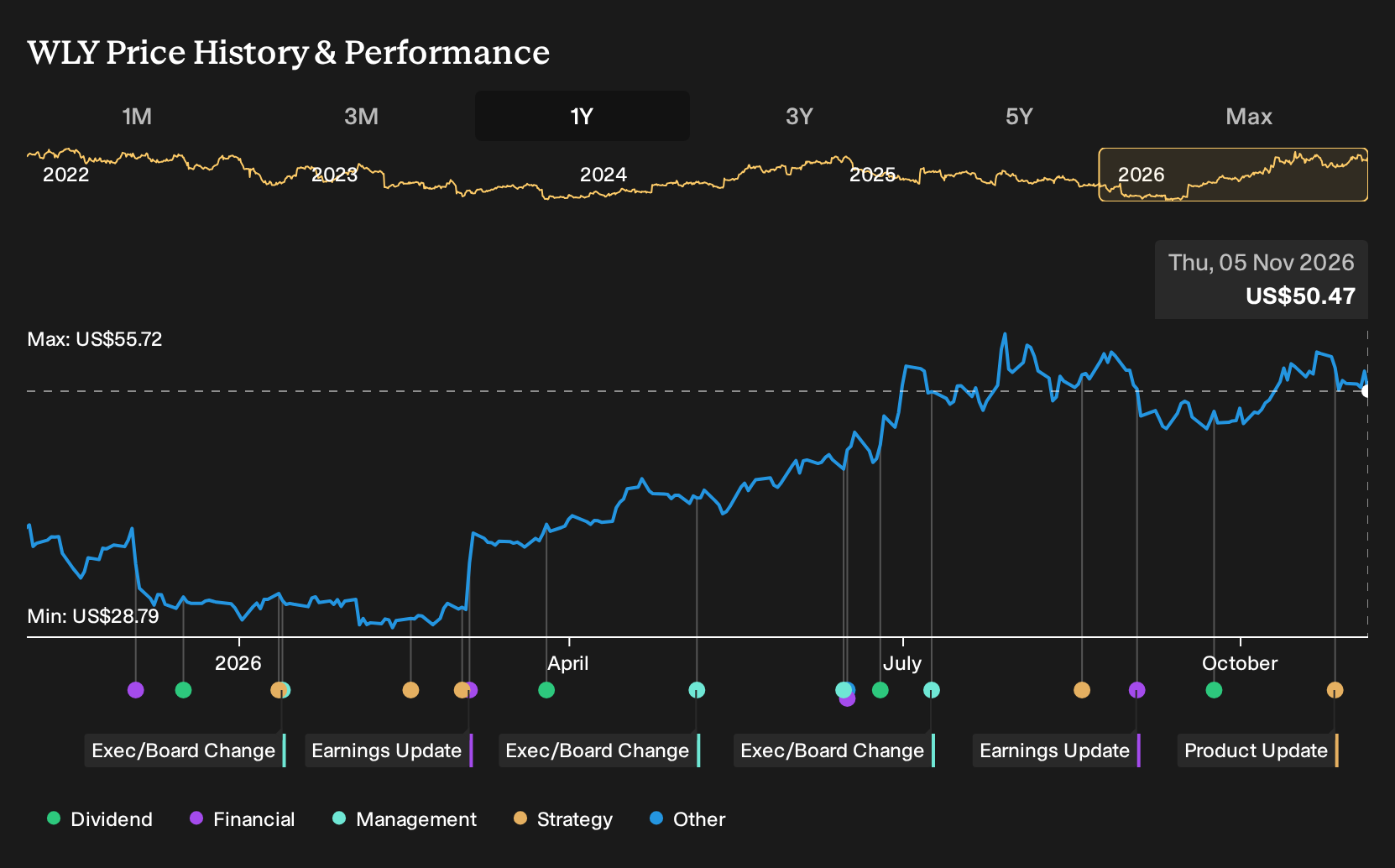
Did New Open Access Journals Just Shift Wiley's (WLY) Investment Narrative?
- John Wiley & Sons recently added four open access titles to its Advanced Portfolio, bringing the collection to 36 multidisciplinary research journals that are now accepting submissions across urban systems, food, microbiome science, and psychology.
- The move extends Wiley's open access footprint, which can affect article volume, publishing costs, and the balance between subscription and author funded research revenue.
- We now examine how this latest expansion in Wiley's Advanced Portfolio may influence the broader investment narrative around its research publishing operations.
Compare how John Wiley & Sons' push into open access stacks up against peers focusing on scalable research content by reviewing our curated list of 21 high quality undiscovered gems in publishing and adjacent information services.
John Wiley & Sons Investment Narrative Recap
To own John Wiley & Sons, you need to believe the research and learning business can keep shifting toward digital, open access, and data driven services while still funding its dividend and managing a meaningful debt load. The key near term swing factor is execution on higher margin digital research and AI related partnerships, while handling lumpy one off items that have affected reported earnings quality.
The new open access titles slightly reinforce that long term pivot, but they do not change the biggest immediate risk. That risk is pressure on traditional subscription and print channels at a time when AI licensing revenue is uncertain and hard to forecast. The earnings profile remains sensitive to funding cycles, pricing on institutional contracts, and how efficiently Wiley integrates new journals into its cost base.
The most relevant recent datapoint alongside the new journals is Wiley’s dividend track record. The firm currently pays US$0.36 per share with a 2.73% yield, above the Publishing, Books industry average, and has raised the payout for five consecutive years. Management is signaling a desire to keep returning cash while the portfolio tilts further toward open access and digital research tools.
For you as a shareholder, the key question is whether that dividend and the forecast earnings expansion, including a Zacks estimate of US$4.80 per share in 2026, can coexist with heavy investment in areas like the Advanced Portfolio and AI partnerships. If open access growth compresses margins faster than digital and licensing revenue scale, dividend flexibility and debt management could quickly become more important catalysts than new title launches.
John Wiley & Sons is currently modeled to move from earnings of US$221.6 million today to US$224.2 million by 2029, with analysts expecting revenues of US$1.9b in that same year. That profile implies forecast top line growth of 4.7% per year and an earnings increase of about US$2.6 million over the period.
Uncover why John Wiley & Sons' fair value indicates a 35% potential upside to its current price, which could narrow quickly.
Exploring Other Perspectives
Fair value estimates for John Wiley & Sons from the Simply Wall St Community span roughly US$68 to about US$84.5 across 2 individual models, so you are looking at a wide bracket of opinions. When you set that beside risks around AI licensing volatility and open access margin pressure, it becomes worth exploring several contrasting viewpoints before committing fresh capital.
Explore another John Wiley & Sons fair value estimate, including one that suggests it could be worth just $68.00!
The Verdict Is Yours
Don't just follow the ticker. Dig into the data and build a conviction that's truly your own.
- A great starting point for your John Wiley & Sons research is our analysis highlighting 5 key rewards and 2 important warning signs that could impact your investment decision.
- See our latest analysis for John Wiley & Sons. The report includes a comprehensive fundamental analysis summarized in a single visual, the Snowflake, making it easy to evaluate John Wiley & Sons' overall financial health at a glance.
Looking for more John Wiley & Sons style investment ideas?
If the John Wiley & Sons story has you thinking about where else steady cash flows, solid balance sheets, or income streams might come from, the Simply Wall St Screener can help you widen the field in a structured way.
- If you want companies that combine financial resilience with cleaner balance sheets, start with a curated list of solid balance sheet and fundamentals (24 results) that have the strength to handle tougher conditions.
- If value is your priority, scan a focused 42 high quality undervalued stocks that blend quality fundamentals with prices that screens flag as below fair value estimates.
- If dependable income is on your radar, zero in on a targeted 6 dividend fortresses that can help you build a watchlist of potential yield ideas.
Have feedback on this article? Concerned about the content? Get in touch with us directly. Alternatively, email editorial-team@simplywallst.com