


EN
Lending Pullback Might Change The Case For Investing In Truist Financial (TFC)
- Truist Financial is reshaping its business mix by exiting or scaling back select lending operations, reviewing expenses, and reinforcing investments in deposits, wholesale banking, wealth and payments.
- The bank is also upgrading merchant services and digital onboarding, which shortens implementation time and tightens the link between payments data and core banking relationships.
- This article examines how Truist Financial's investment narrative shifts as it reallocates capital toward core deposits and payments capabilities.
Truist Financial Investment Narrative Recap
To own Truist Financial, you need to be comfortable with a bank that is still reworking its business mix toward digital deposits, payments and fee income while carrying legacy exposure to commercial real estate and a relatively heavy branch footprint. In the near term, the story hinges on execution in payments and treasury services, plus disciplined credit and expense control.
The most important short term catalyst is whether Truist can translate its payments and onboarding upgrades into deeper client relationships and stickier deposits without letting costs drift higher. The key risk remains credit and regulatory pressure, combined with a large physical network that could keep efficiency from improving meaningfully.
The recent merchant services announcement sits directly in the middle of that catalyst. Truist Financial is shortening merchant onboarding times by up to 80% and tying payments data more tightly into core banking. That directly affects how effectively Truist can win and keep business clients who want a single provider for banking, software and payments.
If the new merchant platform and Truist Merchant Engage tools scale smoothly, the bank may have more scope to grow non interest income and deepen treasury relationships, which can support deposits and funding stability. Execution missteps, or weak adoption of tools like broader Clover access and Paze, would limit that potential benefit and could leave Truist leaning more heavily on lending in a tougher regulatory and CRE backdrop.
Truist Financial's narrative projects US$23.8b revenue and US$6.1b earnings by 2029. That assumes 9.3% yearly revenue growth and an earnings increase of about US$1.2b from current earnings of US$4.9b.
Discover how Truist Financial's fair value indicates a 7% potential upside to its current price before the market closes that gap.
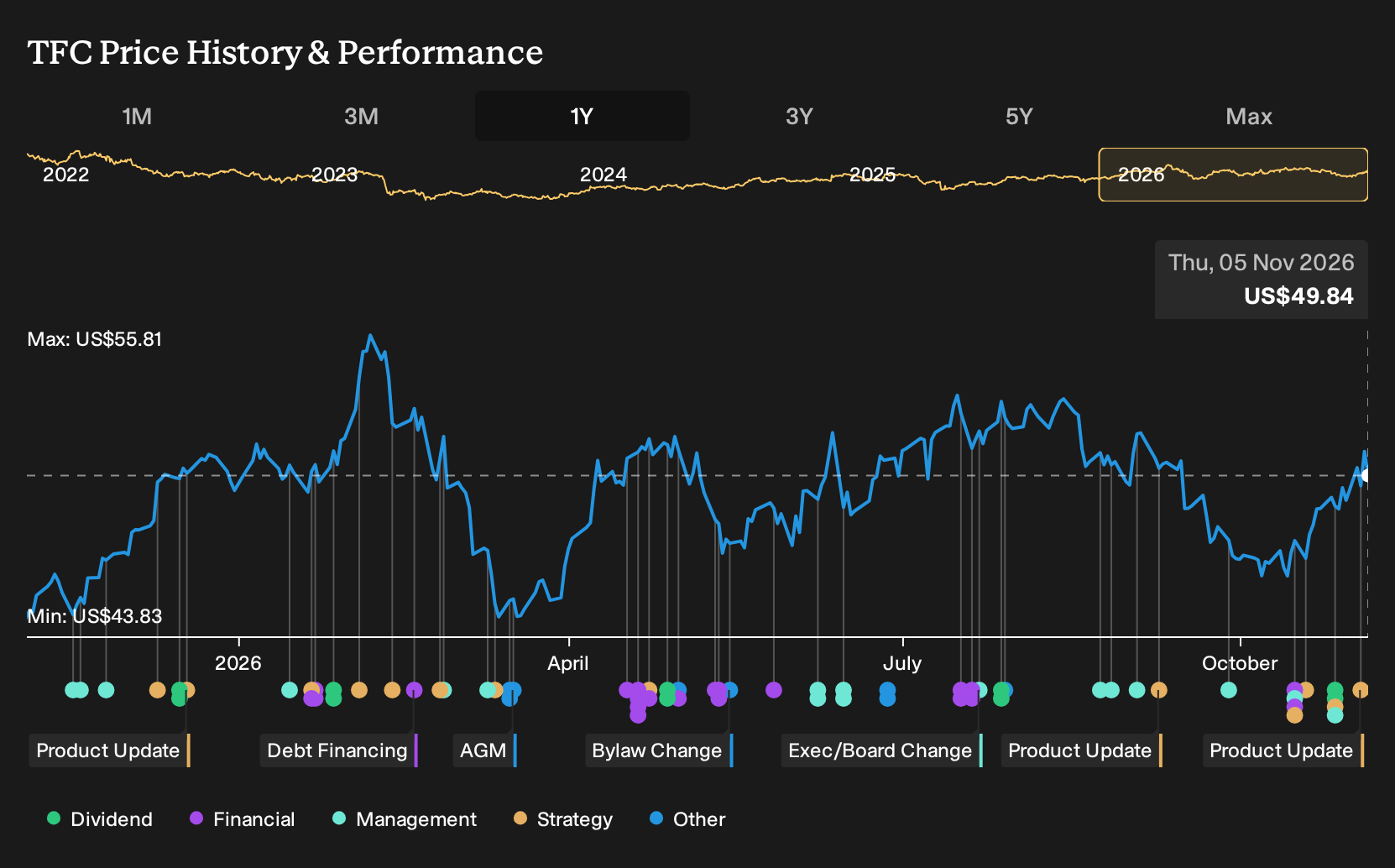
Exploring Other Perspectives
Three fair value estimates from the Simply Wall St Community cluster between about US$53.40 and US$72, which shows how far private investors can spread on Truist Financial. Some focus on digital payments and the recent merchant services rollout as a possible earnings catalyst. Others flag branch costs and commercial real estate exposure as persistent pressure points. Readers should compare these contrasting views and decide which assumptions feel more realistic.
Explore 2 other Truist Financial fair value estimates, including one that suggests it could be worth just $53.40.
The Verdict Is Yours
Don't just follow the ticker. Dig into the data and build a conviction that's truly your own.
- A great starting point for your Truist Financial research is our analysis highlighting 3 key rewards that could impact your investment decision.
- See our latest analysis for Truist Financial. The report includes a comprehensive fundamental analysis summarized in a single visual, the Snowflake, making it easy to evaluate Truist Financial's overall financial health at a glance.
Looking for more investment ideas beyond Truist Financial?
If you want to stress test your view on Truist Financial, compare it with other businesses that share some of the same themes, such as balance sheet strength, income potential, or being under the radar. The Simply Wall St Screener can help you scan for stocks that better match your own risk tolerance and return goals.
- For investors who care most about quality and valuation discipline, review a carefully filtered set of companies that screen as mispriced on fundamentals through the 42 high quality undervalued stocks.
- If steady income matters more to you than price swings, focus on businesses with higher yields and a history of paying out to shareholders by checking the 6 dividend fortresses.
- To prioritize resilience and financial robustness over sheer upside, concentrate on companies with stronger balance sheets and cleaner financial profiles by using the list of solid balance sheet and fundamentals (24 results).
Have feedback on this article? Concerned about the content? Get in touch with us directly. Alternatively, email editorial-team@simplywallst.com