


EN
Did Lawsuits Over Bookings Shift D Wave Quantum's Stock Narrative?
- D-Wave Quantum is facing multiple securities class action lawsuits filed in 2026 that allege misleading disclosures around bookings, revenue recognition timing, demand conversion and shipment delays, alongside investor concern tied to disappointing financial results and senior finance leadership turnover.
- The legal focus on how and when D-Wave Quantum books and recognizes system and QCaaS revenue goes straight to the credibility of its reported growth profile and the reliability of its contract pipeline as a guide to future operating performance.
- The next area of focus is how these allegations around booking quality and revenue timing might reshape D-Wave Quantum's broader investment narrative.
D-Wave Quantum Investment Narrative Recap
To own D-Wave Quantum, you need to believe its quantum optimization tools can mature from pilots into repeatable, multi year QCaaS contracts while the business absorbs continued losses. The short term swing factor is still execution on bookings and system deliveries, because those large deals shape reported revenue and investor confidence in the pipeline.
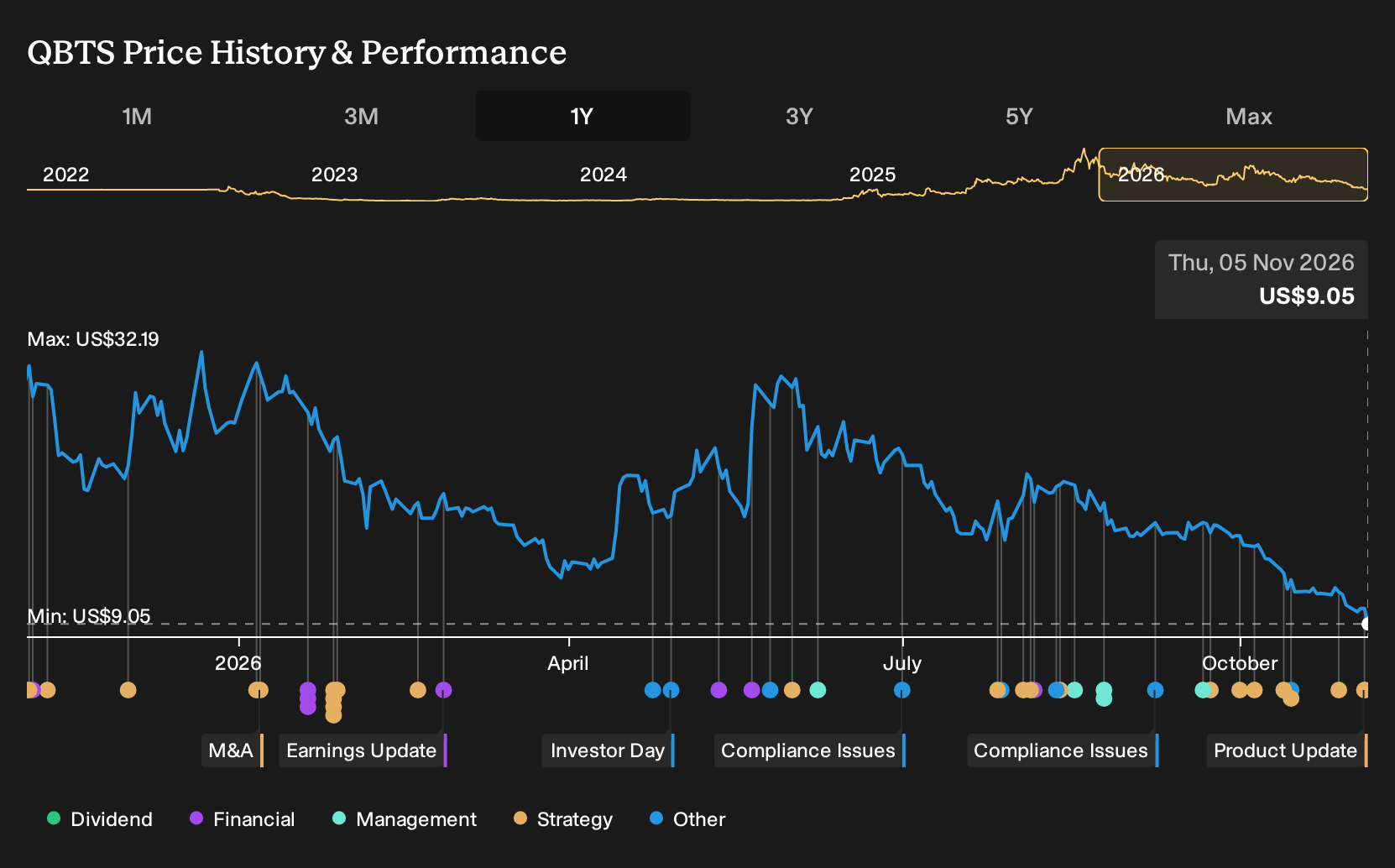
Recent lawsuits over disclosures keep the biggest risk in plain sight. Trust in reported bookings quality and revenue timing is under scrutiny, and the stock has already fallen sharply this year. Even strong product updates do not materially change that near term risk until customers scale usage and cash burn trends become clearer.
The Stride hybrid solver upgrade is the clearest recent operational data point. Faster and higher quality solutions on problems such as large traveling salesperson instances speak directly to D-Wave Quantum’s claim that annealing plus classical resources can tackle complex optimization where classical tools alone struggle. That claim is central to the long term QCaaS story.
Pairing the improved solver with the Applied Quantum Optimization learning path matters because the main catalyst is still broader, deeper customer adoption rather than one off hardware contracts. Better tools and education can help existing users move beyond proofs of concept into more frequent workloads, although that needs to translate into contract size and usage growth against ongoing legal and funding risks.
D-Wave Quantum Forecast Checkpoint
D-Wave Quantum's narrative projects US$201.1 million revenue and US$23.0 million earnings by 2029. This implies very large yearly revenue growth of about 152.9% and an earnings improvement of about US$271.7 million from current earnings of a US$248.7 million loss.
Analysts are effectively sketching a scenario where D-Wave Quantum moves from deep losses to positive earnings while scaling its top line sharply. Those assumptions rest on profit margins shifting from deeply negative levels toward something closer to a typical US software business over the next few years. That pivot would require a very different mix of recurring QCaaS usage, hardware deals and operating costs than seen in recent reports.
The step change in profitability embedded in the consensus, from a loss of US$248.7 million today to forecast earnings of US$23.0 million in 2029, assumes that quantum optimization workloads broaden and that spending on research, sales and overhead becomes more efficient relative to revenue. For you as an investor, the key issue is not whether the model is theoretically possible; instead, it is whether the path implied by those numbers feels realistic given D-Wave Quantum's execution, customer concentration and legal overhang.
Uncover why D-Wave Quantum's fair value indicates a 289% potential upside to its current price that could narrow quickly.
Exploring Other Perspectives
One alternate take on D-Wave Quantum zooms in on cash burn risk. The most cautious analysts already assumed only about US$149.9 million of revenue and US$18.5 million of earnings by 2029, with a very high implied P/E. That view is far more skeptical, and the latest product news could still push expectations in either direction.
Explore 6 other D-Wave Quantum fair value estimates, including one that suggests it could be worth just $20.97.
Reach Your Own Conclusion
Disagree with existing narratives? Extraordinary investment returns rarely come from following the herd, so go with your instincts.
- A great starting point for your D-Wave Quantum research is our analysis highlighting 1 key reward and 1 important warning sign that could impact your investment decision.
- See our latest analysis for D-Wave Quantum. The report includes a comprehensive fundamental analysis summarized in a single visual, the Snowflake, making it easy to evaluate D-Wave Quantum's overall financial health at a glance.
Looking For More Investment Ideas Beyond D-Wave Quantum?
If the D-Wave Quantum story feels too binary for your taste, it can help to balance it with other opportunities that match your risk comfort and income goals. The Simply Wall St Screener lets you filter the market down to a handful of focused shortlists so you can spend time comparing fundamentals instead of trawling through tickers.
- For investors comfortable with smaller companies but wanting financial substance, review a curated group of 9 elite penny stocks with strong financials that pair low share prices with stronger underlying metrics.
- If capital preservation comes first for you, check out a targeted selection of 32 resilient stocks with low risk scores that score well on resilience and balance sheet strength.
- For those hunting for quality that is not already crowded, scan a focused pool of 21 high quality undiscovered gems where fundamentals, not headlines, do the talking.
Have feedback on this article? Concerned about the content? Get in touch with us directly. Alternatively, email editorial-team@simplywallst.com