


EN
Flight Centre Travel Group And 2 Australian Founder Led Stocks To Own
Global markets are punishing AI related stocks after the US election outcome raised the risk of tighter rules on data centres. When momentum trades crack, attention often shifts to businesses where founders still own a meaningful stake and think in decades, not quarters. That is where founder led Australian companies come in. This article highlights three of the strongest candidates from that group and explains what sets each apart.
The three stocks highlighted here offer a compelling starting point if you want exposure to founder led businesses where leadership is personally invested in the outcome. However, if you want the standouts, these 7 top founder-led companies are the most outstanding.
Flight Centre Travel Group (ASX:FLT)
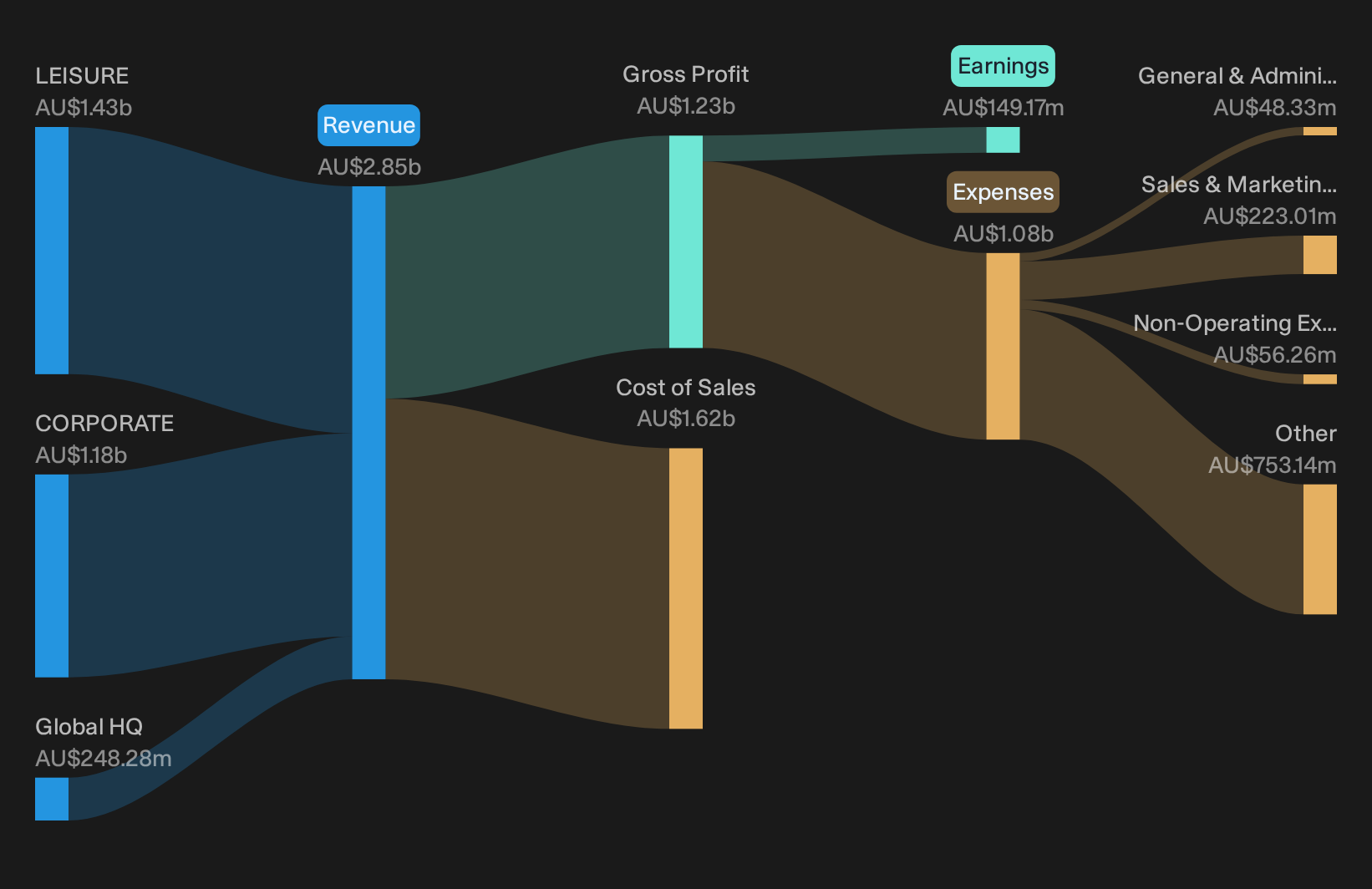
Overview: Flight Centre Travel Group runs founder-shaped leisure and corporate travel brands worldwide, connecting customers with airlines, hotels, cruises and broader travel services.
Operations: Flight Centre Travel Group generates about A$1.43b from leisure and A$1.18b from corporate travel, with A$1.49b coming from Australia and New Zealand.
Market Cap: A$2.55b
Flight Centre Travel Group fits this founder-led theme because Graham Turner’s long involvement and culture imprint still guide how the travel portfolio is run. This matters when the business is juggling capital returns, technology spend and shifting travel demand.
"Although Flight Centre Travel Group reports sizeable productivity gains in corporate travel consultant output, the shift of productive operations costs of about A$12 million into operating expenses in FY27 is set to raise the reported cost base and can limit how much of any future TTV uplift actually reaches EBIT and net margins."
The real test for Flight Centre Travel Group is whether one subtle shift in cost mix ultimately hardens or softens the margin story investors care about.
If that margin puzzle has your attention, the full narrative for Flight Centre Travel Group shows how Flight Centre Travel Group’s cost mix, capital choices and founder imprint could be quietly reshaping future earnings quality.
Mesoblast (ASX:MSB)
Overview: Mesoblast develops regenerative cell therapies such as Ryoncil and rexlemestrocel-L for severe inflammatory, cardiovascular and degenerative conditions, guided by founder-linked leadership.
Operations: Mesoblast currently generates about US$120 million from developing and commercializing its allogeneic cellular medicines platform across its therapy portfolio.
Market Cap: A$2.82b
Mesoblast appeals to founder-focused investors because the same founder-linked leadership that built its mesenchymal cell platform is still steering Ryoncil and other late-stage therapies through commercial and regulatory turning points.
"The first and only FDA approved mesenchymal stromal cell product in the U.S., Ryoncil, together with over 1,100 patents and established commercial scale manufacturing, positions Mesoblast to benefit if cell therapies gain wider medical adoption."
What matters next for Mesoblast is how a single pivot in clinical and reimbursement momentum ultimately shows up in pricing power and long-term margins.
That is where the full narrative for Mesoblast maps how Mesoblast’s regulatory path, capital runway and clinical risk could be quietly accelerating or stalling the long term payoff.

Harvey Norman Holdings (ASX:HVN)
Overview: Harvey Norman Holdings runs founder-influenced big-box retail, franchising and property, with Gerry Harvey and family still major long-term owners.
Operations: Harvey Norman generates about A$952 million from New Zealand, A$777 million from Ireland, A$787 million from Singapore and Malaysia, plus A$232 million from non-franchised retail and A$260 million from Slovenia and Croatia.
Market Cap: A$5.62b
Harvey Norman matters for a founder-led screen because its retail and property engine is still tied to Gerry Harvey’s long-term ownership mindset rather than a short-term executive cycle. This shapes how the group balances big-box stores, franchising economics and a sizeable property portfolio.
"It is worth noting, however, that just over 20% of 2025 profit can be attributed to property revaluations, non-cash gains that can be volatile and are not recurring operational earnings."
The real question for Harvey Norman is how one quiet shift inside that property and franchise machine ultimately filters through to everyday earnings power.
That shift in everyday earnings power is exactly where the full narrative for Harvey Norman Holdings digs in, separating temporary valuation noise from what could be a quietly compounding retail and property engine.

Seeking Alternatives Before The Crowd?
Fresh ideas rarely stay quiet for long. Momentum shifts fast, breakouts get chased and laggards get dropped. Catch under the radar lists while it matters and decide whether to get in early.
- Spot cash generative outliers early by scanning the list of solid balance sheet and fundamentals (12 results) before they get fully priced by broader market participation.
- Explore potential yield resilience by sifting through the 5 dividend fortresses while share prices and payout ratios still look reasonable to you.
- Evaluate possible small cap cycles by reviewing the 22 elite penny stocks with strong financials that already pair cleaner financials with higher quality business models.
Have feedback on this article? Concerned about the content? Get in touch with us directly. Alternatively, email editorial-team@simplywallst.com