


EN
US stock outlook | Futures of the three major stock indexes had mixed ups and downs, and the US hit the non-agricultural sector tonight in October, and chip stocks rebounded sharply
Pre-market market trends
1. Before the US stock market on November 6 (Friday), futures for the three major US stock indexes had mixed ups and downs. As of press release, Dow futures were down 0.99%, S&P 500 futures were up 0.31%, and NASDAQ futures were up 1.62%.

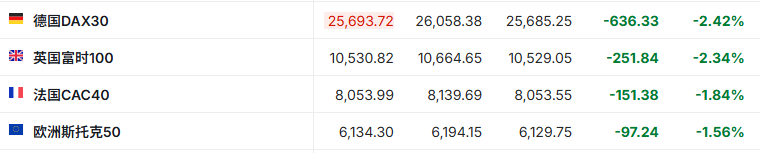
2. As of press release, the German DAX index fell 2.42%, the UK FTSE 100 index fell 2.34%, the French CAC40 index fell 1.84%, and the European Stoxx 50 index fell 1.56%.
3. As of press release, WTI crude oil rose 0.54% to 91.01 US dollars/barrel; Brent crude rose 0.47% to 98.75 US dollars/barrel.

Market news
The non-agricultural sector may release an anti-inflation signal tonight: the number of employed people is expected to pick up, but the wage growth rate may fall below 3% for the first time in five and a half years. The number of non-farm payrolls in the US may have rebounded in October, but wage growth is expected to slow below 3.0%, for the first time in nearly five and a half years. This will reinforce the view that the labor market is not a source of inflation. The high-profile employment report to be released by the Department of Labor on Friday is also expected to show that the unemployment rate remained unchanged at 4.2% last month, and is likely to have fallen to 4.1%. The historically low number of layoffs and the recent surge in job vacancies have raised the possibility that the labor market will tighten.
The sell-off in US stocks pushes capital to shift to US bond traders betting on a further decline in yields. Before the US employment report for October was released on Friday, bond traders had already bet that the US Treasury bond market would rise further, while market expectations that the Federal Reserve would continue to raise interest rates continued to cool down. Global stock markets were sold off after the US midterm elections, driving investors to take refuge on US Treasury bonds this week. The 10-year US bond yield fell to its lowest level since the beginning of September on Thursday.
AI sent positive signals, and NASDAQ futures fought back. Analysts said that the previous sharp decline in US stocks was mainly due to market expectations that AI infrastructure might change as the Democratic Party came to power. However, news today suggests that the matter may not be “sparing no effort to suppress AI” as imagined. Gavin Beck, a well-known technology investor and founder of Atreides Management, posted on X on Thursday that Texas governor-elect Gina Hinojosa has made it clear that all currently licensed Texas data centers will be allowed to complete construction. Hinojosa plans to pass legislation requiring data centers that are newly licensed and scheduled to be delivered from 2028 to 2029 to pay taxes, promise not to push up residents' electricity prices, not affect residents' water use, use union labor, and allow “Texans to have a place in decision-making.”
Federal Reserve Williams: The level of inflation has been too high for too long. Federal Reserve Williams recently delivered a speech: “Currently, the US labor market is extremely stable and stable. The resilience of the US economy is remarkable, and growth has increased. The current level of inflation in the US is too high and lasts too long; the inflation rate must be reduced to 2% in a timely manner. Energy prices are being reflected in ticket prices in an expected manner, and we have also seen a limited impact of artificial intelligence on the price of chips and the like. We have already witnessed the transmission of the impact of tariffs, and now this effect is largely a thing of the past.”
Approximately 40% of the proposed US data center production capacity is located in states considering suspending construction. According to data from market intelligence company Cleanview, about 40% of the US data center capacity plans to be built have landed in these states. In addition, according to statistics, 46 local referendum measures have been or are expected to be passed. These measures will also hinder data center development. At least 17 of these directly prohibit the construction of large-scale data centers.
ABN AMRO plans to sell a $500 million data center loan in a package. According to reports, ABN AMRO is planning to sell a data center loan portfolio totaling about 500 million US dollars in one go. According to people familiar with the matter, the loan portfolio includes a $25 million loan relating to a large data center in New Mexico, USA. The data center is part of “Stargate” (Stargate), an artificial intelligence infrastructure project supported by OpenAI, SoftBank Group, and Oracle. This sale comes at a time when chip makers and so-called “new cloud” companies are facing a wider sell-off.
The situation in the Middle East abates and is expected to heat up. The Qatar Emir's Office said that during a regular phone call with Trump, he discussed measures to ease regional tension through diplomatic efforts. Market hopes for a quicker resolution of the conflict are heating up, but there are still major differences between the two sides. Iran demands that the US lift the naval blockade, ease sanctions, and unfreeze frozen assets before fully reopening the Strait of Hormuz. The report said that Tehran is considering a mediation plan for its nuclear program, which indicates that Qatar's diplomatic efforts to avoid another full escalation of the conflict may be progressing.
Individual stock news
Chip stocks collectively rebounded before the market, and storage and AI chips surged across the board. Driven by overselling repairs after the sharp fall of Thursday, US chip stocks fought back strongly before the market. As of press release, SanDisk (SNDK.US) is up more than 11%, Micron (MU.US) is up more than 9%, AMD (AMD.US) is up more than 9%, AMD (AMD.US) is up more than 8%, TSM.US (TSM.US) is up more than 7%, Intel (INTC.US) is up more than 6%, Broadcom (AVGO.US) is up more than 4%, and Nvidia (NVDA.US) is up more than 4%. The AI computing power demand narrative was partially repaired under performance verification by Cloudflare (NET.US) and IREN (IREN.US), etc., but the shadow of weak previous guidance from Qualcomm (QCOM.US) and Arm (ARM.US) has not dissipated, and whether the sector's rebound can continue depends on tonight's non-agricultural and subsequent AI stock earnings reports.
Cloudflare's Q3 net revenue both beat expectations, surging about 19% before the market. Cloudflare announced the results for the third quarter of 2026 after the market on November 5: revenue of US$782.5 million increased 39% year over year (the fastest quarterly growth rate in the past four years) and non-GAAP earnings of $0.38 per share, all exceeding Wall Street expectations (revenue of $7368 million, EPS 0.34); non-GAAP operating margin of 17.5% reached a record high. The CEO called this season “the best quarter in history”. AI and proxy internet became the main demand line, and active developers surpassed 10 million. The company raised its full-year non-GAAP EPS guidance to $1.35 (for the third time in the year), and the Q4 revenue guidance of $845.5 million exceeded expectations by about 6%.
IREN (IREN.US) Q1 revenue exceeded expectations, but the ARR target was delayed, and it rebounded about 18% before the market. IREN announced the results for the first quarter of fiscal year 2027 (as of September 30) after the market on November 5: revenue of US$228 million increased 66% month-on-month, exceeding expectations of about 221 million, of which AI cloud revenue of 200 million increased 182% month-on-month; net loss of 263 million was narrower than the previous quarter's 684 million, but the loss per share of 0.66 million was greater than expected; the adjusted EBITDA of 66 million exceeded expectations. However, the company postponed Microsoft's annual revenue (ARR) target of over 4 billion US dollars from the end of the year to January 2027 (Microsoft requires a network upgrade).
Anthropic (ANT.US)'s IPO changed, with a valuation of $1.5 trillion or shrinking to $1 trillion. According to reports, AI giant Anthropic's original IPO roadshow scheduled for next week may face variables. Some potential investors questioned that its $1.5 trillion valuation was too high and demanded a larger discount. One investor believes that the valuation may be closer to 1 trillion US dollars. The company continues to record quarterly losses and has invested heavily in AI infrastructure, compounded by the recent sharp sell-off of AI-related assets and weakening market sentiment. If the listing is delayed, it will further heighten market concerns about AI's financing capacity and valuation level, which resonates with the sharp decline in AI stocks this week.
The Democratic Party plans to investigate Apple, Meta (META.US), and Musk's companies. According to reports, senior Democratic Party officials in the US Congress have been studying an 181-page investigation file, which lists hundreds of business executives and companies, and plans to investigate the Democratic Party after taking control of the Senate and House of Representatives next year. The document argues that the Democratic Party should take advantage of the election victory to actively investigate large enterprises, targeting dozens of industries such as tech giants, artificial intelligence laboratories, natural gas companies, private prison operators, and nursing home operators. The document envisages that a series of high-profile congressional hearings will continue to be held next year, requiring healthcare, technology, and energy company executives to attend and be questioned, and pressured in many cases to resign or pay compensation to consumers.
Tesla (TSLA.US) plans to stop production of Cybertruck and switch production to Cybercab. According to reports, Tesla CEO Musk said that the company plans to gradually stop Cybertruck production at the Texas Gigafactory around mid-2027 to free up production capacity to expand the newly launched Cybercab. Since its launch, Cybertruck's performance has fallen short of expectations, and is fraught with many recalls and quality control issues; with Tesla's transformation to AI and autonomous driving, the shift in production capacity towards Cybercab is in line with its strategic focus.
Key economic data and event forecasts
21:30 Beijing time: US non-farm payrolls report for October
22:10 Beijing time: 2028 FOMC voting committee and St. Louis Federal Reserve Chairman Mussalem delivered a speech
23:00 Beijing time: The initial value of the US Consumer Confidence Index for November at the University of Michigan
00:00 Beijing time the next day: Bank of Japan Governor Kazuo Ueda delivered a speech at the International Monetary Fund (IMF), followed by a conversation with IMF Managing Director Georgieva
01:15 Beijing time the next day: Federal Reserve Governor Bauman delivered a speech
02:00 Beijing time the next day: Total number of US drills for the week ending November 6