


EN
Tapestry Stock What Changed After An Earnings Beat And Higher Full Year Guidance
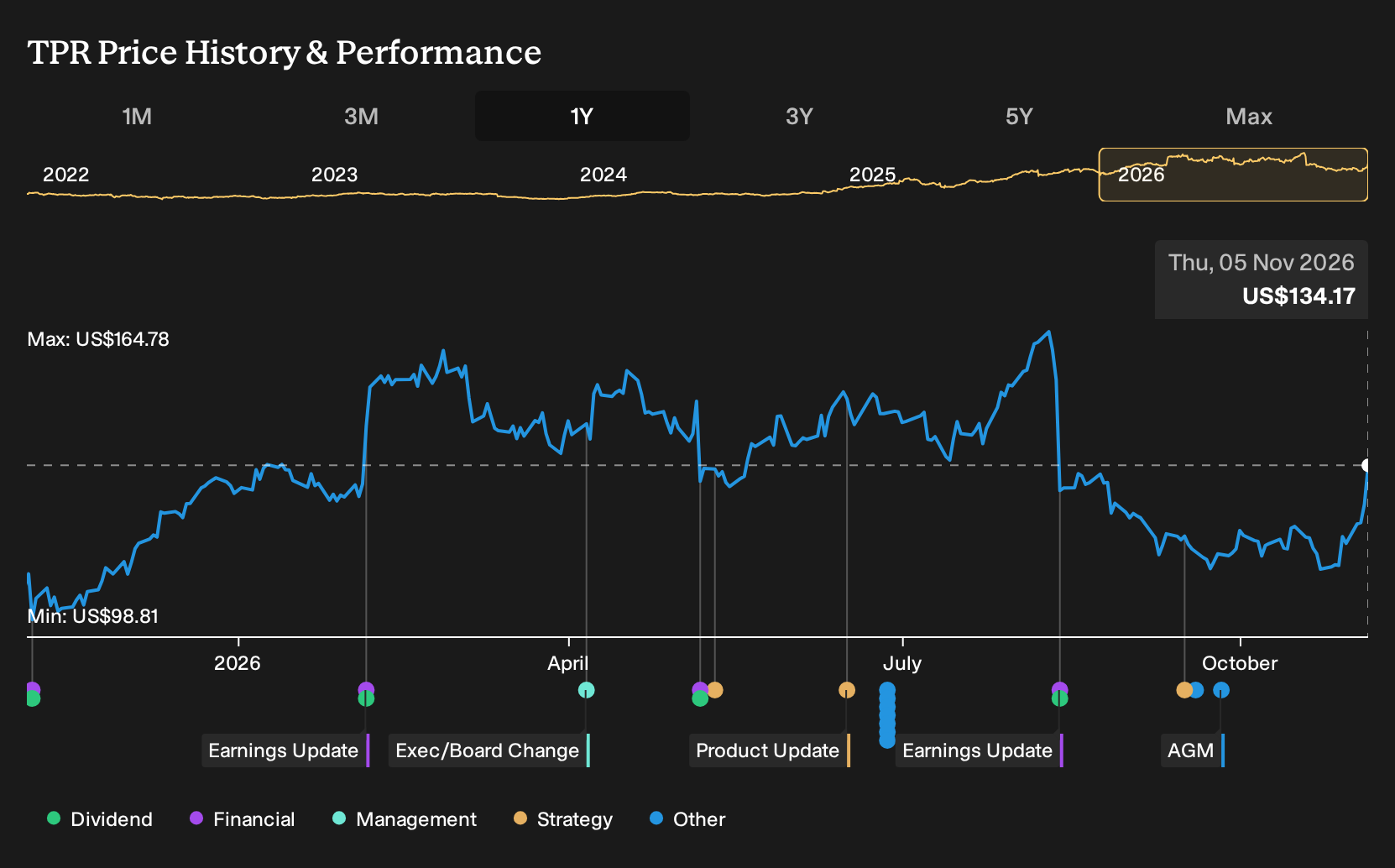
- Tapestry reported fiscal Q1 2027 sales of US$1.894b and net income of US$360 million, with diluted EPS from continuing operations of US$1.76. The company then raised full-year revenue and adjusted earnings guidance while planning about US$2b of capital returns in fiscal 2027.
- The board reaffirmed an annual dividend target of US$1.85 per share and declared a past quarterly dividend of US$0.4625. Together with higher guidance, this highlights management’s focus on pairing earnings strength with ongoing cash returns despite mixed brand performance that includes weaker Kate Spade sales.
- The focus now turns to how Tapestry's raised full-year outlook after an earnings beat could reshape the wider investment narrative.
Compare Tapestry's richer dividend and earnings story with other stocks returning cash to shareholders by scanning our curated 6 dividend fortresses focused on income strength and balance sheet resilience.
Tapestry Investment Narrative Recap
Tapestry shareholders need to be on board with a story that relies on Coach carrying most of the load while Kate Spade remains in repair mode. In the near term, the key swing factor is whether recent strength at Coach and higher margins can continue to offset weaker Kate Spade demand and any tariff or sourcing pressure.
The biggest risk is that the Kate Spade turnaround remains stalled, which would keep weighing on group growth and returns from heavy marketing and omnichannel investment. Recent guidance and dividend clarity help frame expectations, but they do not eliminate the execution risk involved in attracting and retaining younger customers profitably.
The most relevant update is Tapestry reaffirming its annual dividend guidance of US$1.85 per share and declaring a quarterly dividend of US$0.4625. For current or prospective holders, that links the earnings profile directly to ongoing cash distributions while the company invests in direct-to-consumer channels and data capabilities.
A steady dividend plan can support the near-term view that cash generation is keeping pace with higher capital returns, including the US$2 billion distribution target for fiscal 2027. The main points to watch are whether Coach-led international growth and AI-driven merchandising can sustain margins while Kate Spade continues its turnaround and manages tariff exposure.
Tapestry's current analyst narrative points to revenues of US$9.6b and earnings of US$1.9b by 2029. This outlook is built on an assumed 6.1% yearly revenue growth rate and an earnings increase of about US$400m from the US$1.5b reported today.
Uncover why Tapestry's fair value indicates a 21% potential upside to its current price that could close faster than income investors expect.
Exploring Other Perspectives
Some of the most bearish analysts focus on rising customer acquisition costs at Tapestry. Before this dividend affirmation and earnings beat, they were penciling in revenue of about US$9.1b and earnings of roughly US$1.8b by 2029, which is more cautious than consensus. Use that gap as a prompt to compare several viewpoints instead of following a single story.
Explore 3 other Tapestry fair value estimates, including one that suggests as much as 20% downside from the current price.
The Verdict Is Yours
Disagree with existing narratives? Extraordinary investment returns rarely come from following the herd, so go with your instincts.
- A great starting point for your Tapestry research is our analysis highlighting 3 key rewards and 1 important warning sign that could impact your investment decision.
- See our latest analysis for Tapestry. The report includes a comprehensive fundamental analysis summarized in a single visual, the Snowflake, making it easy to evaluate Tapestry's overall financial health at a glance.
Looking For More Ideas Beyond Tapestry?
If Tapestry's mix of income, buybacks, and brand repair work has sharpened your thinking, it can help to compare it with other companies that have different risk and cash return profiles using the Simply Wall St Screener.
- For readers who want potential upside with a margin of safety, weigh Tapestry against a broader pool of candidates screened through 42 high quality undervalued stocks that pair quality fundamentals with attractive pricing.
- If capital preservation and steadier profiles matter more to you than headline growth stories, compare Tapestry with companies in our 32 resilient stocks with low risk scores that focus on resilience and cleaner risk scores.
- When you want to go beyond the well known stocks and hunt for less-crowded situations, scan the 21 high quality undiscovered gems and see which businesses match your criteria on cash flow strength and balance sheet quality.
Have feedback on this article? Concerned about the content? Get in touch with us directly. Alternatively, email editorial-team@simplywallst.com