


EN
Oracle Stock: Analyst Estimates & Ratings
Based in Austin, Texas, Oracle Corporation (ORCL) is a global technology company that provides cloud infrastructure, database software, and enterprise applications. With a market capitalization of approximately $374.1 billion, the company offers products that help businesses manage data, run operations, automate workflows, and leverage artificial intelligence to improve productivity, decision-making, security, and overall business performance.
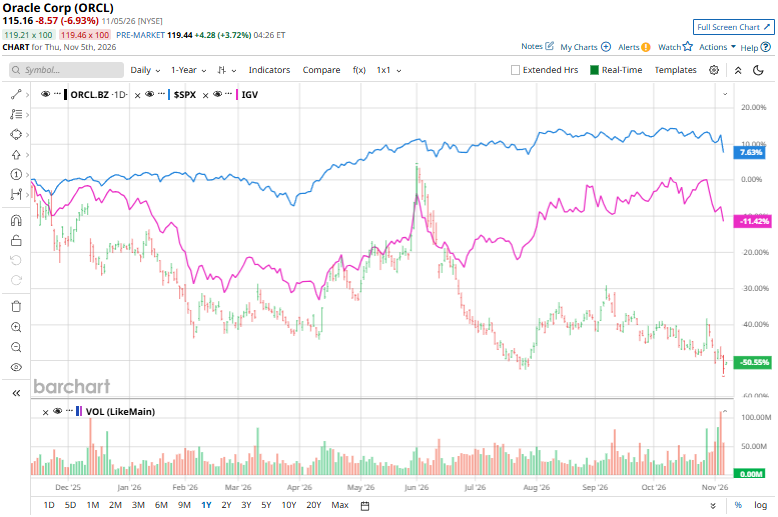
Shares of this technology giant have significantly underperformed the broader market over the past year. ORCL has declined 54% during this period, while the broader S&P 500 Index ($SPX) has rallied nearly 8.2%. The trend has persisted in 2026, with the stock falling 40.9% year-to-date, compared with the index’s 7.4% gain over the same period.
Likewise, ORCL has also lagged the iShares Expanded Tech-Software Sector ETF (IGV), which has declined 11.4% over the past year and 6.3% year-to-date.
On Sept. 10, Oracle Corporation reported its Q1 FY2027 results, beating analyst expectations for both revenue and earnings. However, its shares declined 5.4% in the following trading session. Total revenue increased 29.6% year over year to $19.35 billion, driven by 61.5% growth in cloud revenue to $11.61 billion. Cloud Infrastructure (IaaS) revenue surged 120.7% to $7.39 billion, while Cloud Applications (SaaS) revenue rose 9.9% to $4.22 billion. Non-GAAP EPS increased 30.6% to $1.92, while non-GAAP operating income climbed 30.7% to $8.15 billion.
Looking ahead, Oracle raised its full-year fiscal 2027 non-GAAP EPS guidance to $8.10 from $8.05 while reaffirming its revenue outlook of at least $90 billion. For the second quarter, the company expects revenue growth of 30% to 34%, cloud revenue growth of 65% to 71% in U.S. dollars, and non-GAAP EPS of $1.85 to $1.93. Oracle also secured more than $30 billion in additional AI cloud contracts during the quarter, contributing to a $209 billion year-over-year increase in remaining performance obligations (RPO) to a record $664 billion.
For the current fiscal year, ending in May 2027, analysts expect ORCL’s EPS to increase 6.5% to $6.72 on a diluted basis. The company has beaten the consensus EPS estimate in each of the last four quarters, which is impressive.
Among the 43 analysts covering ORCL stock, the consensus is a “Strong Buy.” That's based on 32 "Strong Buys," one "Moderate Buy," eight "Holds," and two "Strong Sells."
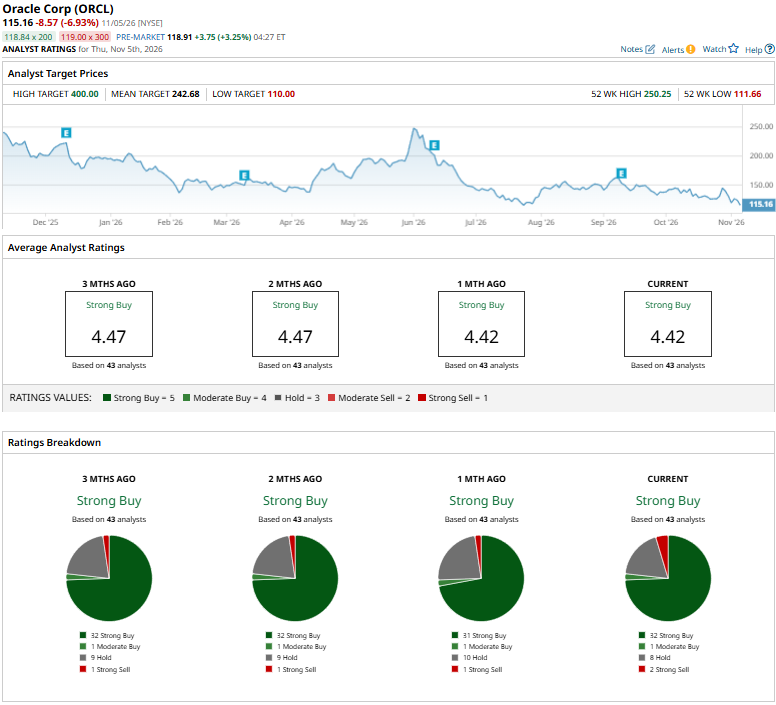
This configuration is more bullish than it was a month ago, when the stock had 31 "Strong Buy" recommendations.
On Nov. 5, 2026, UBS analyst Karl Keirstead reiterated a “Buy” rating on Oracle and maintained his $250 price target.
The mean price target of $242.68 represents a 110.7% premium to ORCL's current share price, while the Street-high price target of $400 suggests potential upside of 247.3%.
On the date of publication, Abhishek Bhuyan did not directly have a position in any of the securities mentioned in this article. All information and data in this article is solely for informational purposes. For more information please view the Barchart Disclosure Policy here.