


EN
Did Lowered Earnings Outlook Just Shift Diebold Nixdorf Stock's Investment Narrative?
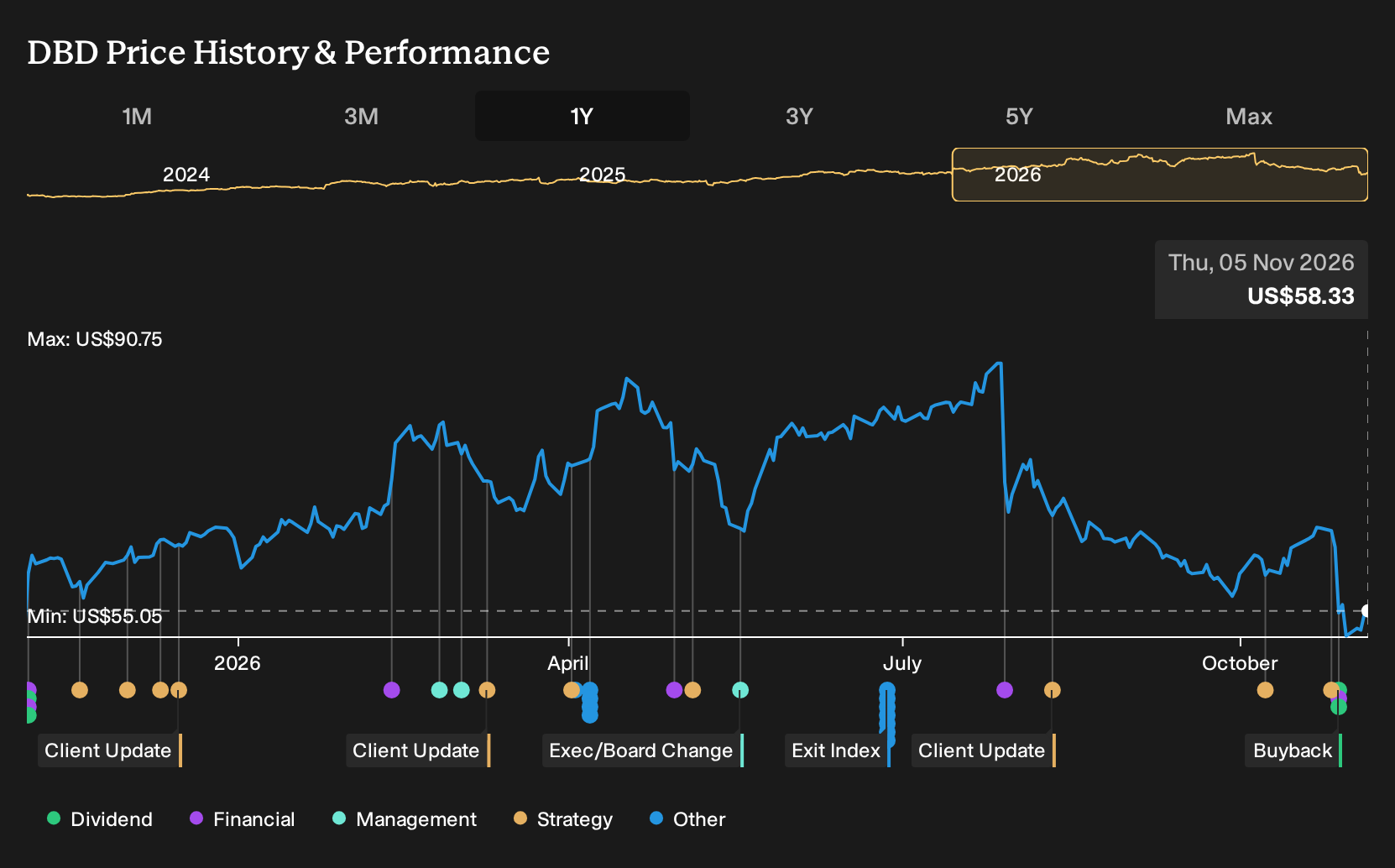
- Diebold Nixdorf reported third quarter 2026 revenue of US$994.3 million and net income of US$6.6 million, cut its full year earnings and cash flow outlook, and announced a US$250 million share repurchase authorization, alongside a planned ATM outsourcing collaboration with Euronet Worldwide.
- The revised guidance reflects pressure from a heavier retail and point of sale hardware mix and higher memory and component costs. A shareholder rights investigation adds legal uncertainty, while management signals confidence through the new buyback plan.
- We will now explore how Diebold Nixdorf's lowered earnings outlook and component cost pressures could reshape the investment narrative for readers.
Diebold Nixdorf Investment Narrative Recap
To own Diebold Nixdorf, you need to believe the shift toward higher margin software, services and managed ATM networks can offset the hardware grind. The third quarter shows the stress point. Revenue of US$994.3 million and net income of US$6.6 million came with heavier retail and point of sale hardware and higher component costs squeezing near term profitability.
In the short term, the key catalyst is still execution on the US$814 million product backlog and working capital clean up that underpins free cash flow. The biggest risk is that memory and component inflation, together with service margin pressure, keeps absorbing that backlog conversion so debt coverage and cash returns look tighter than planned.
Among the recent moves, the US$250 million share repurchase authorization is the one most tightly linked to this earnings reset. Management paired a lower adjusted EPS outlook with a plan to buy back stock, which pushes the operating question back to you: Do you think future cash generation can support both debt obligations and this extra capital return?
The answer rests on how reliably Diebold Nixdorf turns its ATM, self checkout and managed services pipeline into cash while handling higher input costs and a shareholder rights investigation. If order deployment or working capital improvements slip, that program could compete with ongoing investment needs and reduce management flexibility around the next phase of the turnaround.
Diebold Nixdorf Forecasts and What They Assume
Analysts looking at Diebold Nixdorf are not just reacting to the latest quarter. They are pinning their models on a fairly modest shift in the top line and a much bigger reset in profitability. The consensus view references revenue growth of 1.3% a year over the next 3 years, which is a slow build that puts most of the work on margins and cash generation rather than aggressive sales expansion.
The earnings bridge in those projections is far steeper than the revenue line. Forecasts call for profit margins to move from 2.0% today to 10.4% in 3 years, with net income moving from US$76.7 million to US$424.5 million by 2029. That is roughly a 5.5x step up in earnings on the back of software and services, lean programs and better use of the installed base. For you as an investor, the key question is whether that kind of margin reset looks achievable in light of the current component cost and service pressure described earlier in the article.
Valuation assumptions in the same analysis underline that earnings path. To line up with the consensus price target, Diebold Nixdorf would need to reach US$4.1b in revenue and US$424.5 million in earnings by 2029 while trading on a P/E of 7.4x, down from 24.1x today and below the 25.7x multiple cited for the wider GB Tech peer set. The forecast also builds in share count shrinking by 6.36% a year over the next 3 years, which would amplify earnings per share if the profit pool develops as expected, but would magnify any shortfall if execution stumbles.
Those numbers sit on top of a discount rate of just over 10%, which reflects the risk profile that analysts are willing to underwrite. For a reader weighing the stock today, that creates a checklist rather than a script. You can work through whether 1.3% annual revenue growth, a move from 2.0% to 10.4% margins, a P/E compressing toward 7.4x and a declining share count all feel consistent with your own read on Diebold Nixdorf's backlog, hardware cycle and the legal questions now in play.
Diebold Nixdorf's narrative projects US$4.1b revenue and US$424.5 million earnings by 2029. This assumes 1.3% yearly revenue growth and an earnings increase of about 5.5x from US$76.7 million today.
Uncover why Diebold Nixdorf's fair value indicates a 46% potential upside to its current price that may not last much longer.
Exploring Other Perspectives
Some of the most optimistic analysts lean hard into the Euronet collaboration as a potential swing factor for Diebold Nixdorf. Before this earnings cut, they were modeling revenue growth of about 1.7% a year and earnings of roughly US$464.0 million by 2029. You now get to decide whether this new guidance and cost pressure bring that story closer to consensus or instead require a complete reassessment of both narratives.
Explore 7 other Diebold Nixdorf fair value estimates, including one that suggests as much as 301957% upside from the current price!
Reach Your Own Conclusion
Disagree with existing narratives? Extraordinary investment returns rarely come from following the herd, so go with your instincts.
- A great starting point for your Diebold Nixdorf research is our analysis highlighting 4 key rewards and 2 important warning signs that could impact your investment decision.
- See our latest analysis for Diebold Nixdorf. The report includes a comprehensive fundamental analysis summarized in a single visual, the Snowflake, which makes it easy to evaluate Diebold Nixdorf's overall financial health at a glance.
Looking for more Diebold Nixdorf sized investment ideas?
If the shifts in Diebold Nixdorf's outlook have you thinking about position sizing, risk and where else to put fresh capital to work, it can help to run the same questions across a broader watchlist using a structured screener.
- For readers who want potential mispricing paired with stronger fundamentals, start by scanning our curated 42 high quality undervalued stocks that already clear quality and balance sheet checks.
- If capital preservation ranks high on your checklist, filter for businesses with steadier profiles using our 32 resilient stocks with low risk scores, which zeroes in on companies with lower risk scores.
- When financial strength is your first hurdle, build a shortlist from the list of solid balance sheet and fundamentals (24 results) so you are only comparing stocks with sturdier debt and liquidity metrics.
Have feedback on this article? Concerned about the content? Get in touch with us directly. Alternatively, email editorial-team@simplywallst.com