


EN
South Korea's governance reform blocked: investors put pressure on the chaebol, and Samsung became the focus of conflict
The Zhitong Finance App notes that global investors are urging South Korea's largest enterprise groups to speed up corporate governance reforms, saying that progress is uneven, and that progress in the financial industry is being offset by boycotts from large chaebol subsidiaries.
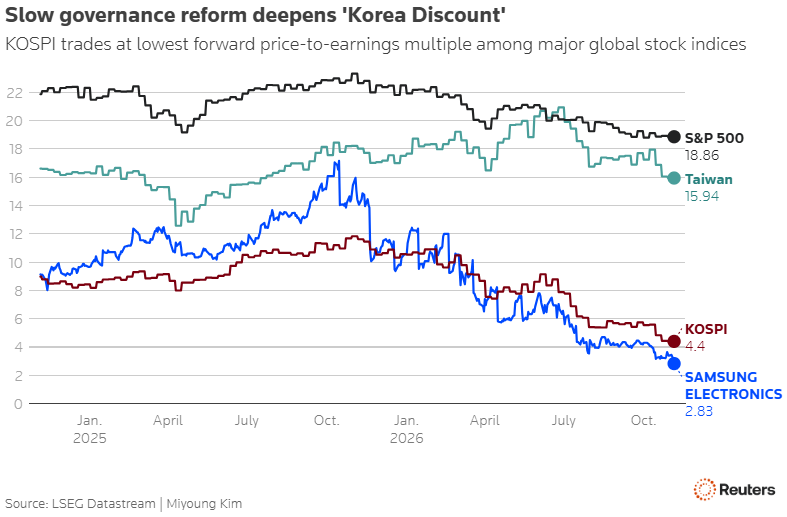
Despite strong gains this year, the Korean market is still one of the cheapest in the world. The index rose 35% during the year, even after experiencing a sharp retracement since the summer (more than doubling at one point), and after the sell-off, its forward-looking price-earnings ratio was about 3.85 times, while the MSCI Global Index was 17.64 times.
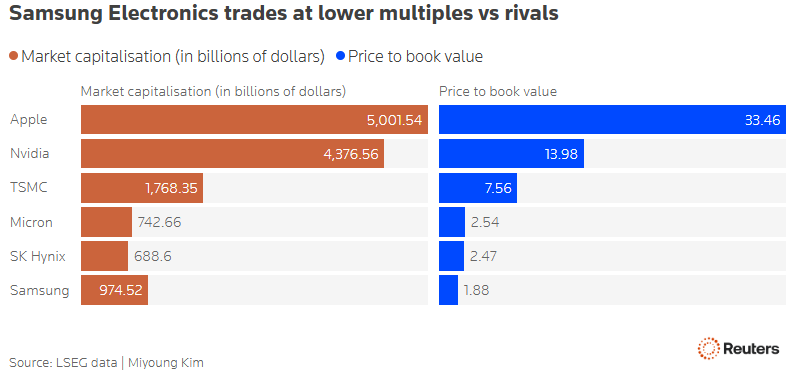
According to LSEG data, about 70% of KOSPI's constituent stocks traded at or below book value. Samsung Electronics is an example of this continuous discount. The company recorded the highest quarterly operating profit of any technology company in history in the third quarter, but its net market ratio was only 1.87 times, compared to 7.8 times that of Micron, 29 times Nvidia, and 44 times that of Apple.
Reforms aimed at attracting more overseas investors are still underway, which has intensified capital outflows from Seoul and raised concerns that President Lee Jae-myung's efforts to eliminate the so-called “Korean discount” may stall.
Namuh Rhee, chairman of the Seoul Korea Corporate Governance Forum, said, “Banks or financial holding companies are progressing according to their respective value enhancement plans.”
He added: “Having said that, large cap stocks, mostly Chae Bol affiliates, have been resisting corporate governance reforms recently, and their lobbying activity has increased dramatically.”
Some investors believe that some corporate groups, especially Samsung, should return more profits to shareholders, simplify corporate structures, and implement strategic changes or divest underperforming subsidiaries.
Samsung is under pressure
Samsung Electronics Chairman Shin Je-yoon met with overseas investors before releasing earnings reports last month. A person familiar with the matter revealed to the media that the meeting took place after global investors, including Capital Group, Artisan, and Fidelity, complained about the company's shareholder return policy.
The source said investors thought the returns were too meager and said they preferred stock buybacks and cancellations compared to increasing dividends. The details of this meeting and discussion are reported for the first time.
Samsung said in a statement that as part of shareholder communication efforts, Shin Je-yoon regularly meets with major global investors. The company says it maintains ongoing dialogue with key shareholders to understand broad opinions on shareholder returns and capital allocation. Capital Group, Artisan, and Fidelity did not respond to requests for comment.
In August of this year, Samsung announced a record dividend of 30 trillion won (about 22.35 billion US dollars), but said it will decide how to deploy the remaining 55 trillion to 75 trillion won earmarked for shareholder returns in January next year.
This is in stark contrast to competitor SK Hynix, which last month announced a $75 billion shareholder return plan, including dividends, share buybacks, and cancellations. Together, Samsung Electronics and SK Hynix account for slightly more than half of KOSPI's total market value.
Changes in the law
A law that came into effect in March requires mandatory cancellation of treasury shares by September next year. Critics say such stocks can be used as takeover defense tools.
Some sectors, particularly the financial sector, have reaped market returns as a result of cancelling such stocks.
An indicator that measures Bank of Korea stocks rose 15.9% this year, insurance stocks rose 48%, while shipbuilding stocks fell 42% and machinery stocks fell 30%.
The non-financial sector is even less willing to accept shareholder-friendly measures. The Samsung Group has particularly attracted dissatisfaction among investors, even though Samsung Electronics has already benefited from the AI boom.
Rights protection challenge
As Korea's biggest chaebol, Samsung is facing increasing pressure from rights protection investors. These investors hope to profit from the government's push for governance reforms and amendments to the Commercial Code.
Seoul-based Life Asset Management said it has requested the Samsung Board Special Committee and the Samsung Compliance Committee to independently review the decision to postpone the use of the remaining funds until the end of January.
The asset management company said the review should examine whether the deferred decision is in the best interests of shareholders, whether potential conflicts of interest are properly managed, and whether the remaining funds can actually be deployed before the end of this year.
Palliser Capital, a rights protection fund headed by James Smith, called for the repurchase and cancellation of preferred shares to be included in Samsung and Hyundai Motor's shareholder return policies. Smith was the former head of Elliott Management's Hong Kong office and has challenged Samsung in the past.
Meanwhile, rights protection actions led by Singapore-based Flashlight Capital calling for Samsung Group to increase returns from its security subsidiary S-1 were largely rejected, but the 450 billion won share repurchase announced by S-1 last month has boosted its stock price.