


EN
H&R Block (HRB) Stock Looks Below Fair Value On Earnings
H&R Block has seen its stock climb to around US$55, and after a strong multi‑year run the question now is whether that price still lines up with what the business earns. With the tax preparer back in focus, the key issue for you is how much of today’s valuation can be explained by its earnings power rather than sentiment around the ticker.
- Over the past 5 years, H&R Block has returned 163.9%, which puts real weight on whether its earnings profile can carry that kind of share price performance.
- Recent discussion around tax policy, including capital gains treatment for investors, can influence how the market values H&R Block’s cash generation and the timing of those earnings in shareholder hands.
- There is a second opinion on H&R Block worth weighing. See what analysts think H&R Block's shares could be worth.
The stock’s next move may depend on whether H&R Block’s current earnings justify the valuation investors are paying for today.
If you want to test the same earnings question you are asking of H&R Block across a wider field, compare it with companies in the 42 high quality undervalued stocks
Is H&R Block Still Cheap on Earnings?
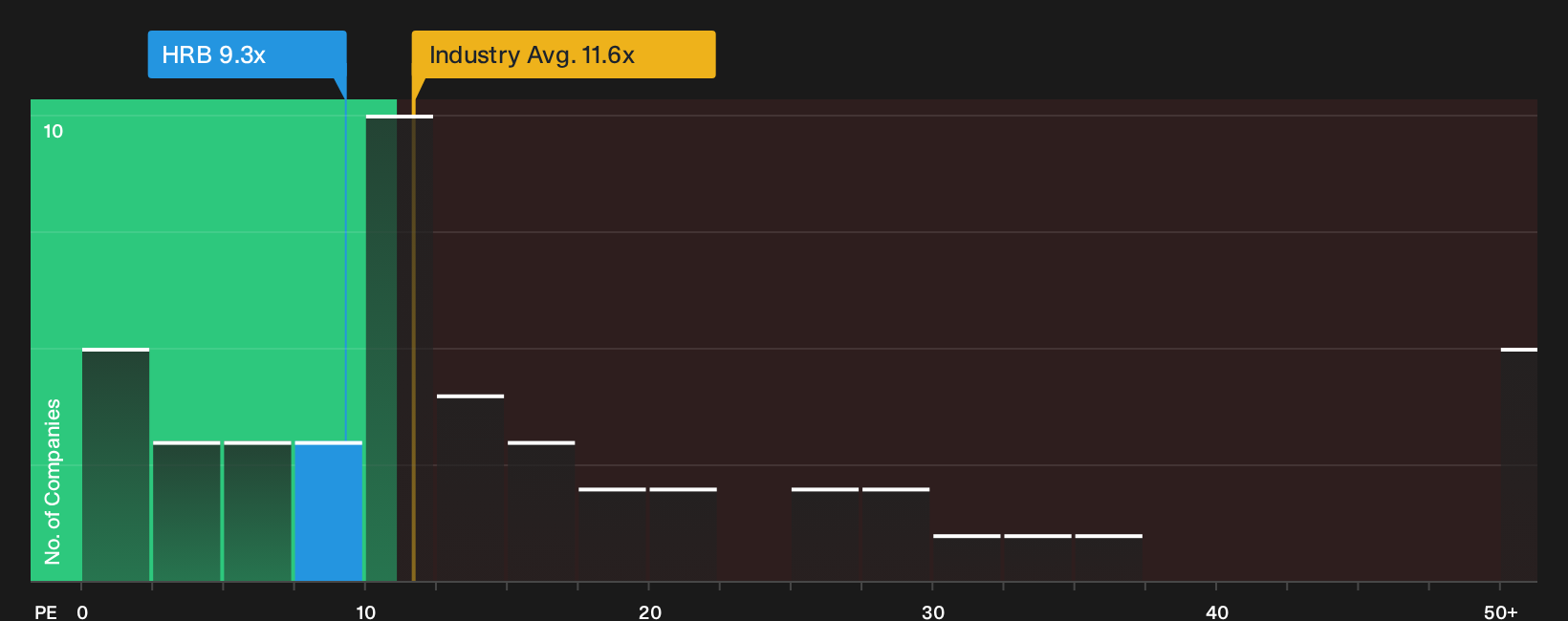
P/E fits H&R Block because earnings remain the main yardstick investors use when they think about a mature, cash generative service business. On this lens, the stock trades on a P/E of about 9.3x, compared with roughly 11.6x for the broader Consumer Services group and about 22.6x across closest peers. As a result, the shares change hands at a clear discount on headline earnings.
The fair multiple implied by the valuation model, which blends in the company’s margins, risk profile and size, sits higher than where H&R Block trades today. This means the current P/E points to the shares looking undervalued on this framework. Because recent capital gains tax debates are pushing investors to think harder about the timing and taxation of returns, a below benchmark earnings multiple on H&R Block may appeal to readers who want exposure to its cash flows without paying a peer level price. Explore the numbers behind H&R Block's P/E valuation.
The H&R Block Narrative: What Would Justify Today's Price?
Simply Wall St Narratives for H&R Block pick up where the P/E question leaves off and explain which potential future paths for growth, profitability and earnings would need to occur for the stock to be worth meaningfully more or less than it is today on the market. Each scenario also links its figures back to a clear view of how H&R Block's expansion prospects, margins and risk profile might develop, which you can revisit as new information emerges.
Community views on H&R Block split between those who see underappreciated execution upside and those who worry that structural headwinds still matter more.
Bull case: 8% undervalued
"The high volume of experiments that H&R Block ran in the 2026 season on client experience and AI enabled workflows, far more than in earlier years…"
Discover why this Narrative puts H&R Block at 8% undervalued.
Bear case: 6% overvalued
"Persistent market share losses, acknowledged by management, indicate that despite improvements, H&R Block continues to lose share to competitors…"
Explore why this Narrative puts H&R Block at 6% overvalued.
One more H&R Block puzzle worth checking before you move on
Share price and P/E tell only part of the story, because the people steering H&R Block and the way their rewards are structured can heavily influence how your capital is treated over time. See who runs H&R Block and how they are paid.
Have feedback on this article? Concerned about the content? Get in touch with us directly. Alternatively, email editorial-team@simplywallst.com